What makes a Pisgah Forest driveway its own job
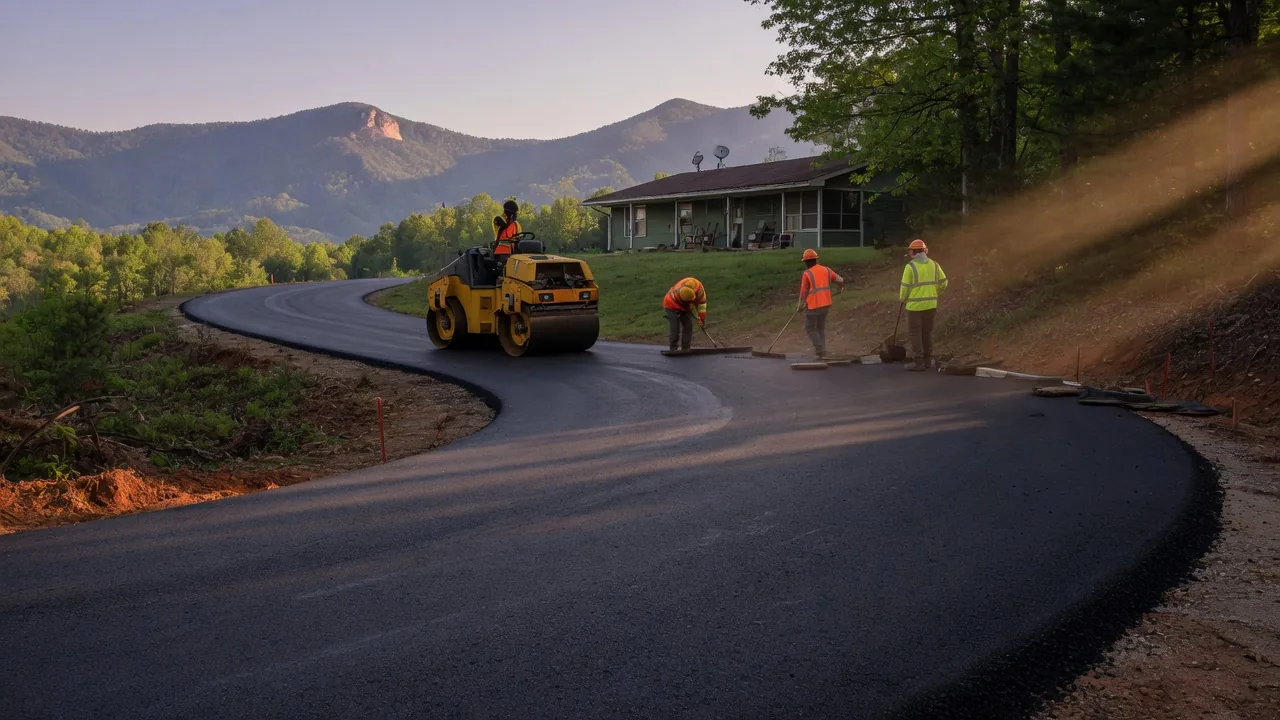
Driveways here are long. A lot off the Davidson River corridor or up toward the Pisgah National Forest boundary often means several hundred feet of gravel climbing a grade that would be a retaining-wall problem in town. That length and pitch are what separate a Pisgah Forest tar and chip quote from anything in flat Hendersonville — you're paying for base work on a slope, drainage control the whole way down, and a surface that has to hold aggregate on an incline.
The other local wrinkle is the tree canopy. Hemlock, white pine, and hardwood shade means constant needle litter, slow drying after rain, and shade that keeps pavement cool and damp longer than sun-exposed drives in Brevard proper. That shade is lovely and it also pushes the timing on when a tar and chip surface can be applied and how long it needs to cure before traffic. A crew that doesn't ask about your canopy and your grade isn't quoting your driveway — they're quoting a driveway.
Many Pisgah Forest properties are also part of older homesteads or small mountain subdivisions where the original driveway was cut decades ago with a dozer and never properly crowned. Those drives often have a crown that's flattened out, edges that have grown in, and a base that's been pumping mud for years. Bringing one of those back to a surface that will hold tar and chip is a different job than paving a new flat pad, and it's the kind of thing a local estimator will recognize in the first five minutes on site.
The Transylvania County price picture
Tar and chip pricing tracks square footage, but length, slope, and existing base condition move the number more than most homeowners expect. Local crews generally price a straightforward reseal or overlay differently from a full build on raw gravel, and a steep, curving, tree-shaded entry can add substantially per square foot over a flat straight run. See the full Transylvania County cost breakdown for the working numbers behind these bands.
| Scope | Typical range | Notes |
|---|---|---|
| Resurface over sound existing surface | $2.50-$3.75 / sq ft | Best value when base is intact |
| New build over prepared gravel base | $3.25-$5.50 / sq ft | Base prep and grading included |
| Steep or long mountain entry | Add per sq ft for grade, drainage | Length, pitch, and water all stack |
| Base repair before surface | $2-$6 / sq ft on bad sections | Soft spots and ruts must be fixed first |
| Small patch or spot repair | A few hundred dollars up | Priced as a minimum trip |
If your driveway is more than a couple hundred feet, get the quote in writing with square footage and prep steps itemized — never a single lump number. The tar and chip overview covers what a proper scope includes from prep to seal.
One more local note on price: mobilization. A crew based in Hendersonville or Brevard hauling equipment and material up a narrow mountain road eats time and fuel before a single shovel hits gravel. On a short in-town drive that cost is spread thin; on a 400-foot Pisgah Forest entry it's a real line item. It's also why quotes from crews who rarely work this side of the county can come in higher, or lower and then surprise you with change orders once they see the slope.
Grade, water, and why prep decides the outcome
On a slope, tar and chip fails from the bottom up. Water sheets down the surface, finds the edge, and undermines the base — which is why drainage and edge work matter more here than on a flat Hendersonville drive. The federal disaster record backs the local instinct: 16 declared events touch this county (1993-2026), and the heavy ones were rain and flood family. Every one of those pushed water at driveways built for drier assumptions. The National Weather Service rainfall patterns for the southern Blue Ridge make that a recurring design condition, not a one-off.
That's also why base thickness and compaction aren't optional upsells. A tar and chip surface is only as good as the aggregate and stone underneath it — skimp there and you'll be patching ruts within two seasons. Prep questions worth asking any crew: how deep is the base, how is it compacted, where does water go at the bottom of the hill, and how are the edges held.
Drainage on a Pisgah Forest grade usually means more than a crown and a shoulder. A cut-off or cross-drain above the drive intercepts water coming off the hillside before it ever reaches the pavement. A turnout or dispersion at the bottom of the hill keeps the last hundred feet from becoming a gully. On drives that hang off the side of a ridge, a properly shaped ditch on the uphill side matters as much as the surface itself. None of that shows up in a per-square-foot surface number, which is exactly why a quote that only talks about the surface is incomplete here.
The rock under the soil is another local factor. Much of this area sits on weathered granite and gneiss, and you don't have to dig far before you hit it. That's good news for base stability and bad news for crews trying to cut a new drainage swale by hand. A crew that has worked this county knows what it's hitting and prices accordingly.
Access, permits, and the NCDOT question
Most Pisgah Forest driveways are private and don't require a state permit to resurface. Where a driveway meets a state-maintained road, though, the connection is regulated — widening or rebuilding an approach can trigger an NCDOT driveway permit, and applications run through NCDOT Connect. Ask before you move dirt at the road edge. For larger structural work, the NC Licensing Board for General Contractors sets the threshold where a licensed general contractor is required, and a reputable paving crew will know where their scope ends. When you're ready to compare local crews, the Pisgah Forest paving contractors page is the place to start.
Access is its own conversation on these drives. A narrow gravel lane with a low tree canopy can keep a full-size dump truck or a paving machine from reaching the work area, which changes how material gets placed and how long the job takes. If your drive crosses a culvert, a small bridge, or a stretch of fill, say so up front — those structures have load limits and a crew needs to know before it schedules equipment. Same for any steep section where a truck has to back down or where a paver can't climb. Local crews ask about all of this; out-of-area crews often don't until they're standing at the bottom of your hill.
Choosing a crew in this market
Three checks specific to a mountain driveway. First, ask for references on sloped, long, shaded drives — a crew that mostly does flat in-town work may not have the equipment or the patience for a grade job. Second, insist the quote itemizes base prep, drainage, and edge treatment, because a lump sum hides where corners get cut. Third, ask about timing relative to weather: tar and chip needs dry, warm conditions to set, and in a shaded hollow that window is narrower than on open ground. A crew that can't explain the weather window is guessing.
It also helps to watch how a crew talks about your specific road. A local estimator will usually reference landmarks, know which lanes are state-maintained and which aren't, and understand that a drive off a Forest Service road has different access realities than one off a county road. That kind of familiarity isn't proof of quality by itself, but it's a sign you're dealing with someone who has actually worked this terrain rather than bidding it from a map.
Finally, get the schedule and payment terms in writing. On a long mountain job, material deliveries, weather days, and cure time all stretch the calendar. A crew that commits to a realistic window and a clear payment schedule is easier to work with than one that promises a date it can't hit. The tar and chip overview walks through what a complete scope looks like so you can compare bids on equal footing.