Asphalt paving and sealcoating, Lake Junaluska NC

Asphalt Driveway Repair in Lake Junaluska, NC

In Lake Junaluska, most asphalt driveway repairs run $350-$2,800, with full overlays typically $3,500-$8,500 and tear-outs more. Also in Lake Junaluska: asphalt driveway paving, asphalt resurfacing and driveway sealcoating. Hot-mix asphalt, tar and chip and sealcoating for mountain driveways, lots and private roads across five Western North Carolina counties.

  • Free on-site estimate, price in writing
  • Potholes, edges, alligator cracks and soft spots
  • Patched, sealed or overlaid, whichever the pavement earns
  • Illustrated below: what the finished job looks like

Pictured: illustration: hot asphalt patch being tamped into a driveway pothole. An illustration of the work, not a job photo.

Get a free estimate

Tell us about the driveway, lot or road. We measure it, check the base and the water, and put a real price in writing.

Free, no obligation. A written price after the site visit.

Free on-site estimateA real number, in writing, after we measure and check the base.
Base first, then blacktopCompacted stone, drainage, then hot mix, in that order.
Five countiesBuncombe, Haywood, Henderson, Madison and Transylvania.
Straight answersWe say when a patch or an overlay is the honest fix.
Quick answer
Asphalt Driveway Repair in Lake Junaluska, NC

In Lake Junaluska, most asphalt driveway repairs run $350-$2,800, with full overlays typically $3,500-$8,500 and tear-outs more. The spread is wide because the money question here isn't the crack — it's whether mountain runoff and tree-root heave have softened the base underneath it before you seal anything.

19
federal disaster declarations on record in Haywood County
Hurricane Dorian
most notable event in the federal record
1973–2026
span of the declaration record
Waynesville
Haywood County hub

Reading your driveway before you buy a patch, an overlay, or a tear-out

Driveways around Lake Junaluska fail on a curve that flatland paving advice never accounts for. Water comes off the lake side of the ridge, crosses your apron, and hunts for the lowest seam in the asphalt. Then the freeze-thaw cycle that runs through Haywood County winters opens that seam into a crack, the crack into a pothole, and the pothole into a soft spot the size of a trash can lid.

So the first honest question isn't how much to fix it — it's what layer failed. A hairline crack that's still tight is a seal job. A crack with a lip you can catch a fingernail on, or the start of alligator cracking (the web pattern), means the base has moved and a patch will pop out within two seasons. A soft spot that flexes underfoot when it's rained means the subgrade is holding water, and no overlay will survive on top of it. And an apron that's crumbling where it meets the county road usually belongs to a different fix — and possibly a different permit — than the rest of the drive.

Read those three signals honestly and you've already saved yourself the most expensive mistake in this trade: paying overlay money for a tear-out problem.

What the repair actually costs here

Lake Junaluska's housing stock mixes century-old lake cottages on tight lots with newer builds on graded ridge property, and the driveway prices follow the access, not the zip code. Steep, narrow approaches cost more because equipment and trucks can't work the same way. The working ranges for Haywood County are in the county cost breakdown; the short table below maps scope to price:

ScopeWhat it meansTypical range
Crack sealing / patchingHairline cracks, isolated potholes, no base movement$350 – $1,200
Full sealcoatOxidized surface, cracks already sealed, structure sound$900 – $2,500
Overlay (1.5"–2")Alligator cracking, widespread surface failure, base still holds$3,500 – $8,500
Tear-out & repaveSoft spots, drainage failure, multiple base repairs$8,000 – $20,000+

Notice the gap between overlay and tear-out. That gap is the entire reason the inspection matters more than the estimate. A bid that jumps straight to overlay without probing the soft spots isn't cheaper — it's just borrowing a year.

Water off the ridge is the real cause, not the asphalt

Haywood County's federal disaster record is dominated by storm and flood events — 19 declarations touch this county across 1973-2026 — and those events pushed water at driveways built for a drier assumption. Around the lake, the runoff question is uglier than it looks: uphill neighbors' drainage, driveway crown, and where the gutter downspouts dump all converge on the same apron.

That's why the honest repair sequence is water first, asphalt second. If grading sends runoff down the drive instead of off its edges, the new surface fails the same way the old one did. The National Weather Service keeps the local precipitation and freeze-thaw record that explains half the calls here, and the state residential code treats drainage as a first-class requirement for exactly this reason. Fix the water path, and the repair lasts.

Permits, licensing, and who can legally do the work

Driveway work near a public road — widening an apron, changing where the drive meets the road, or altering drainage onto the right-of-way — usually needs a driveway access permit through NCDOT. The application and rules live at NCDOT Connect, and skipping that step is the fastest way to have the county undo your repair. On the contract side, the NC Licensing Board for General Contractors sets the dollar threshold at which a paving job must be performed by a licensed general contractor, so ask any bidder how they handle jobs above it.

Two questions separate the crews that fix driveways from the crews that sell asphalt: (1) How will you test whether the base is soft before you quote an overlay? and (2) What's your sequence for water versus surface? The answers tell you everything. When you're ready, the local paving contractor guide covers what a proper site visit includes, and the broader driveway repair hub walks through the scope options in more depth.

Repair versus replace: when each one actually wins

Sealing and patching win when the failure is surface-level and the base is intact — a few hours of work, a couple of seasons of breathing room, and a driveway that still drains. Overlay wins when the whole surface is aged out but the subgrade holds; it's the best dollars-per-year value in the trade. Tear-out wins when you find more than a couple of soft spots, when the drive slopes water back toward the house, or when previous patches have already failed in the same spots twice. Replacing when replacement is the answer isn't a luxury — it's the cheaper option measured over a decade instead of a summer.

The Lake Junaluska version of this decision usually involves trees. Root heave near mature hardwoods pushes up asphalt in a way that sealant can't hold, and the honest fix is to route the repair around the roots rather than through them. That's a conversation worth having with a local crew who has seen your street, not a call center.
Haywood County, NC: the storm record

Federally declared disaster events19
Named storms in the recordHurricane Dorian, Hurricane Florence, Hurricane Helene, Hurricane Ian, Hurricane Isaias, Hurricane Ivan
Incident typesFlood, Hurricane, Severe Storm, Snowstorm, Tropical Storm
Record span (fiscal years)1973–2026
Source: FEMA OpenFEMA disaster declarations. County-level federal declarations, not individual claims.
More in Lake Junaluska

Everything we build in Lake Junaluska, NC

Questions people ask

Straight answers

How much does asphalt driveway repair in Lake Junaluska NC cost?
Most repairs land between $350 and $2,800; full overlays typically $3,500-$8,500 and tear-outs more. See the Haywood County cost table for the line-item ranges — access, slope, and base condition move the price more than square footage does.
Can a crack just be sealed, or does the whole driveway need replacing?
If the crack is tight and the base is firm, sealing is genuinely the right fix. If the crack has a lip, webbing, or the surface flexes when wet, the base has moved and sealing is money thrown at a symptom. A proper visit is what separates the two.
Why does my driveway keep cracking every winter?
Freeze-thaw. Water gets into the seam, freezes, expands, and opens the crack a little wider each cycle. If runoff is also crossing the drive instead of leaving its edges, sealing alone won't stop it — the drainage has to be corrected first.
Do I need a permit to repair or widen my driveway?
Work that touches the public right-of-way or changes where the drive meets the road generally requires a driveway access permit. Applications and rules are at NCDOT Connect. Purely on-property resurfacing usually doesn't require one.
What's the difference between an overlay and a tear-out?
An overlay paves over the existing surface when the base is still sound. A tear-out removes the failed asphalt, repairs or rebuilds the base, and repaves from the ground up. Overlay is cheaper; tear-out is what you need when soft spots or drainage failures run deeper than the surface.
When is the best time of year to repair a driveway in Haywood County?
Late spring through early fall, when temperatures let asphalt compact and cure properly. Cold-weather patching can get you through the winter, but it's a temporary fix — schedule the real repair once the freeze-thaw cycle is done.
Our work

Our work

Illustration: fresh black asphalt on a driveway curving up a wooded mountain lot. Built by Mountain Asphalt Paving.
Illustration: fresh black asphalt on a driveway curving up a wooded mountain lot.
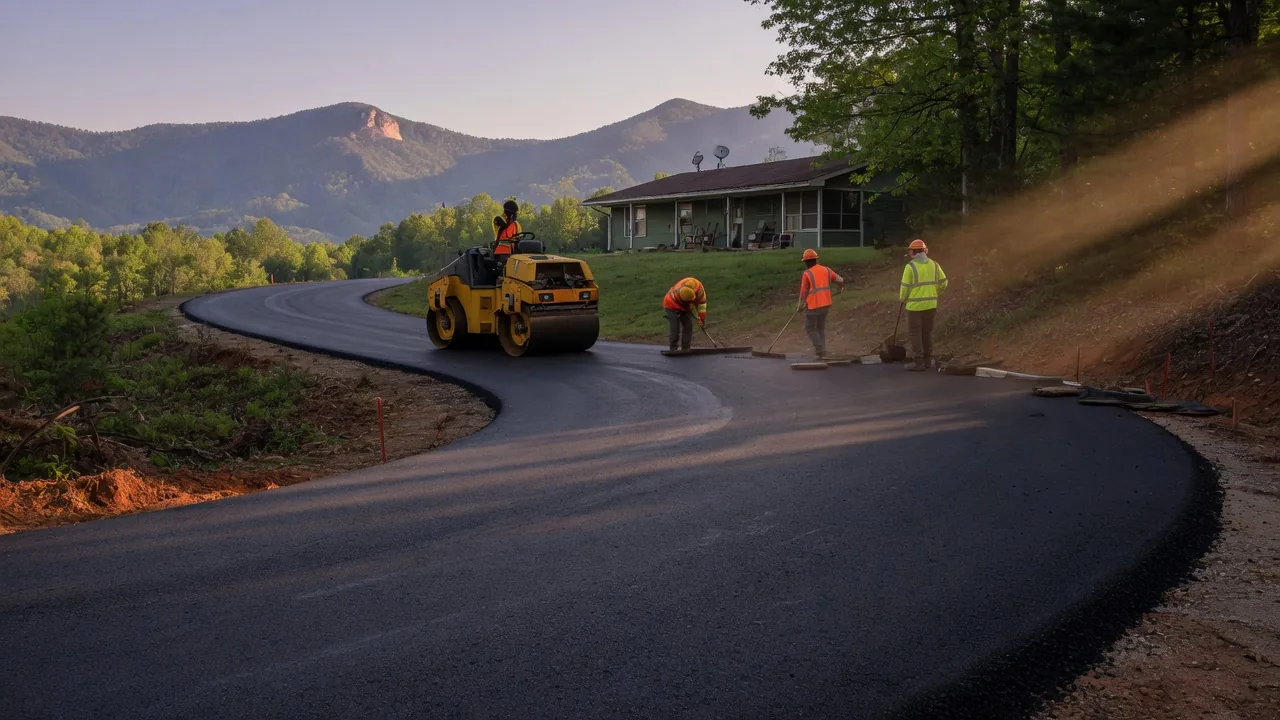
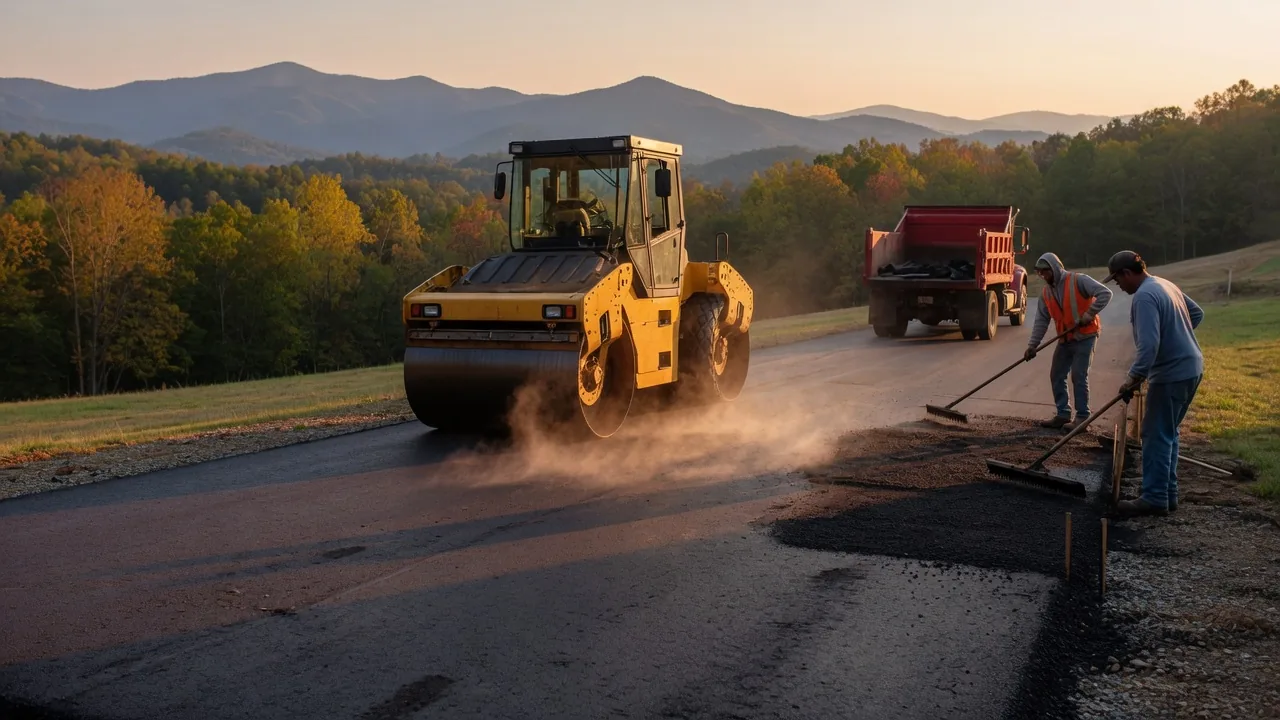
Illustration: a roller compacting hot-mix asphalt on a residential driveway. Built by Mountain Asphalt Paving.
Illustration: a roller compacting hot-mix asphalt on a residential driveway.
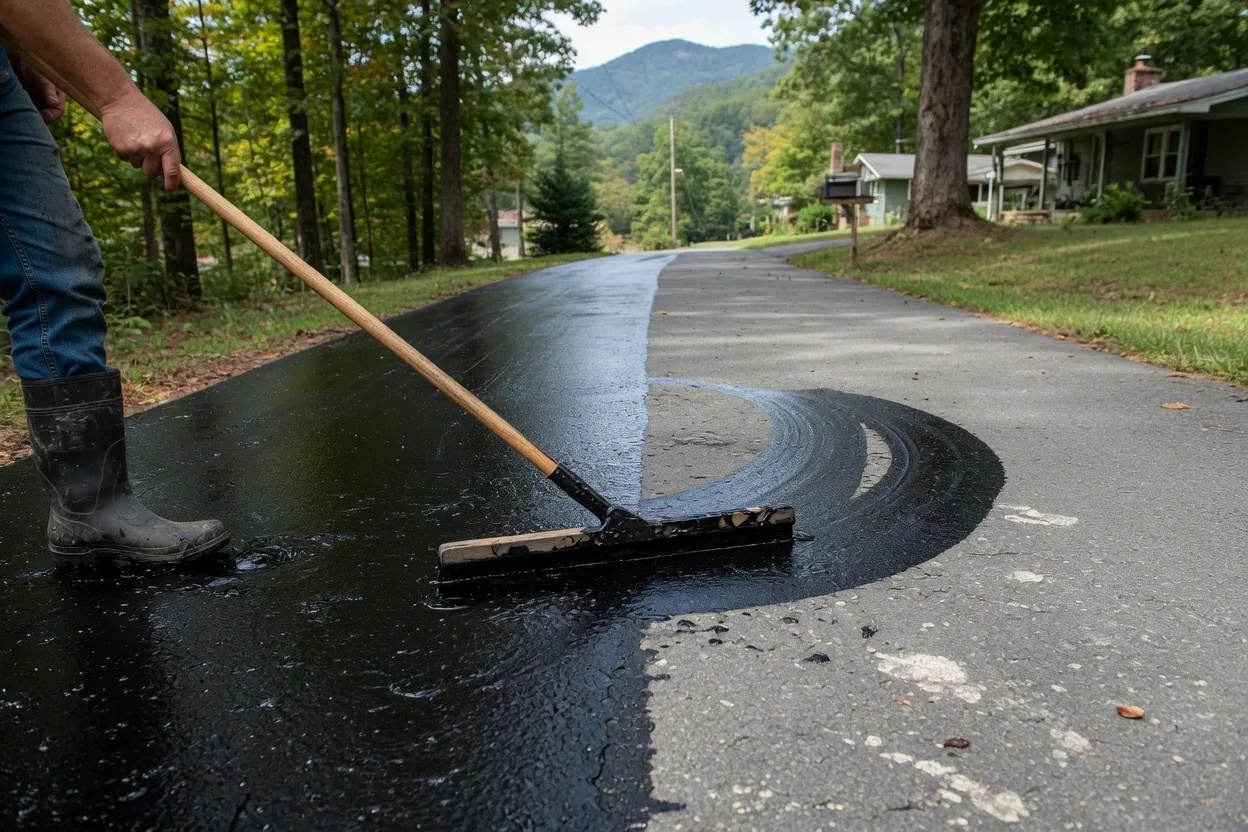
Illustration: sealcoat going down by squeegee, the treated half glossy black beside the faded half. Built by Mountain Asphalt Paving.
Illustration: sealcoat going down by squeegee, the treated half glossy black beside the faded half.
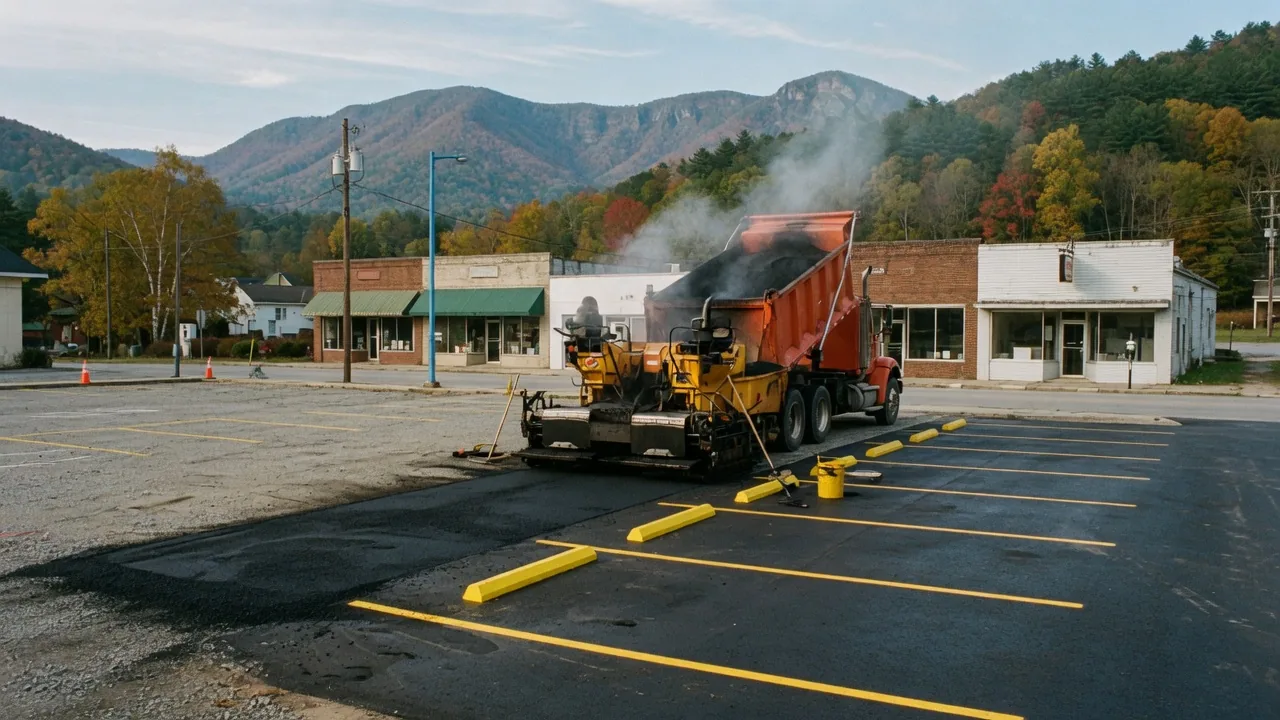
Illustration: a small parking lot being paved, with fresh striping on the finished half. Built by Mountain Asphalt Paving.
Illustration: a small parking lot being paved, with fresh striping on the finished half.
Get a quote

Tell us about your project. We price it straight.

Where it is and what you need — that's all it takes to start. You get a clear scope and an honest number, and your info never gets sold to a list.

Get a free estimate

Free, no obligation. A written price after the site visit.