The red clay under Mills River driveways decides everything above it
Drive a back road off Highway 280 or North Mills River Road and you'll see the pattern: asphalt laid on whatever the land gave the builder — red Henderson County clay, an old gravel farm lane, or fill pushed in during a subdivision build-out. Clay holds water against the asphalt edge and heaves when it freezes; old gravel never got compacted to modern standards, so it shifts under load; fill settles unevenly for years. Sealcoat is a surface treatment, and it can only protect a surface that's still moving with its base. That's why a good Mills River sealcoating quote starts with a probe of the subgrade, not a drum of sealer.
The clay itself comes up nearly everywhere in this valley, and it behaves differently from the sandier soils closer to Asheville. It swells when wet, shrinks when dry, and pushes that movement straight up through the pavement. If your driveway edge is cupping or your cracks reopen every spring, the base is the conversation — not the sealer brand.
How much crushed stone a Mills River driveway actually needs
When a driveway here needs rebuilding rather than resealing, the stone under the new asphalt is the biggest single line item, and it's the one homeowners most often get quoted short. A proper section on heavy clay calls for four to six inches of compacted crushed stone, placed in lifts, not one dumped pile. On native gravel that's already draining well, two to three inches may be enough. A driveway on old fill may need excavation and geotextile fabric to keep the stone from disappearing into the muck below.
That's also why the Henderson County asphalt driveway cost breakdown shows such a wide top end: two driveways of identical square footage can differ by thousands of dollars once the base is corrected. Sealcoating on a sound base is inexpensive by comparison — and the sealcoating overview walks through what a proper application covers.
On the steep lots that climb away from the French Broad bottomlands, stone depth alone isn't the whole story. Water running downhill across a driveway will find any thin spot in the base and start pumping fines up through the asphalt. That's why a Mills River crew that knows this valley will often quote a crowned grade and a shoulder of extra stone on the uphill side before they ever talk about sealer. It's not upsell — it's what keeps the surface from failing in two winters instead of ten.
What sealcoating costs here, by scope
Pricing in this valley follows the work, not the marketing. A clean, sound driveway gets a straightforward rate; one with alligator cracking, a failing edge, or a base that needs stone before sealing gets a different number. The table below reflects realistic regional bands — treat anything well below the low end as a sign the prep was skipped.
| Scope | Typical price range | What it includes |
|---|---|---|
| Sealcoat only, sound asphalt | $0.18–$0.30/sq ft | Clean, fill hairline cracks, one to two coats |
| Sealcoat with crack filling and patching | $0.25–$0.40/sq ft | Hot or cold crack fill, spot patching, two coats |
| Full driveway, 800–1,200 sq ft | $350–$900 | Typical residential job, prep included |
| Long or steep drive, 2,000+ sq ft | $900–$1,800 | More material, edge work, sometimes a second pass |
| Seal after base repair or new stone | Quoted with the rebuild | Stone, compaction, and cure time before any sealer |
New asphalt needs to cure before sealing — usually several months, longer in a wet fall. Sealing too early traps oils that keep the pavement flexible and causes premature cracking. Any crew that offers to seal fresh pavement the same month is telling you what their schedule values.
One more local variable: many Mills River properties sit on lots with a shared private lane or a long pull-off to a shop or barn, and those stretches get far more loaded traffic than a standard residential drive. If a fuel truck, trailer, or horse trailer regularly turns around on your pavement, tell the estimator. The correct sealer mix and number of coats change when point loads are part of the daily routine, and a quote that ignores that is a quote built for a different driveway.
Weather and water in this valley
Mills River drains toward the French Broad through some of the wettest, steepest terrain in Henderson County, and the federal record backs that up: 16 declared events touch this county across 1978-2026, mostly storm and flood family. Every one of those events pushed water across driveways and against their edges. The National Weather Service keeps the local outlook at weather.gov, and after any heavy season it's worth walking the driveway to check where water sits.
Standing water on a driveway edge is the single best predictor of what your sealcoat will look like in three years. Fixing the grade or adding a swale may matter more than the sealer itself.
Henderson County's freeze-thaw cycle compounds the problem. We get enough hard freezes in a typical winter to open hairline cracks, then enough mild, wet days to pour water into them before the next freeze. That cycle is exactly what turns a small crack into a spiderweb in two or three seasons. In this valley, crack filling before sealing isn't an optional add-on — it's the part of the job that determines how long the seal actually lasts.
Picking a crew that understands the base problem
Ask three things. First, how they probe the base — a screwdriver and a look at the edge tells you more than a sales pitch. Second, whether they hot-fill cracks or just smear cold patch over them before sealing, because the difference shows up the next spring. Third, confirm the licensing picture: North Carolina's Licensing Board for General Contractors sets the threshold for when a paving or driveway job needs a licensed contractor, and any reputable crew can tell you where their scope falls.
For anything involving regrading, driveway openings onto a state road, or storm drainage, the NCDOT driveway access rules may apply — worth knowing before work starts, since permits for driveway connections fall under the state, not the county. When you're comparing outfits, the Mills River paving contractors page collects the questions worth asking before you sign anything.
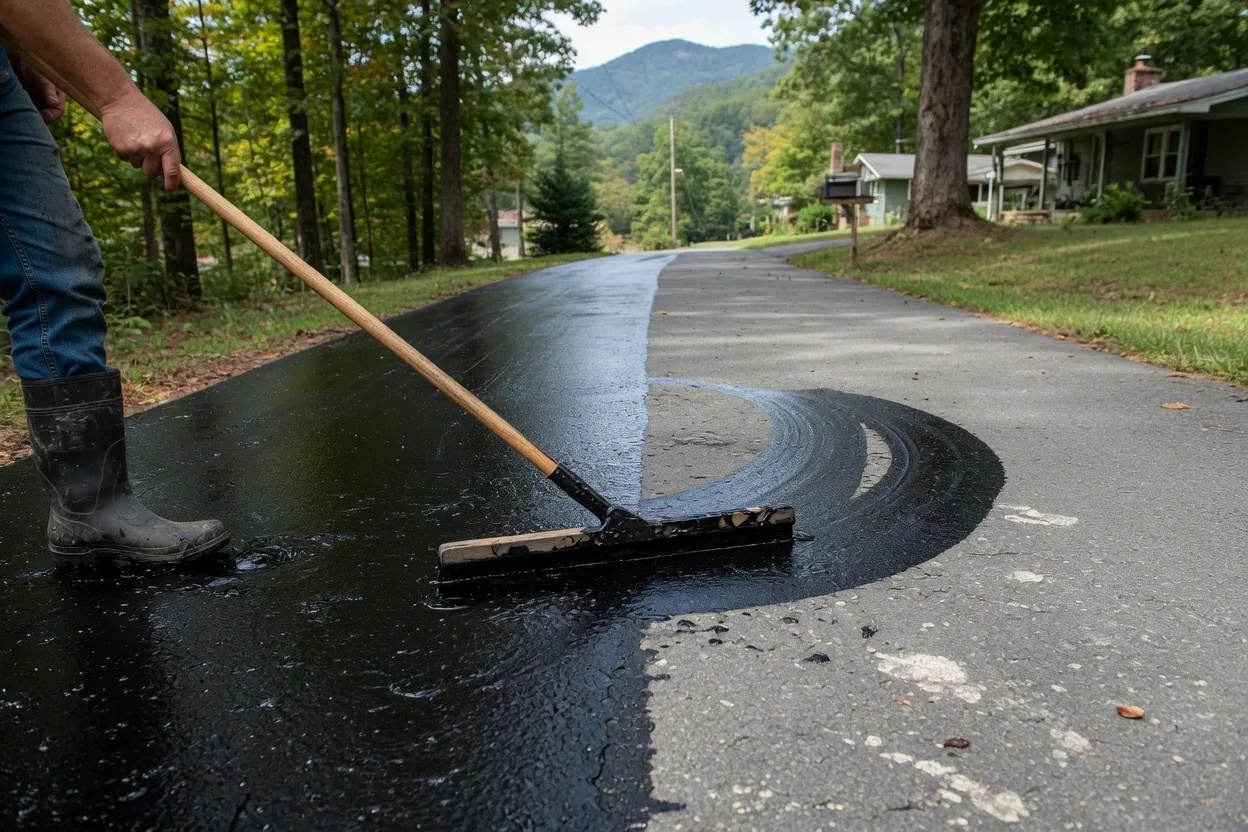
Ask, too, how they handle the sealer itself. Coal-tar and asphalt-emulsion sealers behave differently under the sun and rain we get here, and some contractors thin their mix to stretch a job. A crew that can tell you what's in the drum, and why they chose it for a clay-base driveway in this valley, is a crew worth hiring.