Where the water goes decides everything on a Mars Hill driveway
Driveways in Mars Hill almost never sit on flat ground. Whether you're on a bench cut off a ridge road, a slot driveway climbing toward a homesite, or one of the gravel lanes that run down toward the Shelton Laurel bottoms, rain gets somewhere fast — and the question the whole conversion turns on is whether it leaves your driveway in a controlled sheet or finds a weak spot and takes the aggregate with it. An old gravel drive is a record of that answer. Rutted wheel paths mean the crown is gone. Gravel fanned out at the bottom of the hill means the ditch is doing nothing. Soft spots after a storm mean water is sitting under the base, and no asphalt placed over that stays flat for long.
This is why a conversion done right starts with a walk down the driveway in the rain, or a close read of what the last storm left behind. The contractor should be telling you which way the surface falls, where the crown sits, how the shoulder sheds into the ditch, and where the ditch discharges — not just quoting a per-square-foot number.
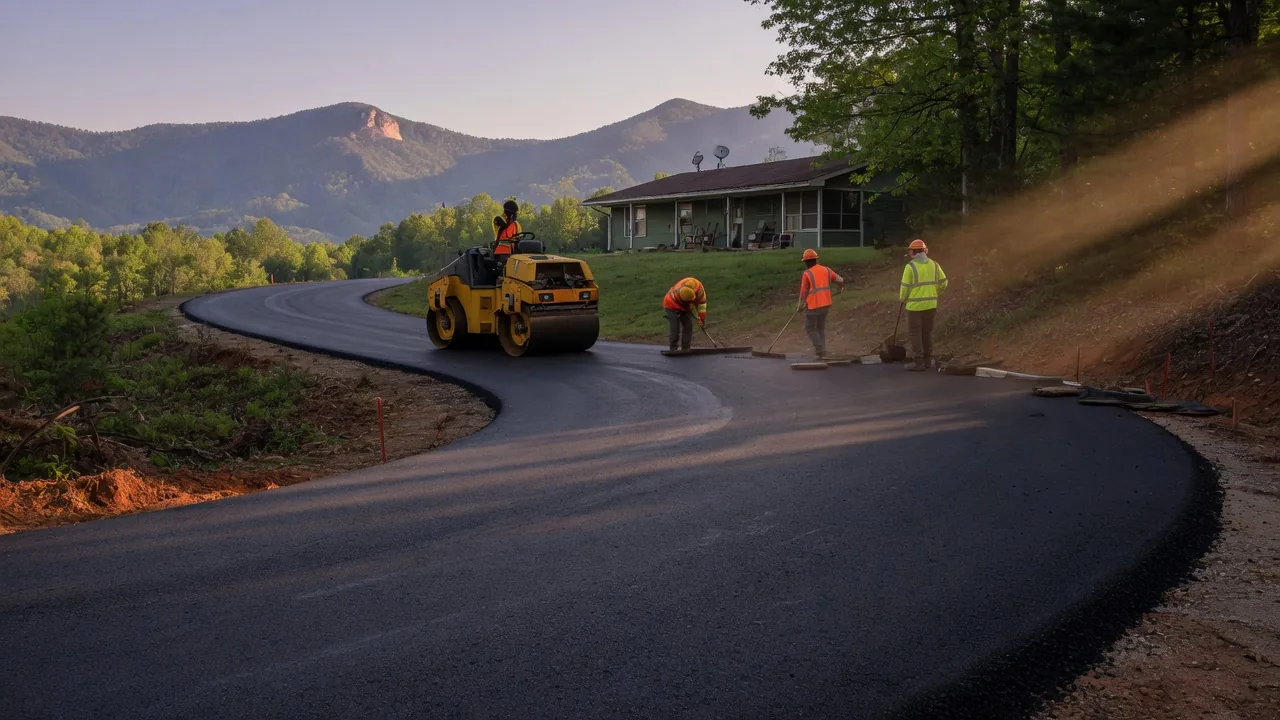
Walk a few driveways in the county and you can read their history without anyone telling you. A drive that still holds its shape after a March downpour was crowned correctly, ditched correctly, and given stone that drains. A drive with ruts down both wheel paths, a gravel fan spread across the apron, and a washout at the culvert was built for a dry week and never tested until it was. That second drive is the one that costs real money to convert, because the water problem has to be solved before any asphalt shows up. On these slopes the asphalt is almost the cheap part — the money goes into convincing water to leave the same way every time.
Where your lot sits matters as much as how it's shaped. A graded bench on a hillside off a ridge road has water arriving from above, off the cut bank, and it needs its own path around the driveway — not across it. A drive that runs down off the main road into a hollow collects everything the road shoulder, the bank, and the next property upstream decide to send. That difference decides whether you're paying for a culvert and an uphill diversion or just a re-crown. It's the first thing a contractor should be asking before they quote.
What the conversion actually costs here
Asphalt over a solid, dry, well-shaped gravel base costs far less than asphalt over a base that has to be rebuilt. The table below shows where Mars Hill-area jobs typically land; see the full Madison County asphalt driveway cost breakdown for line-item detail.
| Scope | Typical range |
|---|---|
| Light prep: re-grade and re-crown existing gravel, spot stone, compact | $1,200–$2,800 |
| Base repair: add 2–4 inches of crushed stone, correct ditch and shoulder | $2,500–$5,500 |
| Full conversion, modest grade, 12 ft wide, up to ~150 ft | $4,800–$7,500 |
| Full conversion, sloped or curving drive, added drainage | $7,500–$11,500 |
| Asphalt-only overlay on an already-sound base | $2.75–$4.50 per sq ft |
Steep entries, culverts, and long pulls off the main road add line items that flat-lot quotes never show. A bid without a drainage line is incomplete, not cheap.
The two-line items people forget: stone. A soft spot found during prep isn't negotiated later — it's dug out to firm ground and refilled with compacted crushed stone, and that stone is measured in tons, delivered and placed. Paving contractors in steep country price it that way because they know they'll find at least one soft pocket on a drive that's been sitting through a wet season without a proper base. The second forgotten item is the connection at the road. Crossing the shoulder means disturbing the existing culvert or adding one, and the material and labor for that can bump a quote meaningfully on the low end. Get both on the written bid before you compare numbers.
Why the old gravel base isn't automatically good enough
Gravel drives in this county were often built in stages — a load here, a load there, over years. That leaves a base that's fine for a pickup and hopeless under a compacted asphalt mat. Before paving, the base has to be uniform, crowned, and draining. Two inches of soft material under a 2-inch asphalt lift will telegraph through in a season. The NC Office of State Fire Marshal oversees the code officials who review driveway and access standards in much of the state, and the NCDOT controls the connection point where your driveway meets a state-maintained road — that permit and culvert requirement is a real line item in most Mars Hill conversions.
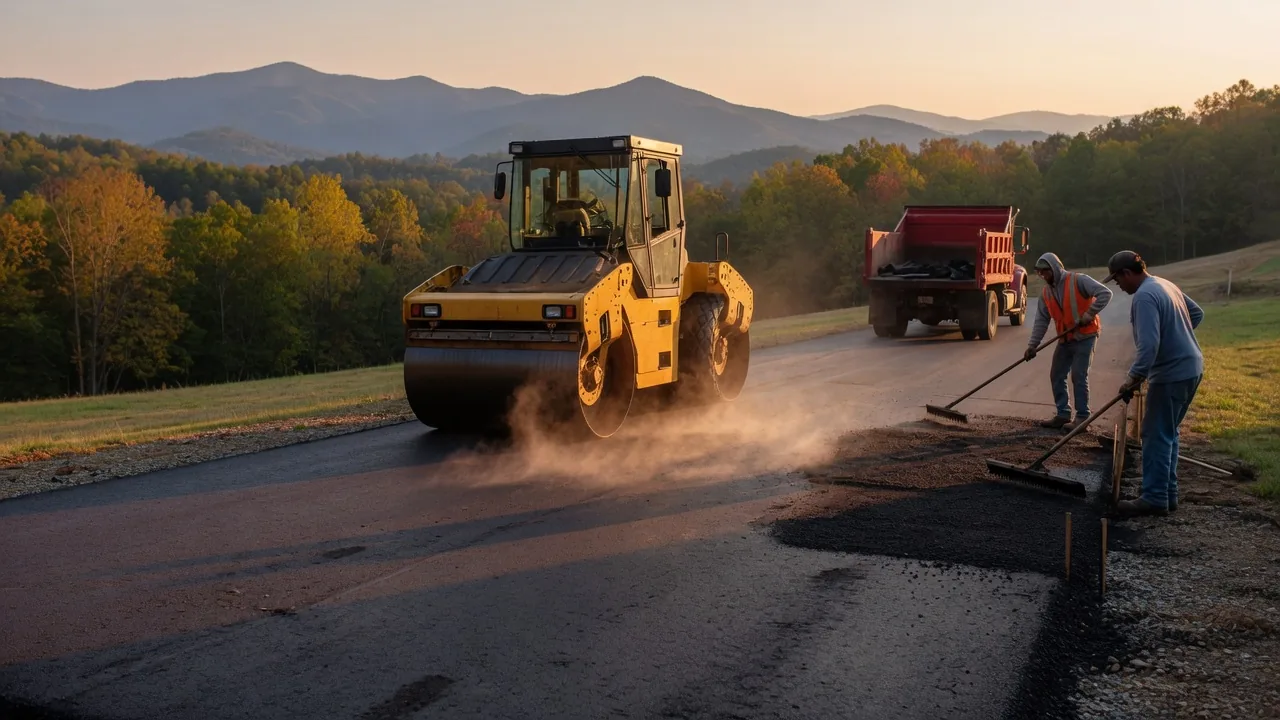
What does a bad base actually look like under asphalt? It looks fine for the first six months. Then a hairline crack shows up along the edge of the wheel path, or a low spot starts holding water after a storm, and by the next spring there's a depression where the base moved. The subgrade is where the asphalt mat gets its support; if that support is a mix of old river gravel, decomposed granite, and whatever was dumped ten years ago, it flexes under load and every flex becomes a crack. That's why the prep work on a gravel-to-asphalt conversion is usually more hours than the paving itself. The paving is the easy part. Building the base so the paving has something to sit on is the trade.
The grade question: crown, shoulder, ditch
Three things have to be right before asphalt goes down. The crown is the slight rise down the centerline that splits water to both sides. The shoulder is the edge that carries that water off the mat without undermining it. The ditch is where the shoulder sends it, and it has to fall continuously to a discharge point that isn't your neighbor's yard or your own foundation. On a sloped Mars Hill drive, water also arrives from above — off the hill, off a cut bank — and that uphill water needs its own path around the driveway, not across it.
Get these wrong and you'll be calling a paving contractor back in two years for the repair you skipped. Get them right and a properly built asphalt drive in this climate lasts decades.
The crown is invisible when it's right and the most obvious thing in the county when it's wrong. Stand at the bottom of a good drive and look up the centerline: you'll see the surface rise slightly along the middle and fall away on both sides. That's the whole point. A drive with no crown holds a thin sheet of water across the entire mat after every storm, and that water sits at the edge seams and works its way in. The shoulder is the second invisible piece. It has to be slightly higher than the adjacent ditch so water crosses out of the mat rather than pooling against the edge and soaking underneath. The ditch carries it from there, and on a hill it has to keep falling until it's off your property or into a natural draw. Where the ditch ends is where most drainage disputes in this county actually get resolved — pick a discharge point that moves water away from every structure on the lot, yours and your neighbor's.
Choosing a crew for this specific job
Not every paving outfit converts gravel. Ask three questions: how they handle the base (do they compact in lifts, or just spread and roll?), how they'll address drainage on your specific slope, and whether the price includes the NCDOT driveway permit if the work touches the state right-of-way. For anything above the state's threshold — and on commercial or multi-unit work — the NC Licensing Board for General Contractors sets the licensing requirement. A short list of vetted local crews is on our Mars Hill paving contractors page, and the broader conversion process is covered in the gravel to asphalt guide.
On a sloped or curving driveway, ask to see a recent job on similar grade. Flat-lot experience doesn't transfer to a drive climbing a hillside, and the difference shows up in how they stage the equipment, how they handle the compaction on the crown, and whether they know where the ditches on a cut-bank lot have to run. A crew that lives and works in this county has already solved the puzzle on a hundred drives around you; a crew driving up from the flatlands will figure it out on yours. Both can do a good job, but the second is more expensive in the long run if they learn on your driveway.
Get the scope in writing. A good bid lists the base prep, the drainage work, the stone, and the asphalt thickness in lifts. A one-line bid is not a bid. Ask what happens if they find a soft pocket during prep, and get the answer written down before anyone starts moving dirt.
Storm history and driveway wear in Madison County
Madison County has seen 21 federally declared disaster events over a 1978-2026 record — a large share tied to flooding and storm runoff. That history is the honest reason to treat drainage as a first-order line item here, not an upgrade. If a heavy rain event has already cut a channel across your gravel, the conversion plan starts with fixing whatever let that happen. The National Weather Service publishes local rainfall data through weather.gov that's useful when you're sizing a culvert or deciding how much ditch the drive really needs.
The pattern in these events is water arriving fast on slopes that already had reason to shed it. What was a manageable flow in a normal spring shower becomes a gully-cut when a summer thunderstorm drops a month's rain in an afternoon. A driveway built for the average storm doesn't hold up to that. The conversion plan has to assume the worst storm, not the median one, or you'll be re-grading the shoulder within a couple of seasons. This is why the honest quotes on these lots carry drainage as a line item rather than a shrug. If a contractor tells you drainage 'looks fine' without walking the discharge path in the rain, get a second opinion before you sign.