What is actually under your gravel in Madison County
Most drives feeding homes off US-25 and the back roads around Hot Springs are one of three things underneath: red clay that was graded and never capped, gravel spread over an old log-skid or farm road, or gravel dumped on cut-and-fill ground where the fill was never compacted. Each one dictates how much crushed stone the new asphalt needs, and none of them can be judged from the surface. A drive that looks solid in August can pump and rut by March because the clay below never drained.
The practical test is a few test holes dug along the length of the drive. If you hit soft clay within a couple inches of the gravel, the base is doing nothing and the conversion starts with 6 to 8 inches of compacted crushed stone. If you hit dense, well-graded gravel over firm ground, 3 to 4 inches of new base may be enough to level and crown the drive. That single difference is usually $2,000 to $4,000 on a typical 12-foot-wide, 150-foot drive — which is why a bid given over the phone without test holes is a guess, not a quote.
The conversion scope and what each stage costs here
Gravel-to-asphalt is a base-building job first and a paving job second. The table below reflects realistic Madison County bands for a rural drive in the 120 to 200 foot range; steeper mountain grades and longer runs push every line up.
| Stage | What it involves | Typical range |
|---|---|---|
| Grading and shaping | Scarify, re-crown, cut out ruts | $400–$1,200 |
| New crushed base | 4–8 in. of #57 or crusher run, compacted in lifts | $1,800–$4,500 |
| Drainage fixes | Culvert, ditch, or crown correction where water sits | $500–$2,500 |
| Binder course | 2 in. of hot mix asphalt | $1,600–$2,800 |
| Surface course | 1.5 in. of finish mix | $1,200–$2,000 |
Steep driveways that climb off the river road often need a third mix pass and a wider apron at the culvert, and that is where the total climbs. For a line-item view of the same numbers grouped differently, see the Madison County asphalt cost page, and for the general conversion method behind all of it, the gravel-to-asphalt guide walks through the sequence in order.
Why stone depth governs the price more than asphalt does
Hot mix is a commodity — the price per ton moves with oil and everyone in the county pays roughly the same. Crushed stone is not, because haul distance from the quarry and how much of it your subgrade demands are both local variables. A drive in Hot Springs proper on relatively flat ground might take four loads; a switchback drive up a hollow might take twelve, and each load has to be spread, watered, and compacted in lifts rather than dumped and driven on.
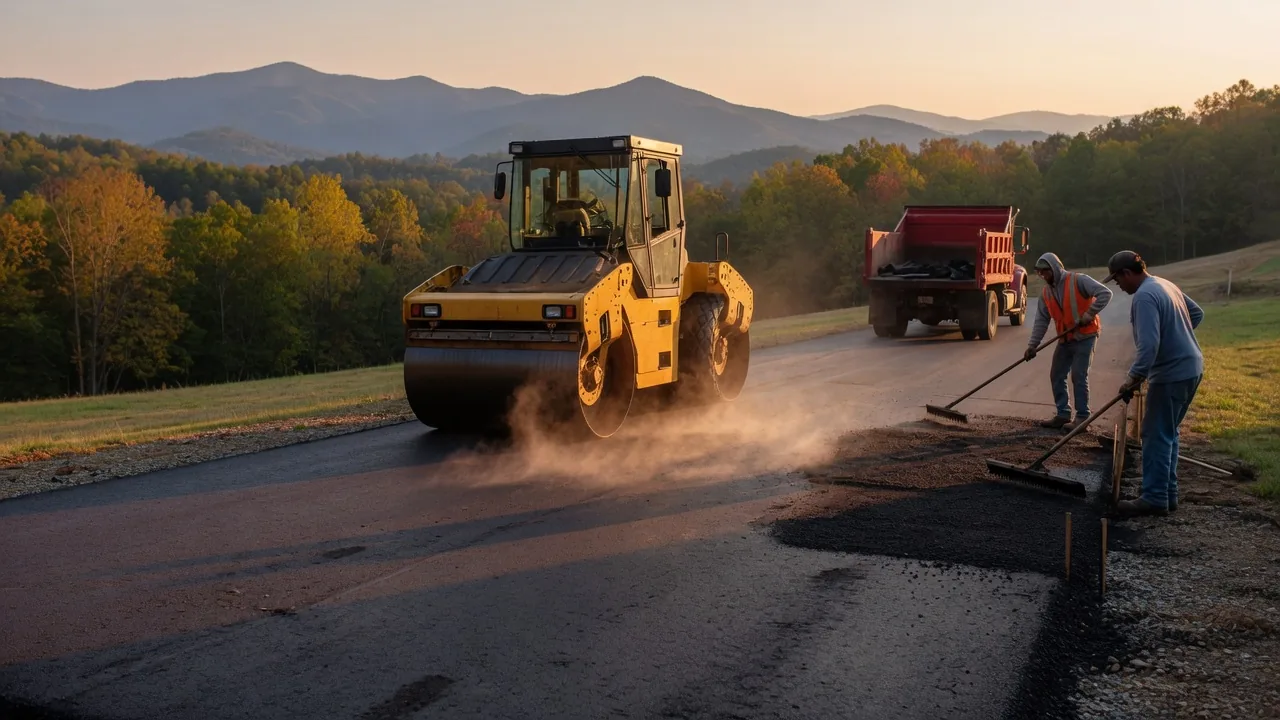
That compaction step matters more than most homeowners expect. Loose stone under asphalt is a sponge: it moves, the asphalt above it bends, and the first freeze-thaw cycle after a wet winter shows you every soft spot. If a crew proposes to spread base and pave the same day, the base is not compacted, and the price you saved reappears as cracking within a couple of seasons.
Water, weather, and the mountain grade problem
Madison County sits in a wet, steep corner of the state, and the federal record reflects it: 21 declared events touch this county across 1978-2026, largely storm and flood family. Any driveway that collects uphill runoff and holds it against an asphalt edge will fail at that edge first. The National Weather Service forecast office covers this area at weather.gov, and the freeze-thaw swings in the French Broad valley are the real design driver — asphalt here has to be laid on a crowned, drained base or it will not survive a decade.
Practical drainage work ahead of paving: clean or replace the culvert at the road, cut a defined ditch on the uphill side of the drive, and make sure the crown sheds water off both edges rather than down the middle. On steep grades, consider a wider surface course and a rougher finish mix for traction. Driveway connections to a state road also need an access permit through NCDOT, handled via NCDOT Connect; the permit rules live at ncdot.gov. Work that touches the state right-of-way without one is a callback waiting to happen.
Choosing a crew that builds base, not just surface
Ask three questions and the field narrows fast. First: will they dig test holes before quoting? Second: how many inches of compacted base does their number assume, and in how many lifts? Third: what is the compaction method — a plate compactor on a 150-foot drive is not enough, and a ride-on roller is. On jobs above the state's threshold for general contracting, licensing rules through the NC Licensing Board for General Contractors apply, so verify the license on the entity actually doing the work, not a subcontractor's.
Around Hot Springs the paving season has real edges: hot mix plants run limited hours and cold-weather paving is a compromise. A crew that schedules your binder and surface courses close together and does the base work in the shoulder season generally delivers a better drive than one that paves in a rush in late fall. Local crews familiar with the county's clay, grades, and plant logistics tend to sequence it right; start with the paving contractors serving Hot Springs to compare scopes on the same terms.