What's actually holding up a Pisgah Forest driveway
Around here the blacktop is the least important layer. Most driveways off the Brevard and Hendersonville side roads sit on one of three things: red clay that swells when wet and shrinks in August, an old gravel bed from a logging or farm road that was never compacted to modern spec, or structural fill placed when a slope lot was cut in. All three let water work underneath, and that is where almost every Pisgah Forest asphalt failure starts — not in the asphalt itself.
The visible symptom is a crack, a rut, or a sunken edge. The cause is usually a base that lost support. A driveway over good compacted stone can take decades of freeze-thaw cycling; a driveway over ten inches of plastic clay will pothole within a few seasons no matter how thick the surface was poured. Before anyone quotes you a resurface, the honest question is what thickness and type of crushed stone is currently under your drive — and whether it was ever corrected.
Reading the damage before you price the repair
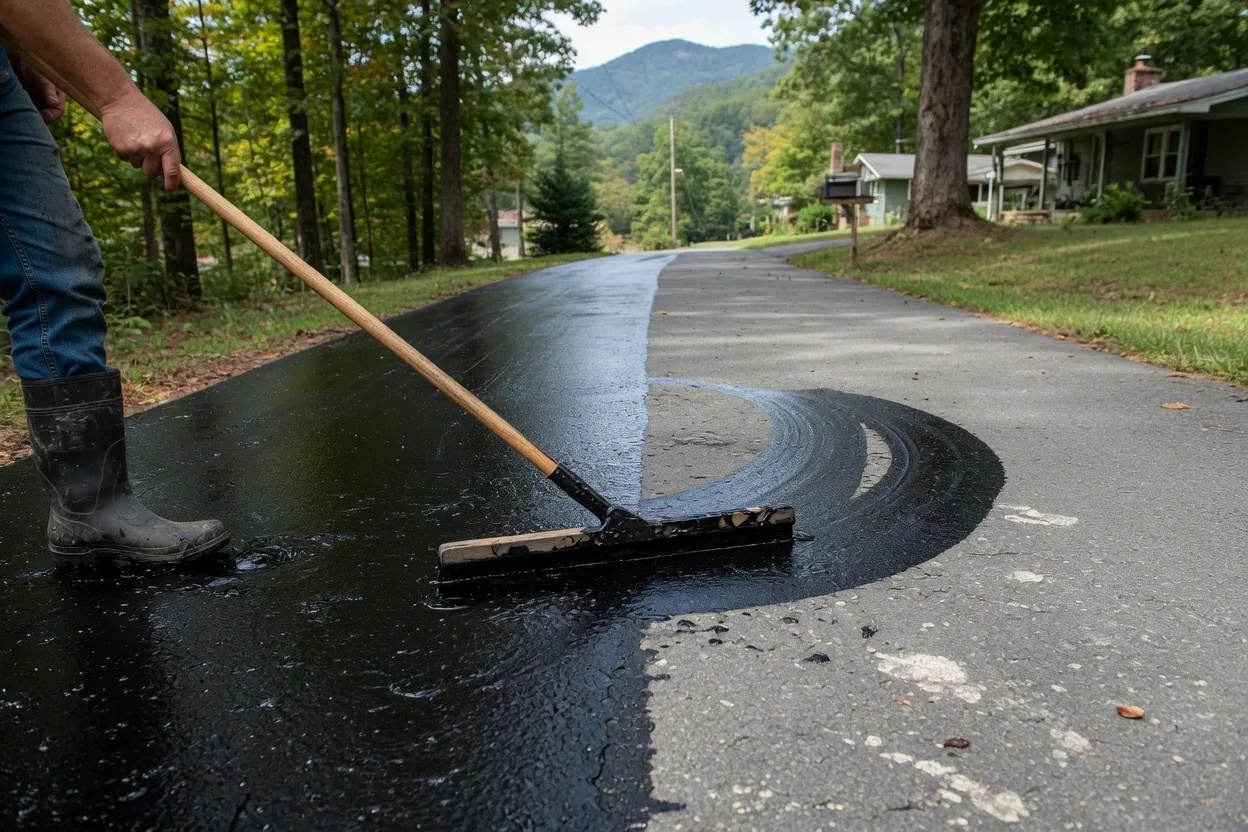
Not every crack means the same fix. Alligator cracking in a wheel track usually means the base has failed there and a patch will just bridge over the problem. A single clean transverse crack is often a paving joint or tree-root push and responds well to proper crack sealing. A sunken edge next to a culvert or a driveway apron is a drainage and edge-support problem, not an asphalt problem.
In Transylvania County the frost-heave and rain cycles are short and repeated, so hairline cracks that would sit quietly for years in a drier climate open up fast here. Sealing them while they are narrow is the single cheapest thing you can do; the same crack a year later is a full-depth patch. The National Weather Service pattern for this part of the mountains — wet winters, hot humid summers, real freeze-thaw cycling — is why our driveways move more than flatland ones.
Where the money actually goes
The table below reflects realistic ranges for mountain-county driveways in this size class. Costs move with access (a steep, narrow drive is more labor), square footage, and how much base correction is needed. The same crack can cost $450 as a seal or $4,200 as a full-depth repair with base rebuild — the difference is what is under the asphalt.
| Scope | Typical price range | What drives it |
|---|---|---|
| Crack sealing (linear crack repair) | $450–$1,100 | Linear feet, crack width, prep |
| Pothole / localized full-depth patch | $650–$1,800 | Patch area, depth to stable subgrade |
| Edge rebuild at culvert or apron | $900–$2,400 | Length, stone quantity, drainage tie-in |
| Section resurfacing with base correction | $2,200–$4,200 | Square footage, crushed stone depth, compaction |
| Full removal and replacement | Higher; scope-dependent | Stripping, haul-off, new base, new hot mix |
For a fuller line-item picture for this county, the Transylvania County asphalt driveway cost breakdown shows how stone, haul distance, and access change the numbers.
Stone first, then hot mix: the anti-clone rule of paving here
If a contractor quotes you a resurface without asking what is under the existing asphalt, that is a resurface of a problem, not a repair. Every credible job in this terrain starts with base evaluation: probe or open a small section, see whether the crushed stone is angular, graded, and compacted, and check that water drains off the drive instead of into the base. The International Code Council family of codes treats subgrade preparation and compaction as a first-class requirement, and there is a reason — hot mix over a soft or wet base will crack again in one or two seasons.
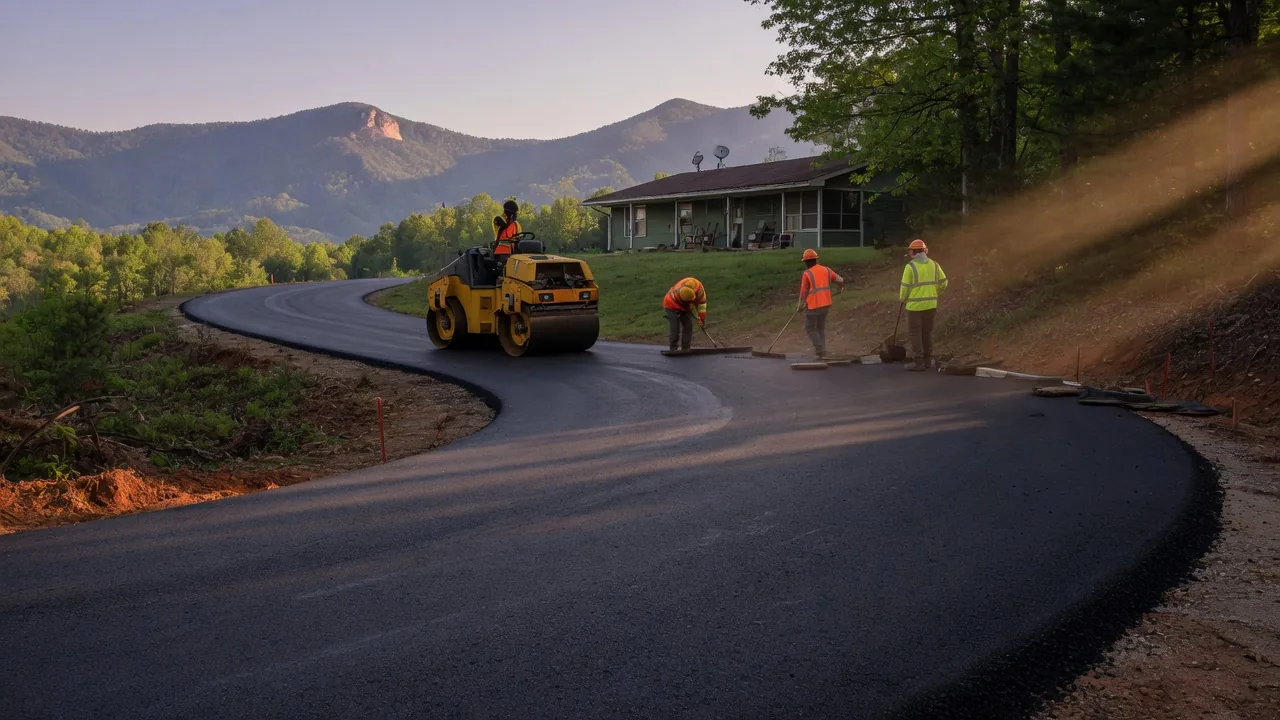
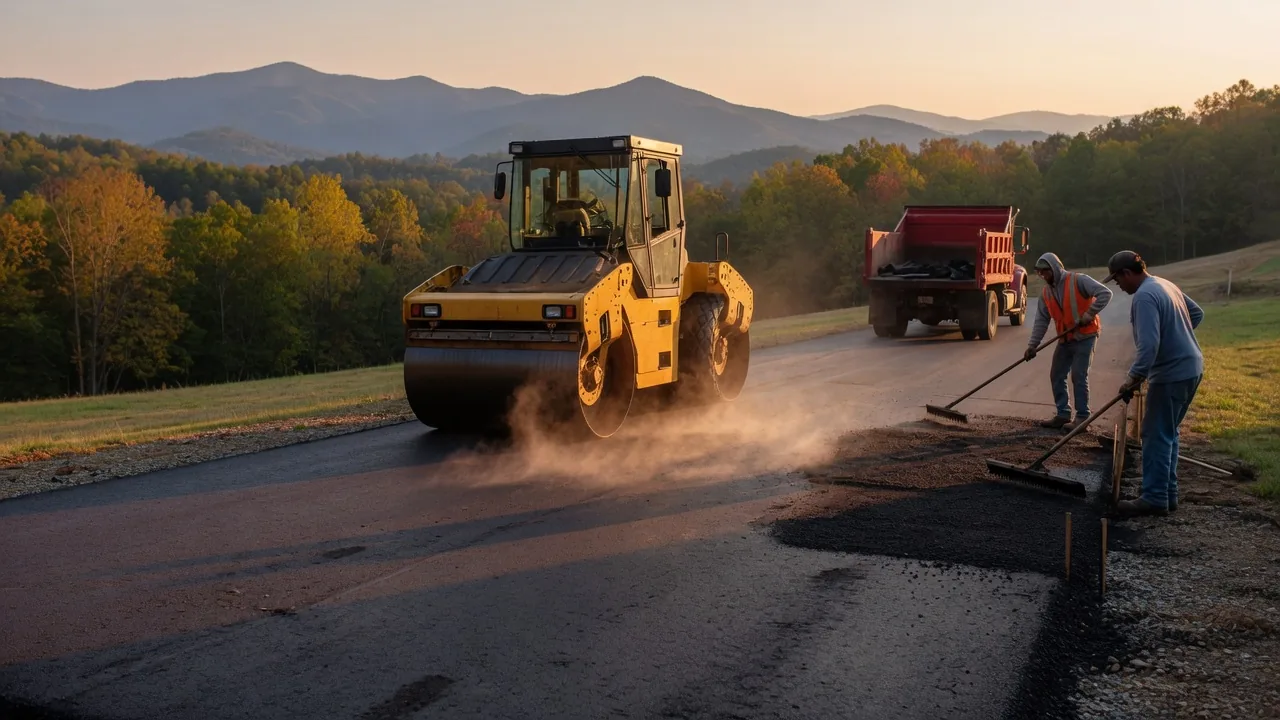
Practically that means most Pisgah Forest jobs involve some amount of additional 2-inch-minus crushed stone, graded and compacted in lifts before the asphalt goes down. On a small patch, the stone correction can be more of the cost than the asphalt. On older farm-road gravel beds, we sometimes find the original gravel is usable if it is regraded and compacted to spec — that is when a repair stays on the low end of the range.
Permits, water, and the slope-lot reality
Anything that changes where runoff leaves your property — a widened apron, a new culvert, a re-graded drive discharging toward a county road — can trigger permitting on the road side. In North Carolina, driveway connections to state-maintained roads go through the NCDOT access permitting process, with applications handled through NCDOT Connect. If your repair stays inside your own existing footprint and does not change drainage, permitting usually is not triggered — but a contractor who has never asked the question is not protecting you.
Storm history matters here, too. 16 federally declared disaster events touch this county across a record spanning 1993-2026, and the overwhelming majority are storm and flood family. Every one of those events pushed water at driveways built for a drier mountain. That is why our repairs lead with water management — grading, ditch, culvert, and edge support — before laying any new asphalt. HUD guidance on site drainage and the EPA on stormwater runoff both point to the same thing: fix where the water goes or you will pay to fix the asphalt again.
Hiring on a mountain driveway
Three checks that matter in this county. First, ask what base thickness and compaction the bid assumes — if the answer is silence, the number means nothing. Second, for any job over the residential general-contractor threshold, confirm licensing with the NC Licensing Board for General Contractors. Third, ask how they will protect the driveway from the slope runoff that comes off the ridge above you, because in Pisgah Forest that water arrives whether or not you planned for it. When the driveway work goes beyond patching, our asphalt driveway repair guide walks through what a proper scope includes, and if the base itself is failing across the whole run, it is worth comparing repair against replacement by talking to local paving contractors in Pisgah Forest.