What's under the asphalt sets the price before a drop of sealer goes down
Transylvania County is red clay country, and most driveways cut into the hillsides around Brevard, Rosman, and Lake Toxaway were laid over whatever the builder found there: clay, old gravel, or fill that never got compacted. That matters because sealcoat protects asphalt from water and oxidation, but it cannot fix a base that is already moving. When we walk a driveway here, the first question is never square footage. It is how much crushed stone the base is missing and whether the surface is cracking because of sun or because of subgrade failure.
Clay holds water against the asphalt edge, and the county's rainfall spreads it fast on grades. That is the honest reason two driveways of identical size can price $300 apart: one is sound asphalt, the other needs patching and edge work before any sealer is worth applying. Our sealcoating service overview breaks the prep steps down further.
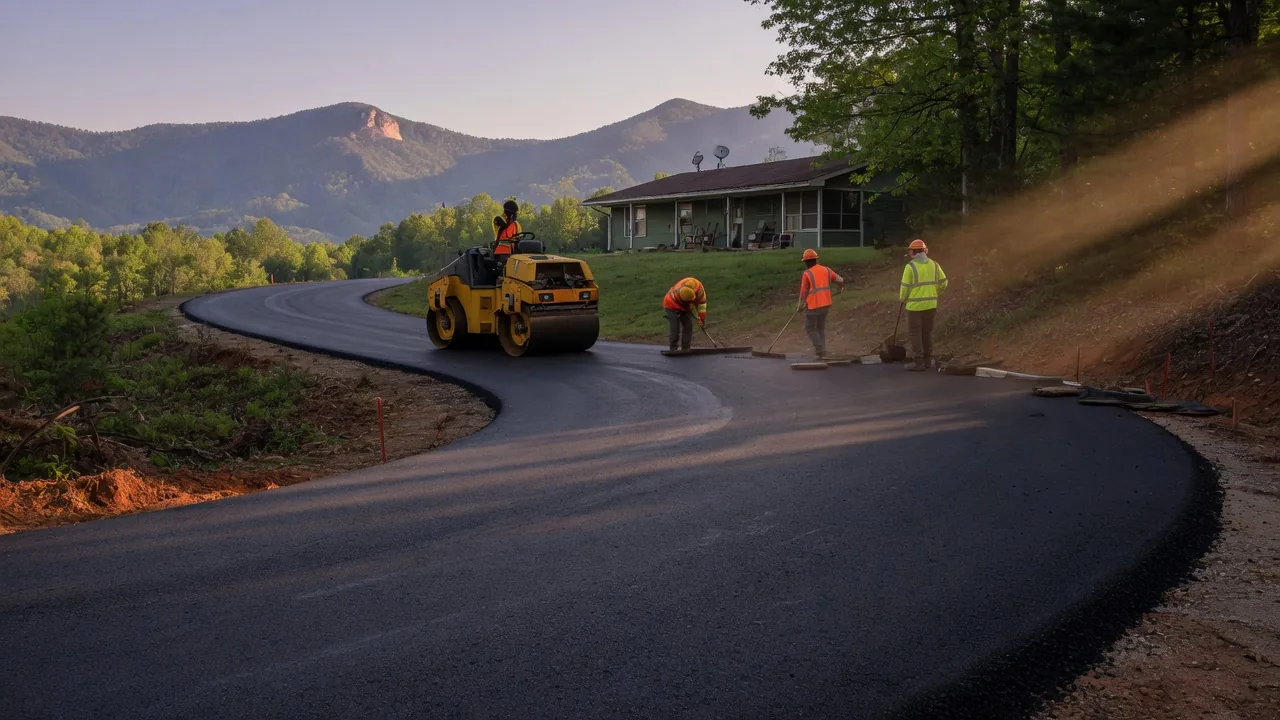
Driveways off the older mountain roads here tend to share a recognizable profile. A builder scraped a bench into the slope, spread whatever rock was on site, and topped it with a thin lift of asphalt. Twenty or thirty years later the asphalt is still there but the bench underneath has settled, especially on the downhill edge where water leaves the pavement. You can often read it from the road: a lip where the drive meets the shoulder, a dip that ponds after every storm, a crack line running parallel to the slope. None of those are sealer problems. They are stone problems wearing an asphalt disguise.
Cold-climate freeze-thaw compounds it. Transylvania sits high enough in the Blue Ridge that winter cycles open cracks that a Piedmont driveway of the same age would not show. Water gets in, freezes, lifts the surface, and the next rain carries clay fines up into the void. By the time a homeowner calls about sealcoating, the honest answer is sometimes that the money is better spent on base repair first and sealer second, or on a full rebuild if the failure has spread. We would rather say that up front than take a sealcoat check and watch it fail within a season.
What homeowners in the Brevard area actually pay
National per-square-foot averages assume flat, clean, unshaded pavement. Very little of that exists in this county, so treat the following as working ranges rather than quotes. A crew that prices over the phone before seeing the base is guessing.
| Scope of work | Typical Transylvania range | What drives it |
|---|---|---|
| Sealcoat only, sound asphalt | $0.15 – $0.22 / sq ft | square footage, number of coats, access |
| Crack fill + sealcoat | $0.20 – $0.30 / sq ft | crack count and width, cleaning time |
| Patch, edge repair, then sealcoat | $450 – $1,400 per driveway | failed base areas, clay edge erosion |
| Gravel build-up plus new asphalt | $3.50 – $6.50 / sq ft | stone depth needed, grade, drainage |
| Sealcoat over old gravel base, steep grade | quoted per project, typically above $1,200 | base stabilization, slope, equipment limits |
Those ranges are shaped by the same thing every time: how much work the base needs before the sealer. If a bid lands far outside them, ask what is under the asphalt and why that changes the job.
Two examples from around the county show how the numbers move. A short, flat drive in a Brevard neighborhood off a paved street, maybe forty feet long and one car wide, sealed with two coats and a handful of hairline cracks filled, lands near the bottom of the range, often under $500. That is about as simple as the work gets here. Now take a drive out toward Rosman climbing to a house pad, sixty or eighty feet of run, shaded all day, with a failing edge on the downhill side and old gravel showing through where the asphalt has worn away. That job needs the edge rebuilt, the failed spots patched with hot mix, cracks cleaned and filled, and only then two coats of sealer. Same county, same trade, and the price can be two to three times the simple drive. The square footage is not wildly different. The base work is.
Access changes things too. A narrow mountain drive that a full-size sealcoat truck cannot safely back down means smaller equipment, more handwork, and more time. That labor shows up in the quote, and it is legitimate. Anyone who prices without asking about slope, turnarounds, and overhead clearance is pricing blind.
Why the shade and the slope matter as much as the sealer
Transylvania sits in a temperate rainforest zone of the southern Blue Ridge, and the tree canopy over many driveways keeps pavement damp far longer than sun-exposed asphalt in the Piedmont. Damp asphalt oxidizes differently, cracks open sooner, and holds moisture in the cracks. That is why a driveway here may need sealcoating on a shorter cycle than the three-to-four-year rule of thumb you see online.
Steep drives bring their own problem. Water running down a grade carries grit and clay across the surface and against the edges, and it finds every crack. Over the county's federal disaster record (16 declared events spanning 1993-2026), the pattern is consistent: heavy rain does more damage to pavement than heat does. The fix order is always water first, then surface. If your driveway grades toward the house or a low corner, sealcoating is a finishing step, not the whole answer, and our asphalt paving guide covers when the base itself needs rebuilding.
The National Weather Service's local outlook is useful for timing: sealcoat cures best in a stretch of dry, warm days, which in this county means watching the forecast more carefully than a flatland homeowner would (NWS).
There is also a moss and algae story here that flatland contractors rarely deal with. Shaded pavement in this humidity grows a film of green that holds moisture against the surface and makes asphalt slick in winter. Cleaning that growth off is part of proper prep, not an optional extra. A crew that skips it is sealing over a wet layer that will not bond. Homeowners often notice this as black or green streaking on the shaded half of the drive and clean gray on the sunny half, which is a good visual cue for where a sealcoat job will actually take.
Drainage at the top of a steep drive matters as much as the pavement. Where a mountain road sheds water onto a private drive, a simple diversion or turnout above the pavement can spare the asphalt years of abuse. That is the kind of small, unglamorous fix that pays for itself, and it costs far less than rebuilding the drive.
Permits, licensing and who can legally do the work
Routine sealcoating and crack filling on an existing driveway generally does not require a permit. New driveway connections to a state-maintained road do: NCDOT controls driveway and street access permits for anything tying into the state system (NCDOT). That distinction matters if your driveway meets a numbered route rather than a private road.
On licensing, North Carolina sets a dollar threshold for general contracting work, and larger paving or grading jobs can cross it (NC Licensing Board for General Contractors). A straight sealcoat job usually falls under that line, but if the work grows into base reconstruction, ask who is licensed and for what. The state building code and its adopted standards live with the NC Department of Insurance (NC DOI). If a contractor shrugs off permits entirely on a structural-scale job, that tells you something about how the rest of it will go.
One local wrinkle: steep-slope work sometimes brushes against erosion-control rules, because disturbed ground on a grade sheds sediment into creeks and lakes. This county's water bodies are the reason a lot of people live here. If a project involves significant grading, not just a sealcoat, it is worth asking whether the work touches any of those requirements and who owns that responsibility. A contractor who knows the answer is a contractor who has done this before in Transylvania County.
How to keep a sealcoating quote honest
Three habits protect you in this market:
- Ask about the base first. Before you discuss sealer brand, ask what is under the asphalt and whether it needs stone. The answer separates real crews from spray-and-go operations.
- Price the coats, not just the job. Two coats of a quality mix behave differently than one thin pass. A per-square-foot rate with the coat count named keeps the comparison fair.
- Check the calendar. Sealer needs dry weather to cure, and this county does not always cooperate. A crew that will wait for a proper window is telling you they care about the result.
Want the fuller picture on what sealcoating costs across the region? See the sealcoating cost guide, or look at how the numbers shift town to town.
One more check specific to this county: ask how the crew handles the transition where the drive meets the road. That apron takes the most abuse from plows, grit, and turning traffic, and it is the first place a good job shows and a bad one fails. On private roads common in the mountain developments around here, that apron is also where standing water collects after a storm, so patching and sealing it properly matters more than the middle of the drive. A bidder who talks about the apron without being prompted has probably worked these hills before.