Why Black Mountain driveways wear differently than Asheville's
The town sits at the base of the Blue Ridge escarpment, and that geography writes the sealcoating rules here. Driveways off Montreat Road, up toward Lake Tomahawk, and in the older pockets along Cherry Street tend to be longer, narrower, and steeper than the compact city lots in Asheville proper. Longer means more surface to seal and more linear feet of edge to fail. Steeper means water moves faster across the surface and finds every crack you haven't filled.
Subdivisions like Ridgecrest and the roads heading up toward the gap sit in heavier shade and hold moisture longer after a rain. Combine that with winter freeze-thaw, which cycles harder here than in the valley, and unsealed asphalt in Black Mountain oxidizes and cracks on a shorter clock than the same driveway in a flatter, sunnier part of Buncombe County. That is the whole argument for staying on a sealcoat schedule here rather than waiting for visible damage.
Housing character compounds the problem. Many Black Mountain driveways serve older homes built decades ago, when asphalt was laid thick and drainage was an afterthought. These drives have already survived years of mountain weather, and their pavement is often at the point where small cracks become structural if ignored. The older sections near downtown, where narrow lots abut sidewalks and stone walls, leave little room for water to spread before it hits the pavement edge. Newer builds in the higher subdivisions bring longer runs and sharper grades, which put more stress on the surface and demand more attention during prep. In both cases, the work is not just about spreading sealer — it is about reading how water behaves on that specific slope before a single bucket is opened.
What a Black Mountain sealcoating job actually includes
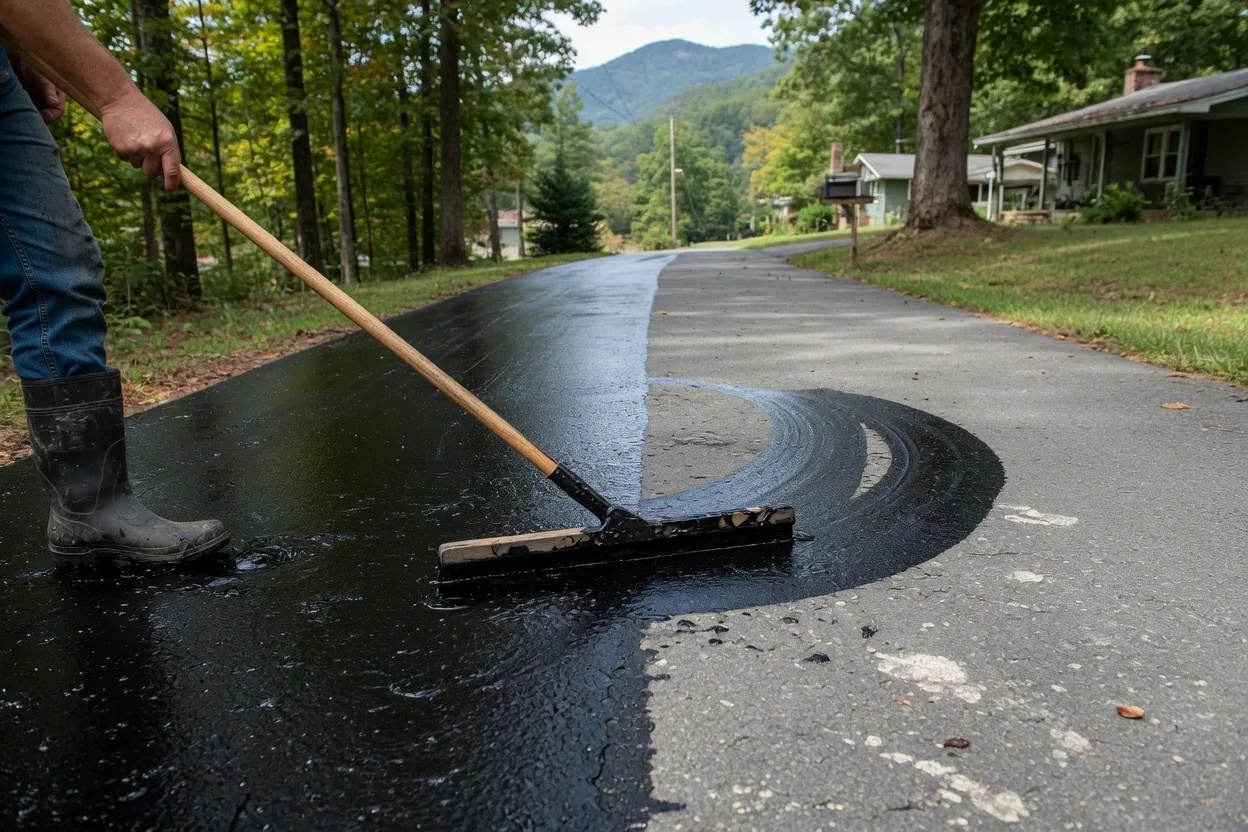
A real sealcoat job is not a single pass with a squeegee. It starts with cleaning — blowing off grit, pulling weeds from the edge line, scraping out failed patches. Cracks get filled before any sealer goes down, because sealer over an open crack just hides it until spring. Then the surface gets one or two coats depending on porosity and how long it has been since the last sealing.
Edges matter more here than in flatter towns. On a steep Black Mountain driveway, water sheets to the edges and undermines them first; a crew that ignores the edge line is leaving the highest-failure part of the job untouched. If your drive ties into a steep grade or a culvert, that transition is where the surface breaks up first and where prep time should go.
Porosity is another variable that changes the scope. Some Black Mountain driveways have never been sealed and soak up the first coat like a sponge; those need a second coat to build any real film. Others were sealed a few years ago and only need a refresher. A good crew will test by pouring a small amount of sealer and watching how fast it disappears into the surface. If it flashes off quickly, a second coat is not optional. This is also where the difference between a budget quote and a real quote shows up. The cheap bid assumes one coat and minimal prep; the honest bid accounts for what your specific driveway actually needs. Ask any contractor how they decide between one and two coats, and listen for whether they mention a test or just guess.
Scope and price ranges for Black Mountain driveways
These are working regional ranges, not quotes. Final price moves with square footage, slope, prep load, and how many coats the surface needs.
| Scope | Typical price range |
|---|---|
| Crack fill and spot prime only (small drive, no sealer) | $150–$350 |
| Single-coat seal, short residential drive (under ~800 sq ft) | $180–$320 |
| Two-coat seal, standard Black Mountain drive (800–1,600 sq ft) | $320–$650 |
| Long or steep drive with edge repair (1,600–3,000 sq ft) | $650–$1,200 |
| Seal plus patching and edge rebuild on failing sections | $900–$2,000+ |
Compare this to full replacement before you decide. The Buncombe County asphalt cost breakdown shows what a new drive costs; sealing a sound surface is a fraction of that, and it is the cheapest way to delay the replacement line item.
Keep in mind that steep drives often require more crack fill because water accelerates through every opening. A driveway that climbs toward the gap may need twice the linear feet of crack treatment as a flat drive of the same square footage. That is why square-foot pricing alone can be misleading here. When you compare bids, ask whether crack fill is priced by the gallon, by the linear foot, or included as a lump sum. Each method is legitimate, but the scope behind the number is what matters. Longer driveways also eat more labor in cleaning and edge work, which shows up in the final price even when the sealer quantity is similar.
Filling cracks now versus repaving later
The federal disaster record for this county is a fair proxy for how hard water hits pavement: 19 declared events touch Buncombe County across 1973-2026, and the overwhelming majority are storm and flood family. Every one of those events pushed water across driveways that were built for gentler drainage. The National Weather Service tracks the freeze-thaw pattern that does the rest of the damage — water enters a crack, freezes, expands, and widens the crack a little more each winter.
Sealcoating interrupts that cycle. It does not fix a failing base or a broken culvert, and any crew that claims it will is selling you the wrong service. If the asphalt is alligatored, sunken, or crumbly at the edges, the honest answer is patching or replacement, not another coat of sealer. See the sealcoating overview for how to tell the difference before you call anyone.
The timing math is simple. A sealcoat every few years costs a fraction of a repave, and it keeps the surface flexible so it can move with the ground instead of cracking. In Black Mountain, where the ground itself shifts with moisture and freeze cycles, that flexibility is not a luxury. Driveways that go unsealed for a decade often develop interconnected cracks that let water reach the base. Once the base is saturated and soft, no amount of sealer will bring the surface back. The repair becomes a full-depth patch or a new drive. Homeowners who stay ahead of it spend less over the life of the driveway and avoid the disruption of a repave. The tradeoff is scheduling: sealing is a maintenance item, not an emergency repair, so it is easy to postpone. The pavement does not care about your schedule.
Hiring a crew for a Black Mountain driveway
Three local checks. First, ask how they handle slope — a crew that has only worked flat commercial lots will under-prep a steep residential drive. Second, ask whether crack filling and edge work are included or billed separately, because that is where budget quotes get thin. Third, on any job touching a driveway apron or a town right-of-way, ask about the driveway permit; the NCDOT Connect system handles driveway permit applications for state-maintained roads, and the NCDOT site spells out when one is required. General contracting thresholds are set by the NC Licensing Board; for a straightforward residential sealcoat, most jobs fall under those thresholds, but any crew doing structural driveway replacement should be able to speak to them.
When you are comparing bids, our Black Mountain paving contractor guide covers what a proper scope looks like on paper so you can line up quotes side by side.
Ask for a written scope that lists each step: cleaning, crack fill, edge treatment, number of coats, and cure time. A verbal promise is not a scope. Also ask how they will protect adjacent surfaces — sealer overspray on stone walls or garage doors is difficult to remove. Local crews know which driveways need extra masking because of tight clearances. If a contractor cannot explain how they handle drainage on your slope, that is a sign they have not worked many Black Mountain jobs. The best crews will walk the driveway with you, point out specific areas of concern, and explain why they are recommending a particular number of coats. That conversation is free, and it tells you more than any brochure.