What's under the lot decides what you pay
Drive through Waynesville and you can read the ground under half the commercial lots without getting out of the truck. Downtown and along Main Street, parking sits over a century of stacked surfaces — old brick, coal-era fill, gravel laid down by whoever ran the business before. Out toward Russ Avenue and the commercial strips, you get graded clay pads cut into the hillside, and clay is the number one reason a new lot fails in three years instead of fifteen. On the slopes above town and in the valley pockets off Richland Creek, it's often loose fill that was never compacted to anything resembling a spec.
That subgrade is the whole job. Hot mix asphalt is a wearing surface, not a structural one. It flexes with whatever is beneath it, which means soft clay subgrade turns into rutting in the drive lanes and alligator cracking at the entrances by the second summer. The fix is crushed stone — typically a 6-inch to 12-inch compacted base of NCDOT-approved aggregate, deeper where the clay is heavy or drainage is poor. An honest quote in Haywood County names that stone depth. A cheap one hides it, and you pay for it in five years.
Waynesville pricing, line by line
Nobody can quote a parking lot from a phone call, but the working ranges below are realistic for this market. Use the Haywood County asphalt cost breakdown for the residential-scale comparison — commercial lots carry heavier base and thicker lifts, so they price higher per square foot even when the paving itself looks identical.
| Scope | Typical Range |
|---|---|
| New lot, good subgrade, 4" stone base | $2.50-$3.75 / sq ft |
| New lot, clay subgrade, 8"+ stone base | $4.00-$6.00 / sq ft |
| Base repair only (stone + grading, no paving) | $1.25-$2.50 / sq ft |
| Remove-and-replace failing asphalt (full-depth) | $3.50-$7.00 / sq ft |
| Mill and overlay (structural base intact) | $1.75-$3.00 / sq ft |
| Sealcoat and restripe, per cycle | $0.20-$0.45 / sq ft |
| Line striping (per stall, minimums apply) | $4-$12 |
Those ranges move with asphalt tonnage pricing, haul distance from the plant, and how much of the existing lot can be salvaged. A 30-stall lot with intact base is a very different number than the same lot sitting on wet clay with a broken storm line under it.
Water, freeze-thaw, and the mountain problem
Waynesville sits at just under 2,700 feet, and that elevation changes the freeze-thaw arithmetic. Mountain winters here cycle the surface above and below freezing repeatedly, which opens cracks, drives water in, and pops the aggregate loose from the binder. The federal disaster record backs up the water half of that story: 19 declared events have touched this county across 1973-2026, and the overwhelming majority are storm and flood family. Every one of those pushed water across lots that were graded for a drier assumption.
That means the paving quote and the drainage plan are the same conversation. Positive slope away from the building, functional catch basins, and a storm line that actually drains are not extras on a Haywood County lot — they are what keeps the asphalt from being a $60,000 puddle. The EPA publishes stormwater guidance for commercial sites that's worth reading before you sign anything, and if your lot drains to a creek or the Pigeon River watershed, state rules apply too. The NC Department of Environmental Quality is the agency that enforces them.
Permits, access, and who can legally do the work
Two regulatory realities hit commercial lot projects here. First, if your lot connects to a state-maintained road — which includes most of the commercial frontage along Russ Avenue, Howell Mill Road, and the 276 corridor — any change to the driveway apron or entrance requires an NCDOT driveway permit. Applications run through NCDOT Connect; the general NCDOT site has the rule sheets. Skip it and the entrance can be flagged on inspection, which means tearing out work you already paid for.
Second, the contractor question. North Carolina's Licensing Board for General Contractors sets the thresholds: once a project crosses the statutory dollar amount for construction work, the contractor has to be licensed. Paving is not exempt from that framework when the scope includes grading, base, and drainage. Ask for the license number, then verify it. If a crew can't produce it or dodges the question, that's your answer.
Getting a quote that means something
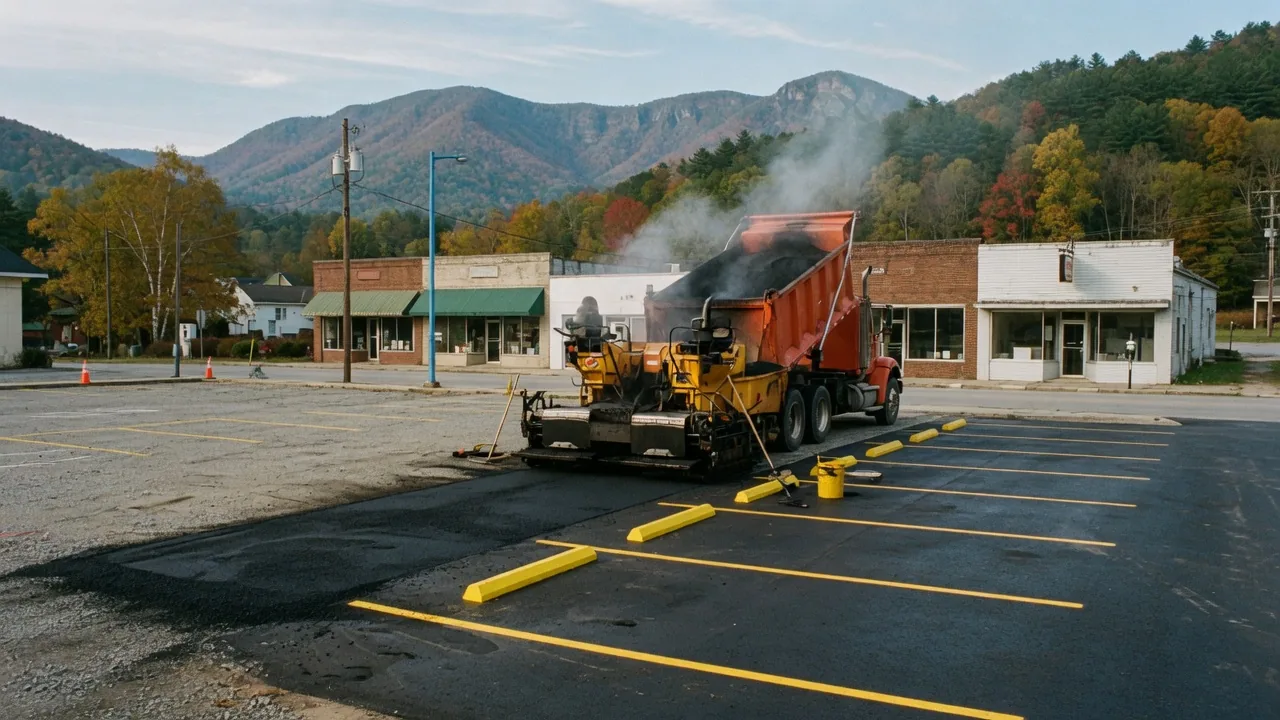
A real paving bid for a Waynesville lot should include: stone depth and aggregate type by name, asphalt lift thickness for base and surface courses, compaction spec, drainage scope, striping layout, and a stated warranty period. The one to watch is the local paving contractor comparison — the crews that put stone depth in writing are usually the ones who put it on the ground. For the broader view of what paving work costs and how it's scoped, the parking lot paving overview walks through lot sizes and phasing options.
Two practical notes. Spring and fall are the busy seasons here — book earlier than you think you need to, especially on commercial timelines. And if your lot is genuinely at the end of its life, ask whether phasing makes sense: fix the base and high-traffic lanes now, surface the rest next budget cycle. It can spread the cost without leaving the lot in a rutting state for three more winters.