Why Flat Rock driveways cost what they do: haul and access
Flat Rock sits in Henderson County just south of Hendersonville, where the terrain rolls hard and the lots tend to disappear into rhododendron. A paving crew working here isn't pricing sealer so much as logistics: how far the tanker or hot-mix load has to travel, and whether the truck can actually back to the far end of a 400-foot private lane without cracking a culvert or spinning out on the grade.
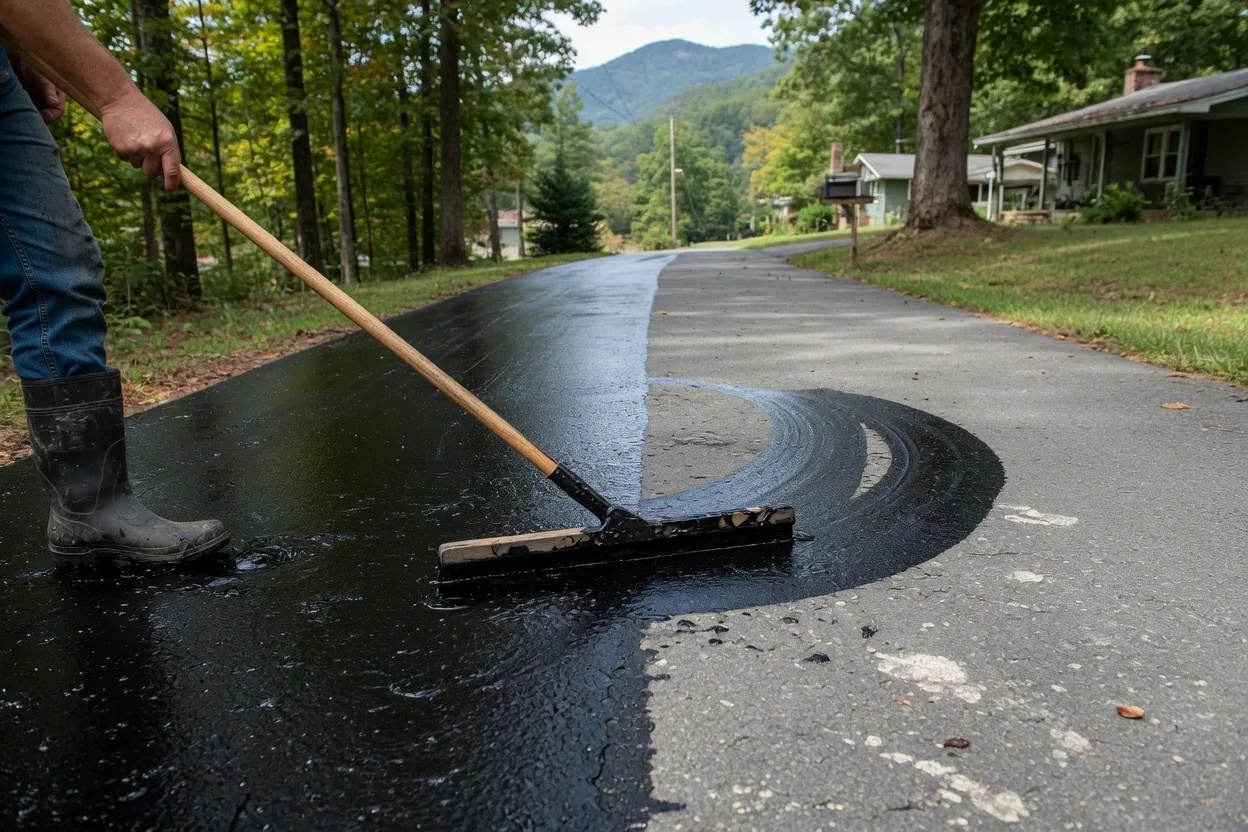
Sealcoating is the gentler job — it's a spray-and-squeegee operation, not a paver train. But the same access math applies. A driveway the crew can drive straight in and out of gets sealed on a tight schedule; a switchback lane with a low tree canopy and no turnaround point adds labor, setup, and sometimes a partial hand-application around the tight corners. That's the difference between a quote at the low end of the band and one near the top.
If you're weighing sealcoating against replacement, the Henderson County asphalt driveway cost breakdown puts the two in context — sealing is a fraction of what a full tear-out and repave costs.
One more local variable: the historic flat-rock communities and gated communities scattered between Hendersonville and the Green River corridor often have private-maintenance agreements that dictate how and when a crew can work. Some HOAs require advance notice, some restrict heavy equipment, and a few ban sealcoat application during certain months to protect nearby streams. Knowing that before the crew arrives saves a wasted trip and a rescheduled quote. It also explains why two neighbors on the same ridge can get quotes that differ by several hundred dollars even when their driveways look identical from the road.
What runs up the number: scope, not salesmanship
Steep grades matter more than most homeowners expect. On a pitch above roughly 10 percent, sealer can migrate before it cures, so a competent crew adjusts application method, adds a sand or aggregate load for traction, and works in cooler morning windows. A shaded hollow lot holds moisture longer into the day, which can push a job to a second visit. Neither is an upsell — they're the physics of sealing asphalt on Henderson County's hillsides.
Cracks, potholes, and failed edges get addressed before any sealer goes down, because sealing over a deteriorating surface just traps the problem. The sealcoating service overview walks through the crack-fill and patch prep that precedes the topcoat.
Age and sun exposure cut the other way. A west-facing driveway on an open ridge above Flat Rock takes full afternoon sun and oxidizes faster than a driveway tucked into a north-facing cove, even when the cove lot is longer. The cove driveway may grow moss and algae along the shaded edge instead, which a crew has to treat before sealing or the coating won't bond. Both conditions show up on the same street here, which is why a fair quote walks the driveway instead of measuring from the mailbox.
Drainage is the silent cost driver. Where a driveway sheds water toward the house, a low spot, or a neighboring property, the sealer isn't the fix — regrading or a small swale is. A crew that flags this before sealing is doing you a favor; a crew that seals over it is selling a two-year cosmetic patch on a problem that will return.
Scope-versus-price ranges for Flat Rock driveways
Ranges below reflect typical regional pricing for a residential asphalt driveway in this part of Henderson County. Length, grade, tree cover, and condition move the number — treat every row as a band, not a quote.
| Scope | Typical price range |
|---|---|
| Short, flat driveway (under 1,000 sq ft), simple squeegee application | $1,200-$1,800 |
| Mid-length driveway (1,000-2,500 sq ft), light cracking, standard spray | $1,800-$2,600 |
| Long or steep driveway (2,500-5,000 sq ft), aggregate additive for traction | $2,600-$3,800 |
| Crack fill and spot patching (priced separately, before sealing) | $150-$600 |
| Edges, turnaround, and hand-work on tight or canopied sections | $200-$700 add-on |
These are working bands, not a rate card. A short straight driveway off a paved Henderson County road is a very different job from a half-mile private lane climbing toward a ridge lot.
The haul cost buried inside every one of those bands is tied to where the sealer and any aggregate additive come from. Flat Rock sits roughly half an hour south of the Asheville-area suppliers, and a crew hauling a tanker up a mountain two-lane burns fuel and clock time before the first squeegee touches pavement. On a short driveway, that haul is spread across few square feet and shows up as a higher per-foot cost. On a long lane it dilutes. It's one reason the smallest driveways don't always get the cheapest per-foot price.
The right season and the right surface
Asphalt needs to be cured before it's sealed — typically several months to a full season on new pavement. Sealing too early traps oils that haven't finished flashing off, and the coating fails from underneath. On an older driveway, the question is whether the surface still has structure or is at the end of its life; if the base is failing, sealcoating is a cosmetic answer to a structural problem.
Weather closes the working window fast in this part of North Carolina. The National Weather Service forecast drives scheduling more than any calendar here: sealer needs warm, dry conditions and time to cure before rain, and afternoon thunderstorms rolling off the Blue Ridge can wipe out an application that started too late in the day. A crew that reads the radar and starts early is worth more than one that promises a fixed date regardless of sky.
Spring and early fall tend to be the sweet spots in Flat Rock. Mid-summer afternoons bake the surface and can flash-cure sealer before the crew finishes a long lane, while deep winter keeps overnight lows below the range most sealers need to cure. The county's storm history matters too: Henderson County has recorded 16 federal disaster declarations across 1978-2026, and several of those involved flooding and slope damage that left driveways needing regrading before they could be sealed at all. That history is a reminder that water, not sun, is the bigger long-term enemy of a mountain driveway.
Hiring and the paperwork that protects you
For a residential driveway, most sealcoating work doesn't cross the dollar threshold that requires a licensed general contractor, but the NC Licensing Board for General Contractors is the place to check if your project involves larger paving, reconstruction, or a price point that triggers the rules. Ask any crew for proof of insurance and a written scope that names the prep steps, the sealer type, and the number of coats.
If your driveway ties into a state-maintained road, or if work touches the right-of-way, a NCDOT driveway permit may be required before anything gets disturbed. Most resealing doesn't reach that line, but a widened apron or a new culvert often does. When you're ready to line up bids, the Flat Rock paving contractors page lists local crews and what to ask each one.
Environmental rules also apply to how and when sealer is applied, particularly near storm drains and waterways — the NC Department of Environmental Quality is the reference if a crew's disposal or runoff practices look careless. Slope lots in Flat Rock drain toward creeks and the Green River corridor, so runoff isn't a hypothetical here. A crew that parks its tanker over a storm drain inlet or rinses tools on the lawn is telling you something about how it values the site. The EPA keeps plain-language material on stormwater and paving runoff if you want to know what best practice looks like before you sign.
Finally, get the quote in writing with the prep steps itemized. Verbal scopes are where disputes start, and a driveway in this terrain is a big enough investment to warrant one page of paper describing exactly what happens on the day.