Why two inches and three inches are not the same driveway here
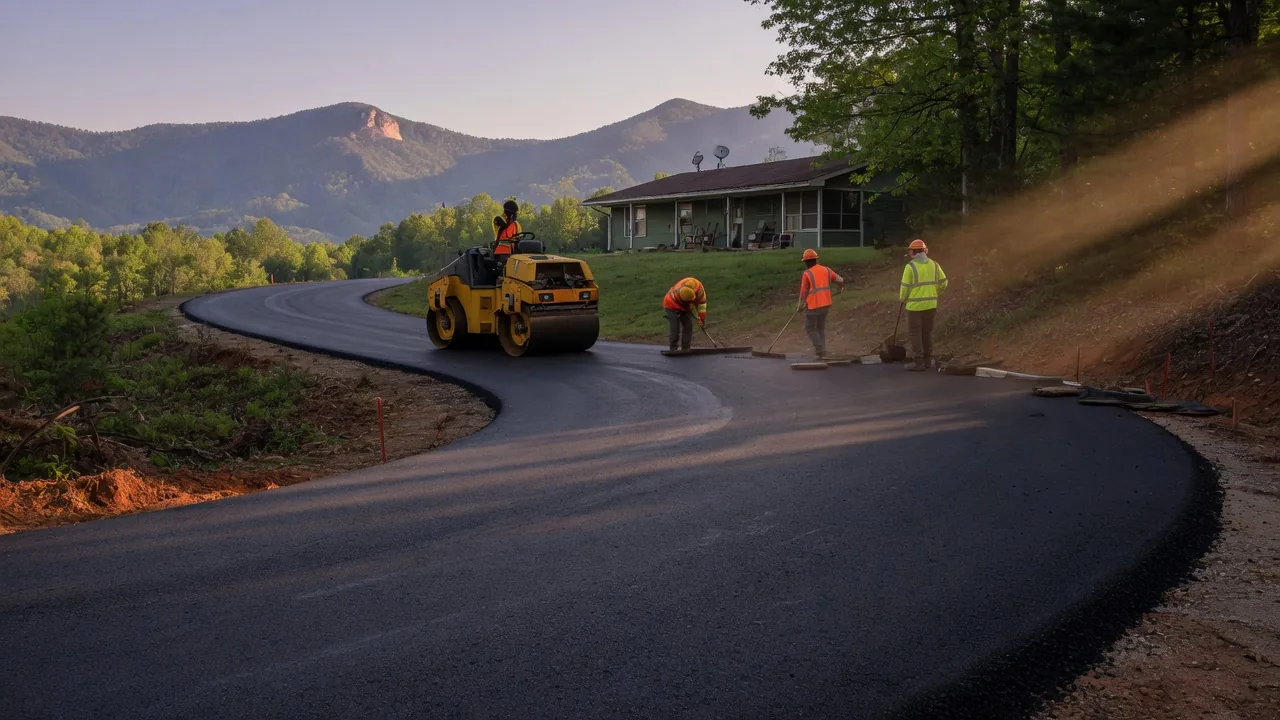
A driveway in Hot Springs has a specific job description that flatland paving advice ignores. It climbs. It turns tightly near the house. And depending on where you sit off the river corridor or up one of the hollows toward the county line, it may take a delivery truck, a fire apparatus, or a propane truck with a full tank on a wet morning. Compaction thickness is the whole conversation: two inches of compacted asphalt over a prepared base handles a passenger car and a pickup fine, but three inches — or two full lifts of two inches — is what a grade with truck loads and turning torque actually calls for.
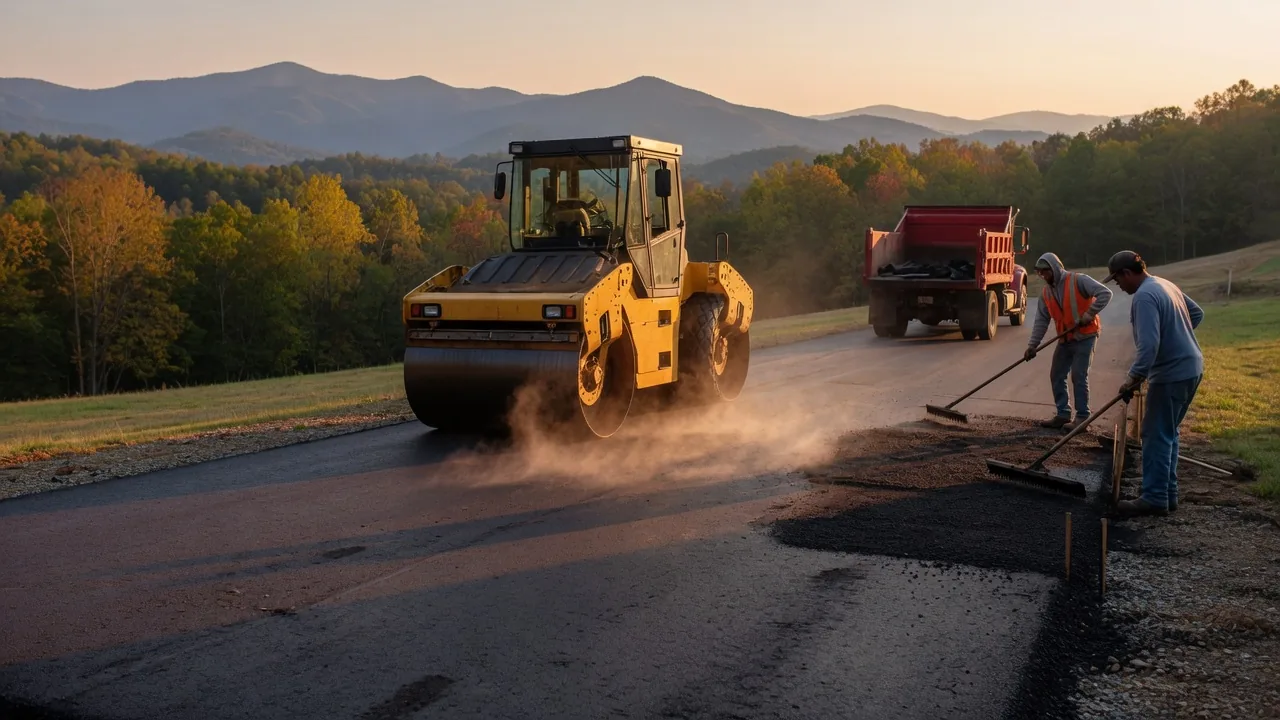
Here is the honest tradeoff most bids skip. One lift of three inches compacts unevenly on a steep pull; the screed rides the slope and the thick edge stays soft. Two lifts of two inches costs more in labor and equipment time but gives you a denser, more uniform mat with a joint that can be sealed later. On the grades common around Hot Springs, the two-lift spec usually wins — and a contractor who quotes a single lift without asking about your slope and loads is quoting a driveway he has not actually thought about.
Mix design matters just as much as thickness. In this part of Madison County, a standard surface mix with a mid-range aggregate gradation handles temperature swings and the freeze-thaw cycle at the ridge lines better than a tight, fine-grained mix. The binder grade also shifts: a mix that performs on a shaded north slope in January may rut on a south-facing pull in August. A paving crew that works this valley regularly knows to ask which way your drive faces and adjust the binder spec accordingly. That question alone tells you whether you are talking to someone who has actually paved here or someone who is pricing the same mix they use everywhere.
What Madison County ground does to a paving budget
Madison County's terrain makes base prep the line item that swings the number more than the asphalt itself. Rock, clay, and old gravel that has been punched down by years of water need different treatment, and a driveway that drains toward the house needs a crown and a ditch before any blacktop shows up. That is why two drives of the same length can price $3,000 apart with no one lying to anybody.
The working table below is a scope guide, not a quote. See the full Madison County cost breakdown for the line-item version.
| Scope | Typical range | What drives it |
|---|---|---|
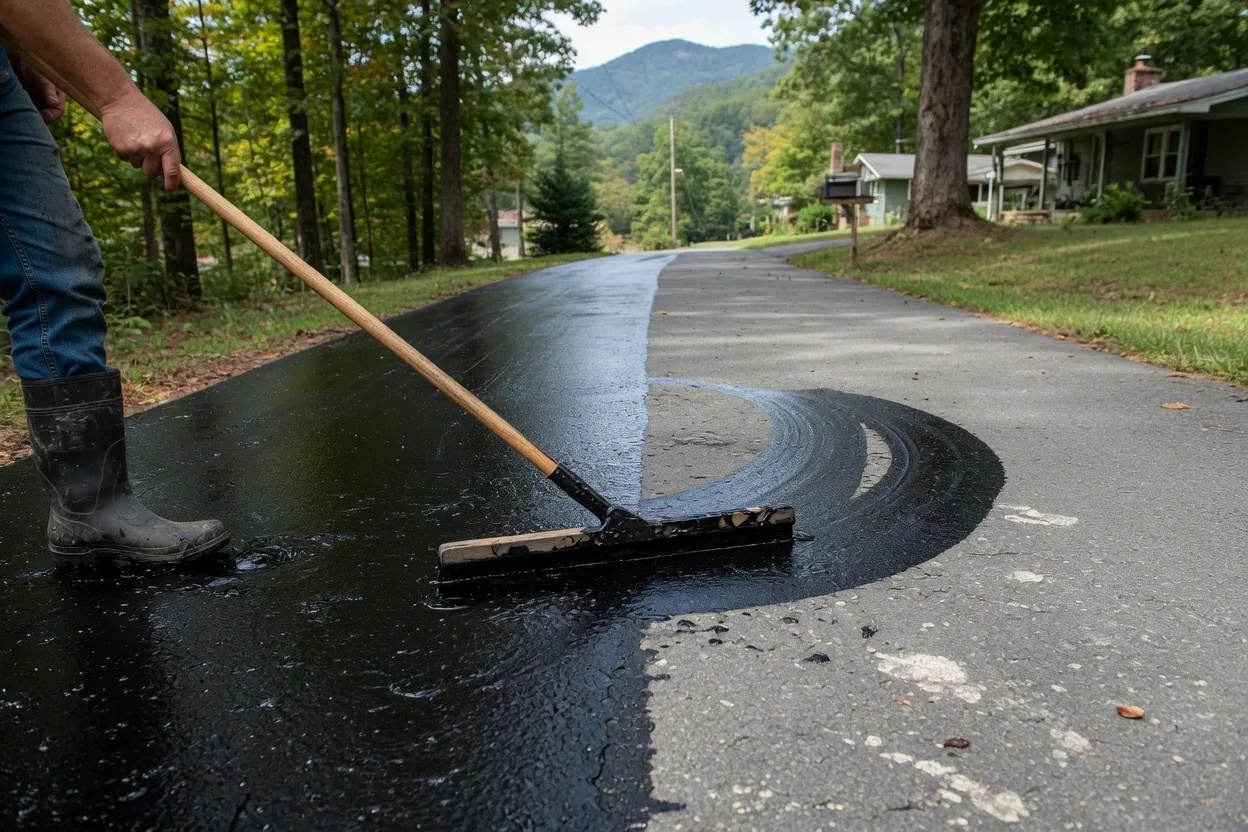
| Crack fill and sealcoat only | $350-$1,100 | Square footage, crack count, prep |
| Overlay over sound existing asphalt | $2,400-$5,600 | Thickness, edge milling, tonnage |
| New drive, 2-inch single lift | $3,200-$7,200 | Base depth, grade, access for equipment |
| New drive, two 2-inch lifts | $4,800-$9,800 | Tonnage, compaction time, slope |
| Heavy-use / truck-rated spec | $8,500-$16,000+ | Base design, 3-inch-plus mat, drainage |
Ranges assume reasonable equipment access. A drive a dump truck cannot back into changes everything.
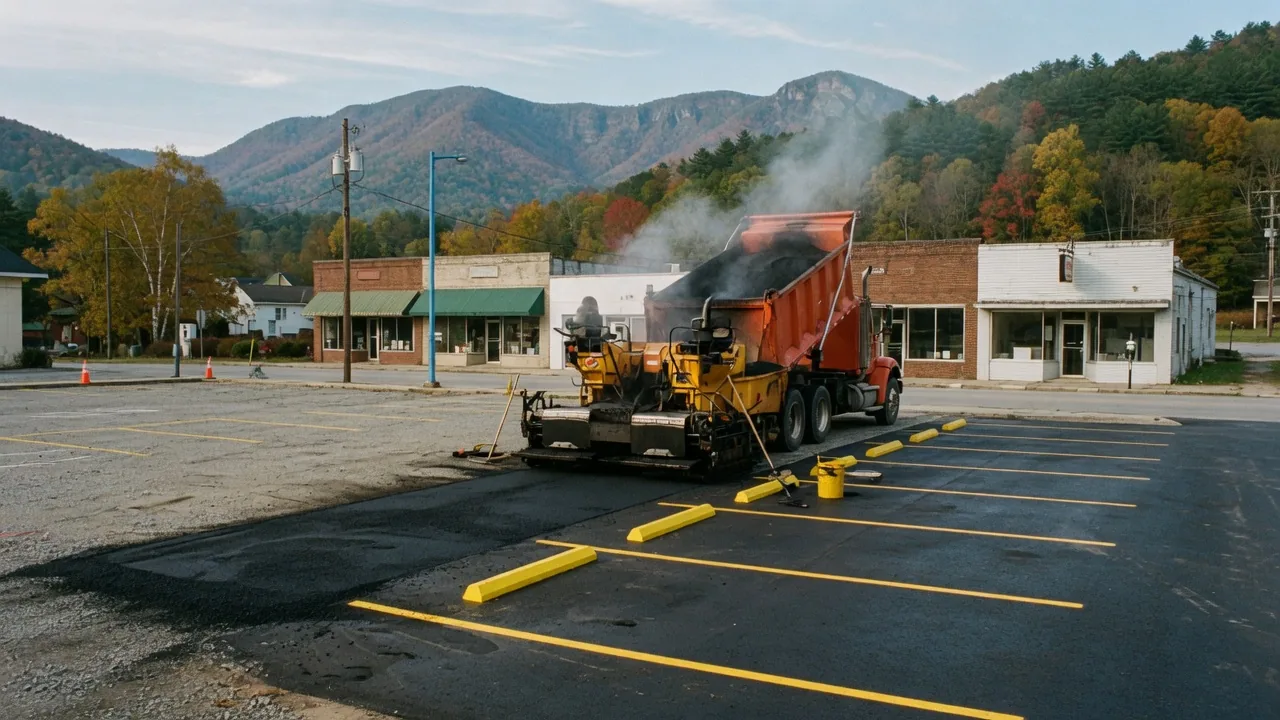
Access is the hidden variable that surprises homeowners most. A narrow hollow road, a bridge with a posted weight limit, or a steep switchback that a loaded dump truck cannot navigate means material gets staged at the bottom and shuttled up in smaller loads, adding labor hours and equipment wear to the bid. In the older parts of Hot Springs where lots were carved before modern equipment sizes were a consideration, this is the rule rather than the exception. A paver who has worked the tight residential pockets near the river knows to walk the access before pricing; one who has not will hand you a number and then ask for more once the truck shows up.
Water, storms, and the reason base work is not optional
Madison County's federal disaster record is a water record. 21 declared events touch this county over 1978-2026, and in this valley that means high water, saturated ground, and driveways that get undermined from below. Asphalt laid over a base that has already been washed out will crack within a season no matter how good the mix is.
That is why a real paving scope starts with drainage: where the water goes when it leaves the road, how the drive is crowned, and whether the culvert at the entrance is sized for the flow. The EPA's stormwater guidance treats runoff as a source problem, not a nuisance, and a driveway is a runoff surface. If your quote has no drainage line item and you have ever watched water cross your drive in a storm, the quote is incomplete, not cheap.
On the steepest hollows, drainage design sometimes means a cross-slope or a water bar that interrupts the sheet flow before it gains volume and velocity. A drive that drops 30 or 40 feet over its run behaves like a small stream during a heavy rain, and asphalt edge that lacks stone shoulder support will unravel from the outside in. The repair pattern is predictable: first a crack at the edge, then a void under the mat, then a pothole where the base has migrated downhill. Addressing drainage at the design stage costs a fraction of what reconstructing a failed base costs later, and in this county, the storm history makes that math difficult to argue with.
Permits, right-of-way, and the NCDOT question
If your driveway meets a state-maintained road, the entrance is regulated. NCDOT controls driveway connections and issues the access permit, and the application process runs through NCDOT Connect. This matters in Hot Springs because much of the through traffic runs on state routes, and a widened or relocated entrance can require a permit before a single ton of asphalt is placed. Skipping that step is the fastest way to a stop-work order and a re-do.
For the paving contract itself, North Carolina sets a dollar threshold above which a general contractor's license is required — the licensing rules live at the NC Licensing Board for General Contractors. Ask any paving outfit how they handle the threshold. The answer tells you whether you are dealing with a licensed operation or a crew that hopes you never ask.
There is also a right-of-way dimension that catches homeowners off guard. The paved apron where your drive meets the state road sits partly on NCDOT right-of-way, and modifications there — widening the throat, changing the culvert, altering the slope of the apron — can trigger a permit requirement even if the rest of the drive is entirely on your property. A contractor who understands the process will flag this early and handle the paperwork as part of the scope. One who does not may complete the work and leave you to discover the permitting question when you next sell the property or when a road crew comes through. Confirm which road you are on before work starts, because the answer changes both the paperwork and the timeline.
Reading a Hot Springs paving quote like a local
Three questions separate a real bid from a number on a business card. First: how many tons, and at what compacted thickness per lift? A quote without tonnage is a guess. Second: what happens to the existing material — is it being removed, graded, or paved over, and does the base get compacted in lifts? Third: who pulls the permit if the entrance touches a state road?
Then walk the drive with the estimator and look at where the water stands after a rain. If he does not look at that, he is pricing a surface, not a driveway. When you are comparing bids, our Hot Springs paving contractor guide covers what to ask and what a complete scope includes, and the asphalt driveway overview explains the mix and thickness options in plain terms.
Pay attention to the season the work is scheduled. Asphalt needs warm, dry conditions for proper compaction, and in this valley, a crew that tries to lay mix on saturated ground in early spring is setting you up for a mat that never reaches density. The best work here happens in a window when the base has had time to dry and the air temperature supports the mix. A contractor who tells you that honestly — even if it means waiting a few weeks — is worth more than one who promises to start tomorrow regardless of conditions. Scheduling around weather is not delay; it is the difference between a driveway that lasts fifteen years and one that needs overlay in five.