Two inches or three: what actually drives it here
A lot in Mars Hill is not a lot in Weaverville, even though the asphalt comes out of the same plants. The deciding variables are elevation and axle load. At roughly 2,300 feet, Mars Hill sits in a freeze-thaw band where water enters the surface, freezes overnight, and pries the mat apart from the base by spring. A 2-inch mat over a marginal base survives that cycle for a few seasons; a 3-inch mat over a corrected base survives it for a decade. And because US 19 and NC 213 feed the town, any lot serving delivery trucks, church buses, or a gravel-hauling outfit is carrying loads a residential driveway never sees.
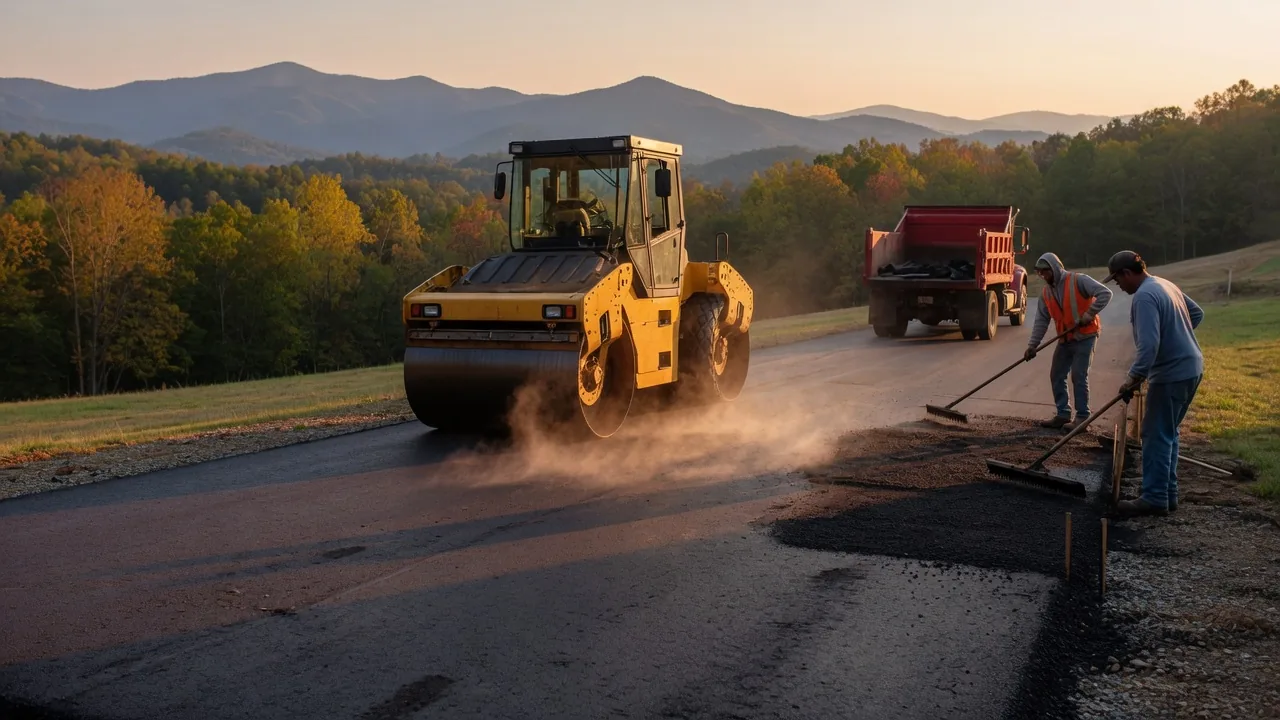
That pushes most commercial lots here toward 3 inches compacted — either placed in two 1.5-inch lifts or one 1.5-inch base course topped with a 1.5-inch surface course. A single 3-inch lift laid in one pass is nearly impossible to compact to density, and poorly compacted asphalt is the single most common reason a new Mars Hill lot looks tired in three winters. Two lifts, rolled hot, is the standard that holds. Residential driveways are a different animal, and the Madison County driveway cost breakdown covers that scope separately.
The scope-to-price table
These are working ranges for Mars Hill and the surrounding Madison County terrain, not quotes. Site access, base condition, and how much of the subgrade has to be rebuilt move the number more than any other factor. Contractor mobilization also matters here — Mars Hill is a haul from the mixing plants, and trucking time lands in every bid whether it is itemized or not.
| Scope | Typical range | Notes |
|---|---|---|
| Crack fill & sealcoat only | $0.20–$0.40/sq ft | Maintenance, not repair — hides nothing structural |
| 1.5-inch overlay (mill & fill patched areas) | $1.50–$2.25/sq ft | Only over a base that is still sound |
| 2-inch overlay, two lifts | $1.75–$2.75/sq ft | The common commercial refresh |
| New construction, 3-inch compacted | $3.00–$4.50/sq ft | Includes graded base and two lifts |
| Full-depth base rebuild (soft spots) | $4.00–$8.00/sq ft | Where subgrade fails, asphalt alone is wasted money |
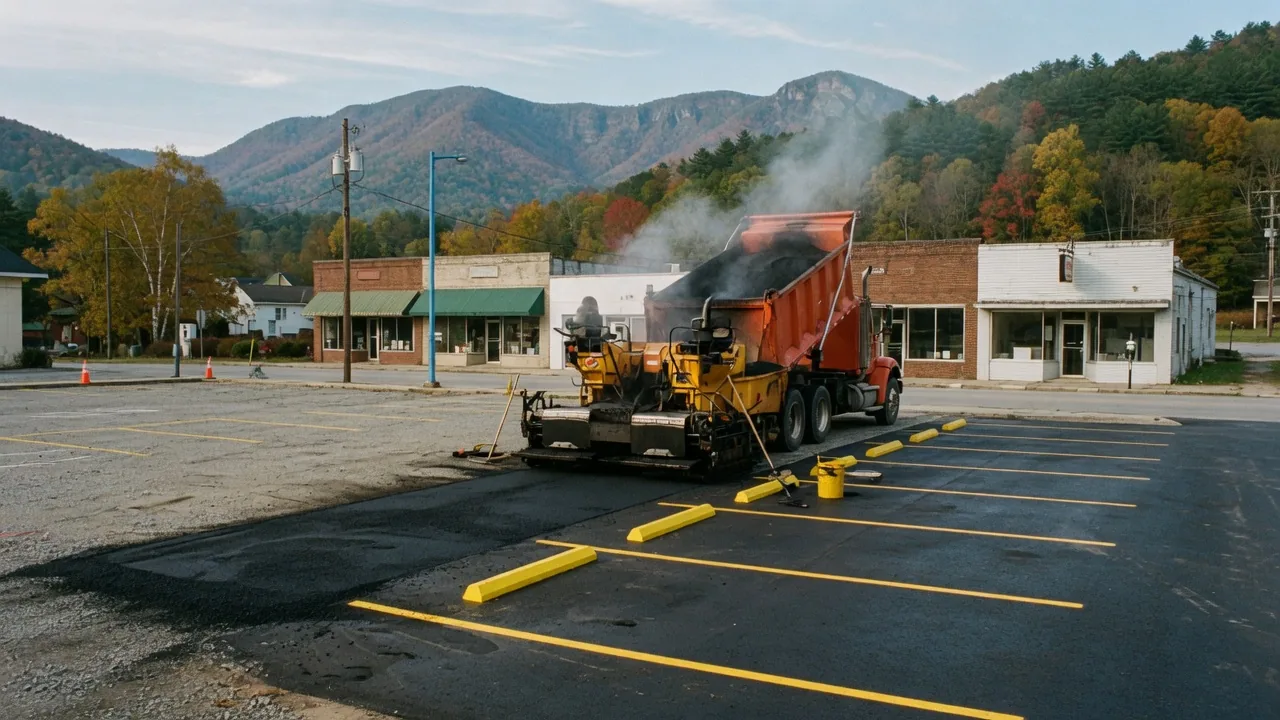
| Striping & wheel stops | $0.10–$0.30/sq ft | Set after the mat cures, not the same day |
Any bid that quotes new asphalt over failed base without addressing the base is selling you a temporary surface. Ask what happens to the soft spots.
Mix design and the plants that serve this end of the county
Mars Hill lots get surface-course mix from plants west and north of Asheville, and the mix design matters as much as the thickness. A standard NCDOT-approved surface mix with a proper binder grade handles the seasonal swing; a bargain mix cut with excess recycled asphalt can look fine at laydown and ravel within two winters. Ask what binder grade the mix is specified at for this climate zone, and ask for the plant ticket. Reputable crews hand it over without flinching.
Drainage is the second half of mix performance. Water that ponds on a Mars Hill lot in January will be an ice sheet in February and a pothole field by April. Slopes, swales, and where the runoff daylights all have to be graded before the first lift goes down. When the project touches stormwater discharge or a drainage way, the NC Department of Environmental Quality is the agency with jurisdiction, and any work that changes a driveway connection to a state-maintained road runs through NCDOT permitting before a single load of asphalt arrives.
Turning loads, tight downtown radii, and where lots fail first
Mars Hill's commercial core has tight parking entries and older lots laid out for smaller vehicles than what parks there now. When a box truck or a bus turns across a 2-inch mat on a warm day, the mat scuffs and shoves; when it turns on a cold morning, it cracks. The failures cluster exactly where you would predict — entry aprons, dumpster pads, drive-through lanes, and any corner where drivers cut the wheel while stopped.
The fix is not more thickness everywhere. It is thicker asphalt and a heavier base at the turning zones, and standard thickness in the straight runs where cars just roll. A crew that bids one uniform section across the whole lot either did not walk it or is pricing convenience. A crew that prices the high-load zones separately understands what actually wears out first.
Water, freeze-thaw, and the record behind the bids
Madison County sits in a storm-and-flood family of federal disaster declarations — 21 declared events touch this county across 1978-2026. Each one rearranged drainage somewhere: a culvert that used to carry the runoff now does not, a hillside that used to shed water now seeps at the toe of a lot. That history is why a paving bid in this county that ignores drainage is incomplete rather than competitive.
Paving is a licensed trade in North Carolina once the job crosses the threshold the NC Licensing Board for General Contractors sets, and commercial lot work generally crosses it. Ask for the license, ask for the base preparation plan, and ask what happens to the water. The answers tell you whether you are buying asphalt or buying a surface that will be asphalt again in five years.
Reading a Mars Hill paving bid
A complete bid for a lot in this town should state the compacted thickness per lift, the number of lifts, the base preparation scope, the mix specification, the drainage plan, and the striping scope as a separate line. Vague bids — a lump sum and a start date — leave everything negotiable after the trucks are on site, which is the wrong time to negotiate.
When you are comparing crews, the Mars Hill paving contractor guide walks through what to ask and what a good answer sounds like. If you are still deciding between repairing and replacing, the parking lot paving overview covers the decision framework. For a town this size, the difference between a lot that lasts eight years and one that lasts twenty is usually a couple of inches and a conversation about water — not the headline price per square foot.