Where the rain goes decides what you pay
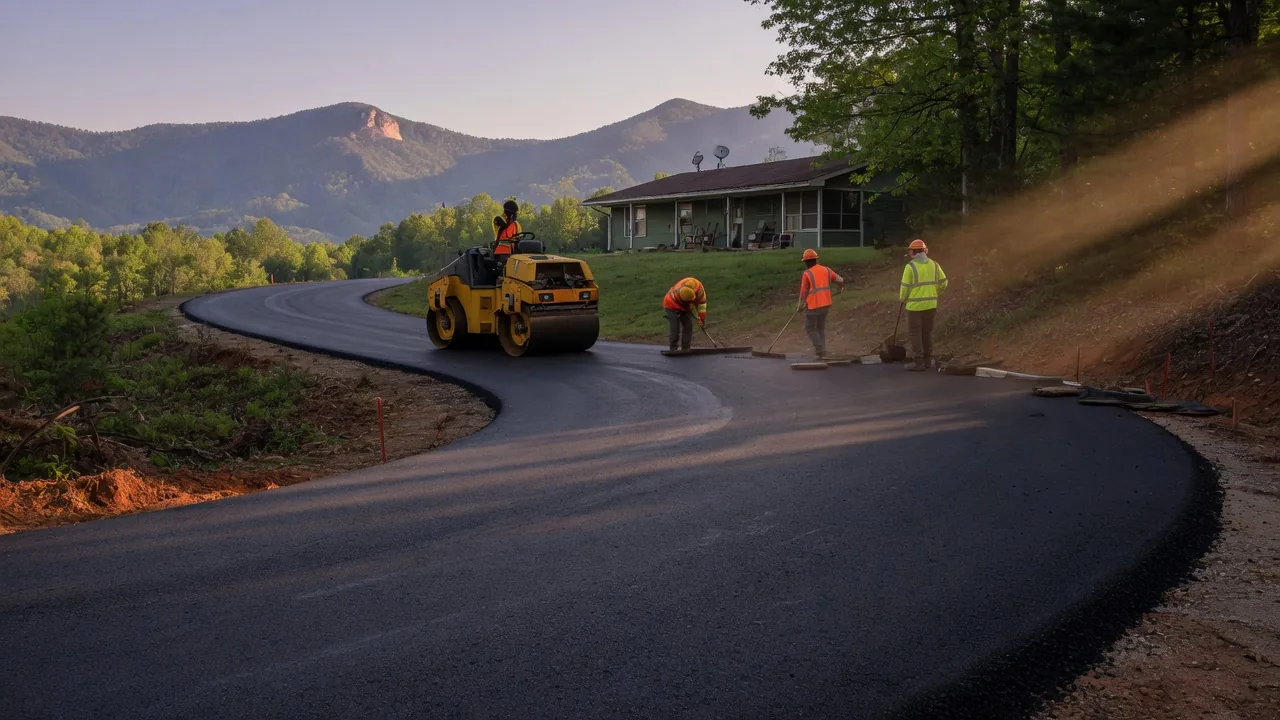
Stand at the bottom of almost any driveway cut into a Buncombe County hillside and you can read the whole job before a contractor pulls in. Rain that lands on the upper slope runs downhill along the surface, and the driveway is the path of least resistance. If the crown is too flat, the edges are lower than the surrounding grade, or the ditch below the cut bank has nowhere to discharge, that water sits on the asphalt, seeps into the base, and starts the freeze-thaw cycle that cracks a mountain driveway long before a flatland one.
This is why two neighbors on the same ridge road can get bids thousands of dollars apart. One lot sheds cleanly to a daylight ditch at the road; the next one has a low spot at the garage apron that holds a puddle for two days after every storm. Around Asheville, 19 federally declared disaster events have touched the county over 1973-2026, most of them storm and flood related. That record is why grading and drainage get priced into the job here, not treated as an afterthought. The full breakdown of asphalt driveway cost per square foot shows the same pattern in miniature: base prep and grading are the line items that swing, not the blacktop itself.
Terrain here is not a single condition. A lot off a valley floor in Weaverville or Fletcher might have nearly flat ground with a high water table after a wet spring. A lot up a Swannanoa or Fairview hollow might drop twelve feet from the road to the house. Those are two entirely different drainage problems, and they get two entirely different price tags even when the square footage matches. On the valley lot, the risk is water rising from below and softening the subgrade; on the hollow lot, the risk is water racing down the surface and stripping the mat off the base. A contractor who asks which direction the lot faces and where the nearest creek sits is reading the same clues you can.
One more local wrinkle: our clay-heavy subsoils in the county hold water and swell, then shrink in a dry August. That movement telegraphs straight up through a thin base. This is why base depth gets asked about first on a Buncombe bid, not last. If the subgrade is soft clay and the contractor is planning to lay asphalt directly on it, you are paying for a driveway that will rut within a few winters.
What Buncombe County homeowners actually pay
Residential asphalt work in this county is priced per square foot of finished surface, but the total climbs with every foot of cut, fill and drainage you add around it. Expect a working range rather than a quote until someone has walked the slope.
| Scope of work | Typical Buncombe range | What drives it |
|---|---|---|
| New driveway, gentle grade, good base | $3,500 – $7,500 | square footage, base depth, number of lifts |
| New driveway, steep lot with retaining | $8,000 – $20,000+ | cut and fill, wall height, culvert, switchback layout |
| Overlay on sound existing asphalt | $2,000 – $5,000 | surface condition, cracking, edge repair, thickness |
| Full removal and replacement | $5,000 – $14,000 | haul-off, base rebuild, drainage correction |
| Culvert, ditch or French drain tie-in | $1,200 – $6,000 | length, pipe size, rock, outlet location |
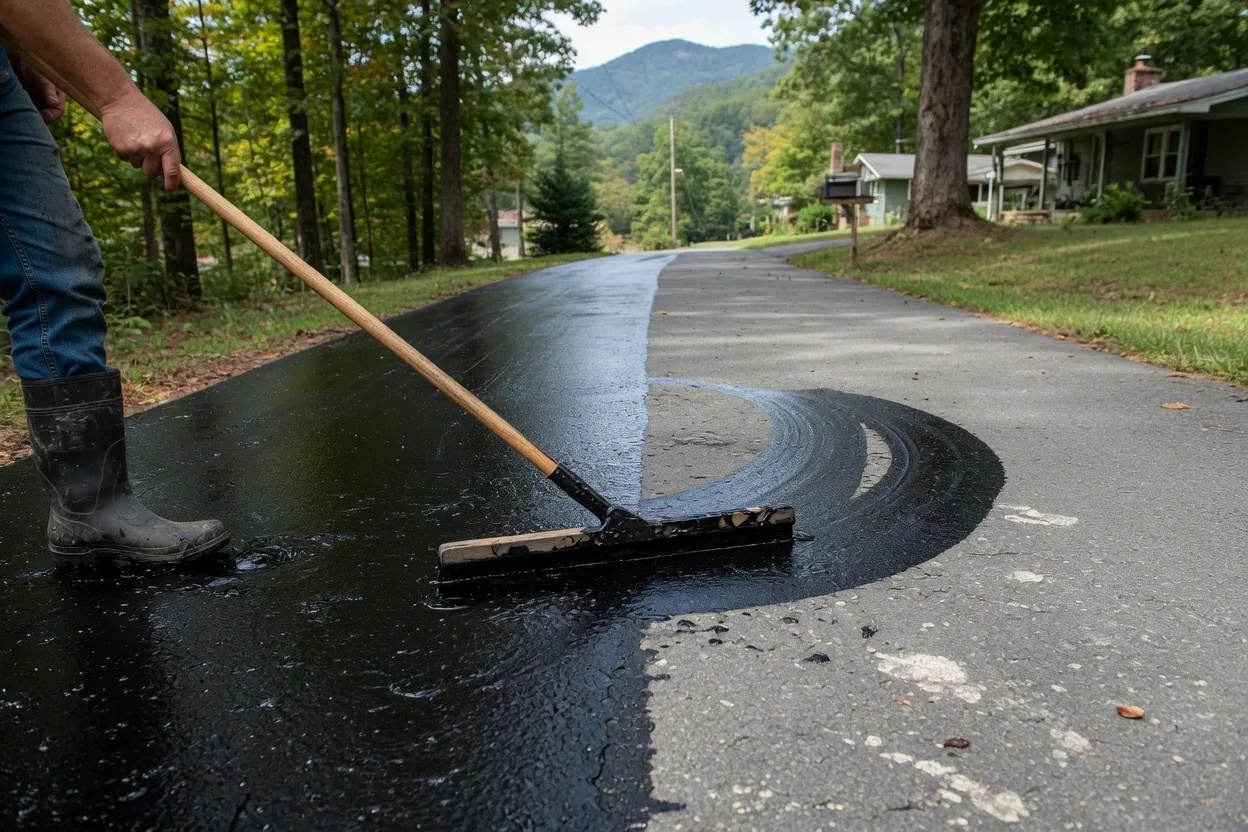
| Sealcoat (maintenance, not structural) | $400 – $1,200 | area, cleaning, crack filling before coat |
Those numbers assume a paved surface with proper compaction. A crew that quotes a firm price before seeing how your lot drains is quoting the driveway they wish you had.
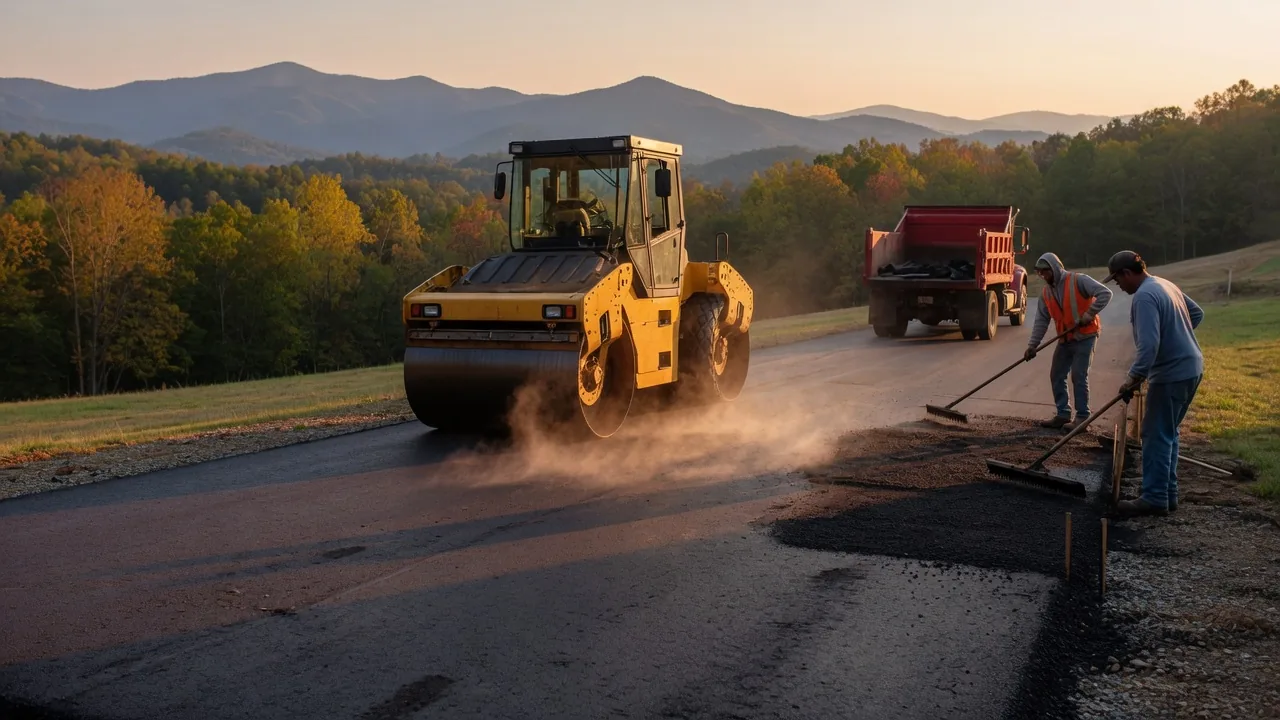
Two real-world patterns worth knowing. First, the cheapest bids in the county usually come from crews that skip the fabric or geotextile layer on soft subgrade. That omission saves a few hundred dollars up front and shows up as a rutted drive three winters later. Second, mountain lots with a switchback or a long run often cost more than the square footage suggests, because the paver has to run a smaller machine and lay the mat in shorter pulls. The equipment cost per ton goes up on a tight grade. A driveway that looks simple on a satellite map can be one of the hardest lays in the county.
Why the crown, edges and ditch carry the job
A driveway is a drainage structure that happens to be driveable. Three details do the heavy lifting on a Western North Carolina slope:
- The crown. A slight center crown sheds water to both edges before it can pond. On a steep run, the crown has to stay consistent the whole length, or water channels into the low side and starts pulling the mat apart.
- The edges. Asphalt needs shoulder material holding it in place. When the edge drops below the adjacent grade, runoff undercuts the base and the corner breaks off. On a cut bank this happens fast.
- The ditch or swale. Above the driveway or along the uphill edge, a shallow ditch collects sheet flow and carries it to a daylight outlet. If that outlet is a culvert under the drive, the pipe has to be sized for the storm that actually shows up here, which the National Weather Service records show is a real budget consideration in the mountains.
Get all three right and an asphalt drive in this county holds up for decades. Get one wrong and you are repaving the same section every few years. The same water logic is why so many homeowners weigh asphalt versus concrete on steep lots, since concrete cracks differently when the base moves.
Look at a well-built driveway in the county and you can often see the engineering from the road. There is a shallow grassy swale running along the uphill shoulder, rock lining the steeper sections, and a culvert headwall where the water crosses under. The driveway itself sits slightly proud of the surrounding dirt, so runoff leaves the surface instead of pooling at the edge. Compare that to a failed drive nearby: the edges are lower than the yard, the asphalt is stained dark with trapped moisture, and there is a permanent low spot just below the garage door. The difference between the two is rarely the asphalt mix. It is whether someone thought about water before they laid the mat.
On a lot with a cut bank above it, the ditch on the uphill side is doing more work than the driveway itself. Sheet flow from a steep bank picks up speed fast, and if that water is allowed to run across the driveway surface, it scours the edges and carries grit into the culvert. A properly sized ditch intercepts the flow before it reaches the pavement and turns it into a controlled channel. That is a small line item on the bid and the difference between a driveway that lasts and one that gets patched every spring.
Permits, codes and who is allowed to do the work
In North Carolina, the asphalt surface itself does not trigger a building permit, but work that touches the road, a stream buffer or the storm drainage system does. If your driveway connects to a state-maintained road, you need a driveway permit from the NCDOT, and the culvert size and sight-distance requirements come with it. If the lot has a creek, ditch or mapped floodplain near the driveway, grading near the water falls under state rules administered by the NC Department of Environmental Quality. Locally, Buncombe County enforces its own land development and erosion control ordinances, and the state building code is set by the NC Building Code Council under the Department of Insurance.
On the contractor side, general contracting work in North Carolina is regulated by the NC Licensing Board for General Contractors. Paving is not a licensed trade by itself the way electrical or plumbing is, so the credential to check is whether the contractor pulling a structural job is properly licensed for the scope. Ask for a certificate of insurance and a written scope before work starts.
Two county-specific notes. First, a lot of the unincorporated county and the city of Asheville sit in the French Broad River watershed, which means stormwater rules can apply to larger impervious surfaces. If your new driveway adds significant paved area, the local stormwater ordinance may require a treatment or detention element. That is a design cost, not just a permit fee, and it belongs in the bid. Second, if your driveway crosses a known floodplain, you may need floodplain development approval before you move any dirt. These are not obstacles so much as facts of building in a county defined by its river bottoms and its ridges.
How to keep a paving bid honest
Three questions separate a real price from a lowball here:
- How deep is the base, and what is it made of? On a slope, base depth and stone size are the difference between a driveway that lasts and one that ruts. Get it in writing.
- Where does the water leave the property? A bid that does not name an outlet for your runoff is unfinished.
- How many lifts, and what compaction? Two compacted lifts of the right mix outperform one thick pour every time, especially on a mountain grade.
If a bid lands well outside the table above, ask why. Sometimes there is a real reason, like a failed culvert or a cut bank that needs a wall. The answer tells you whether the contractor understands your lot. For the maintenance side, our guide to asphalt driveways covers sealcoat timing, patching and when overlay beats replacement.
Other practical checks. Ask to see a similar driveway the crew poured a few years ago, ideally on a slope like yours, and go look at it after a rain. Ask whether the quote includes hauling off old asphalt or just stacking it on site. Ask what happens if they hit rock during excavation, because in this county they might, and a bid that does not address rock can turn into a change order fast. Finally, get the payment schedule in writing and never pay in full before the final lift is compacted and the edges are dressed. A driveway is not done when the truck leaves; it is done when the water runs off it the way the plan said it would.