What Mills River pavement actually looks like
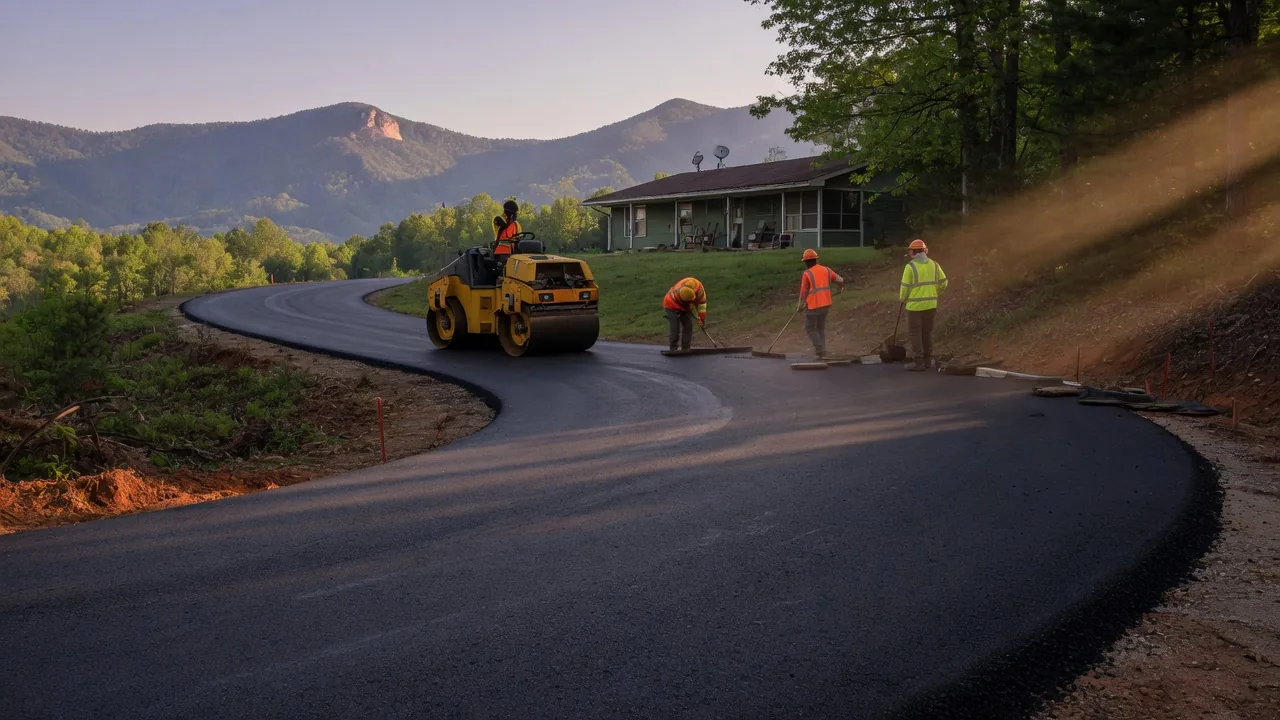
Mills River is horse country with a highway running through it. That single fact drives the resurfacing market here. Driveways off Banner Farm Road, School House Road, and the side lanes that run back toward the French Broad bottoms are often 300, 600, or 1,200 feet long — three to ten times a typical Asheville city driveway. A resurfacing job here is measured in tons, not patches.
Three other local patterns matter. First, tree cover: wooded lots along the river corridor drop leaf litter and hold shade, so pavement stays damp longer and oxidizes unevenly. Second, grade: dairy-and-farm history left many lots with a crown, a dip at the culvert, or a short steep run down to a barn pad. Third, mixed age — a 1990s subdivision off Ray Hill Road may sit a quarter mile from a working farm lane laid decades ago. That mix is why a single per-foot number never survives contact with a Mills River measure.
Compare that to a typical Asheville city lot off Merrimon Avenue, where a driveway is short, flat, and hemmed in by curbs. Here, the drive is often the longest paved surface on the property. A half-mile private lane serving three houses is not unusual off North Mills River Road, and those shared drives raise questions about who pays for what and how a contractor accesses the whole run without blocking a neighbor. The pavement itself tells the story: older farm lanes tend to be thinner, with a gravel shoulder that has crept into the edge over the years, while newer subdivision drives are wider, cleaner-edged, and more likely to have a proper culvert. A resurfacing plan has to respect both.
The Henderson County resurfacing price picture
Henderson County sits in the middle of the Western North Carolina cost band — below Buncombe County metro pricing, above the smaller mountain counties. Below is what the scope rows actually look like when a contractor walks a drive and measures. See the fuller breakdown on the Henderson County asphalt cost page for the line items that move price most.
| Scope | Typical range | What drives it |
|---|---|---|
| Patch + seal a short drive (<800 sq ft) | $650–$1,600 | Crack count, sun exposure, color |
| Standard subdivision drive resurface (1,000–2,000 sq ft) | $2,200–$5,000 | Edges, culvert tie-in, drainage |
| Long farm or estate lane (3,000–8,000 sq ft) | $6,500–$18,000 | Ton count, access, turn pads |
| Full drive replacement (tear out + base) | $4.50–$9.00 per sq ft | Base condition, haul distance, subgrade |
| Mill-and-overlay (grind + repave) | $3.25–$6.50 per sq ft | Depth, transitions, drainage reset |
Two honest cautions. Resurfacing is not a fix for a driveway that has settled at the culvert, broken into alligator cracking, or sunk into a soft spot near a barn or turn pad — those need base repair first, or the new lift will crack within a season or two. And prices swing with asphalt binder and haul distance; a quote that is months old should be re-confirmed before you sign.
Long lanes also change the math on mobilization. When a paver has to travel twenty minutes up a winding road and then set up on a narrow farm entrance, that setup cost gets spread over far more square footage than it would on a city driveway. A short drive in a Mills River subdivision may hit the low end of the range simply because the crew can be in and out in a morning, while a 1,200-foot lane with two turn pads and a culvert crossing takes a full day of prep before any asphalt shows up. That is the honest reason two neighbors with similar-looking pavement can get bids that are thousands apart.
Water, grade, and the culverts that run the show
Almost every Mills River resurfacing problem traces to water. The French Broad and its tributaries shaped this valley, and the federal record is the plainest evidence that water arrives here in volume: 16 declared events touch Henderson County across 1978-2026, overwhelmingly storm and flood family. Driveways that drain badly show it faster here than on a flat city street — a low spot at the culvert, a driveway pitched back toward the house, a swale that has silted in since the last big rain.
The National Weather Service maintains the flood and rainfall outlook for this region at weather.gov, and any resurfacing bid should treat drainage as a first-class line item, not a suggestion. If the drive pitches the wrong way, no amount of new asphalt fixes the problem — it just moves the puddle to next spring's seal-coat failure. Good crews correct grade, clear or replace culverts, and cut a positive slope before the paver arrives.
Consider a typical sloped entry off a road that climbs away from the river bottoms. Water sheet-flows off the hillside above, crosses the drive, and if the culvert is undersized or crushed, it pools at the apron and seeps under the pavement. Over a couple of winters, that subgrade softens, the asphalt settles, and cracks open along the wheel tracks. Resurfacing over that without fixing the culvert is money spent to watch the same failure return. On flatter farm lanes near the river, the opposite problem shows up: the drive sits low, the water table is high after spring rains, and the edges stay saturated. Both cases push a contractor toward base repair and drainage work rather than a simple overlay, and both are why a bid that skips the water conversation should be treated with suspicion.
Permits, licensing, and the driveway tie-in
Two rules that trip up homeowners here. First, if the drive connects to a state-maintained road — and many Mills River lanes do — modifying the driveway apron or culvert requires an NCDOT driveway or encroachment permit. Applications and thresholds are at NCDOT Connect. Second, larger paving and grading jobs cross the state licensing threshold, which the NC Licensing Board for General Contractors publishes — worth checking before you sign on a long farm lane or a shared private drive serving more than one residence.
Neither is frightening. They just mean the qualified contractor already knows to ask about the connection point, and the wrong one doesn't. When you're ready to compare bids, the Mills River paving contractors page covers how to vet a crew on this terrain, and asphalt resurfacing explains the process in plain terms.
Stormwater rules are the quieter third piece. Henderson County and the state both care about how runoff leaves a site, and a resurfacing job that adds impervious surface or redirects flow toward a neighbor or a creek can run into environmental review. The NC Department of Environmental Quality publishes the stormwater and sediment guidance that applies here, and a contractor who has worked the river corridor will already know when a simple overlay crosses into a grading permit. For most homeowners resurfacing an existing drive in place, none of this is triggered — but if the project involves widening, regrading, or a new culvert, it is worth a five-minute check before the first load of asphalt is ordered.
Scheduling and what a good bid looks like
Paving in Western North Carolina is a warm-weather trade — most resurfacing here runs from late spring through early fall, with the shoulder months of April and October living on weather bets. A serious bid for a Mills River drive should always include: a measured square footage, the planned lift thickness, base-repair scope stated separately, drainage and culvert adjustments as their own line, edge treatment, and a stated timeline for sealing after the overlay cures.
Anything thinner than that is a phone estimate dressed up as a proposal. Long farm lanes especially deserve a walk, not a number over the phone — nobody can price a quarter-mile of shaded drive off a satellite image.
Ask the contractor how they handle the transition where a new overlay meets an older surface, because on a long lane with multiple sections poured at different times, that seam is where trouble shows first. Ask whether they will tack the existing surface before the overlay, and ask what they plan to do about the edges, since a farm lane without defined edges tends to ravel. A crew that answers these questions without hesitating has probably resurfaced a dozen drives just like yours in the river bottoms and off the ridge roads above town. One that can't is still learning the terrain at your expense.