What's under the asphalt sets the real price
Drive a private road anywhere from Weaverville out toward Leicester and you will see the same thing under a failing surface: hot mix laid directly on compacted red clay, or on a thin lift of gravel that has pumped full of fines and stopped draining. Asphalt is only the wearing course in a road structure. If the subgrade moves, the pavement cracks within a couple of seasons no matter how good the mix.
That means the honest question on any private road quote is not "how much per ton of asphalt," but "how many inches of crushed stone, and do we need to stabilize the clay first?" On a sound stone base, a new surface course can be a straightforward overlay. On old gravel that has lost its binder, the road may need a full re-section: scarify, add base, compact in lifts, then pave. The same hundred feet of road can swing thousands of dollars between those two realities.
Buncombe County's terrain makes that base question sharper than it is in the flatlands. Roads here climb ridges, cross spring seeps, and follow old farm lanes that were never engineered for anything heavier than a pickup. A road cut into a north-facing slope above the French Broad floodplain stays wet far longer than one on a sun-exposed south grade, and that moisture sits in the clay subgrade until the whole structure loses bearing. When we talk about the base, we are really talking about how the road handles water it cannot avoid.
Look at what actually sits under the surface on a typical Weaverville or Leicester private road. There are three common conditions. First, native red clay that was graded and compacted but never capped with stone — it holds water, swells in a wet spring, and shrinks in a dry August, cracking anything laid on top. Second, decades-old gravel that has been re-graded so many times the fines have risen to the top and the section no longer drains. Third, old fill placed when a house pad was cut into a slope, which may have been dumped rather than compacted in lifts. Each one needs a different answer before asphalt.
Private road paving cost in NC: what each layer runs
Ranges below reflect working numbers for private roads in the Asheville area, priced per square yard so you can compare bids against actual measured area rather than a lump sum. They are not quotes; soil, grade, and access decide the final figure.
| Scope of work | Typical range (per sq yd) | What drives it |
|---|---|---|
| Overlay on sound existing base | $4.50 – $7.00 | surface thickness, prep and cleaning, edge work |
| New base plus hot-mix surface | $7.00 – $9.50 | stone depth, subgrade stability, haul distance |
| Base correction only (gravel, no paving) | $2.00 – $5.00 | how much unsuitable clay gets removed |
| Subgrade stabilization under new road | $1.50 – $4.00 | clay depth, moisture, whether fabric or lime is used |
| Steep-grade or tight-access premium | adds 15% – 40% | hauling, paving equipment reach, drainage structures |
A road running uphill to a ridge lot pays more at every line because trucks and the paver work slower, and because a steep grade demands better drainage detail or water will cut the road apart from underneath. If your road is shorter or a driveway rather than a through route, our asphalt driveway cost per square foot page breaks the math down in the units most homeowners already think in.
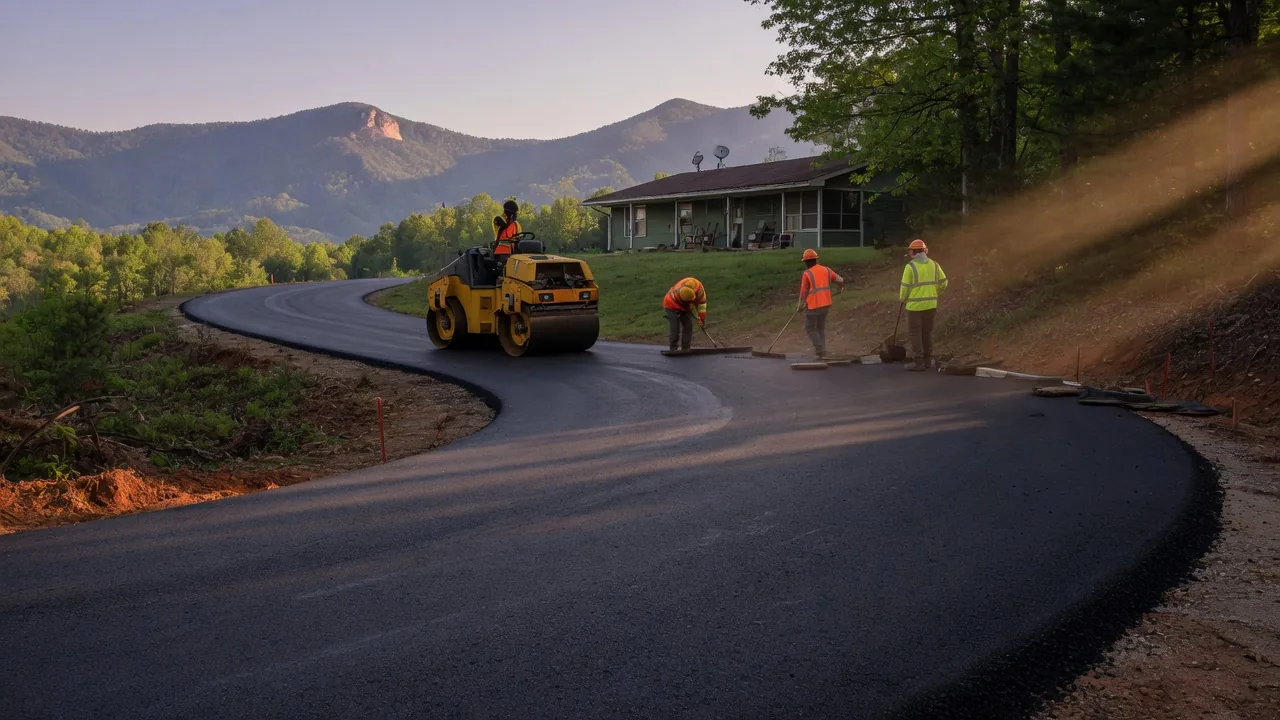
Stone placement itself is where labor hours hide. On a flat lot, a crew can tailgate crushed stone and compact it in long straight pulls. On a switchback drive in the Bent Creek or Riceville area, the same tonnage has to be placed in short lifts, feathered around curves, and compacted with a roller that may not fit where a tri-axle can reach. That is why the base rows in the table carry so much range: the material is a commodity, but placing it well on a mountain road is not.
Why the ground here punishes shortcuts
Buncombe County sits in a wet, steep, clay-heavy corner of the state, and the record backs up what every road builder here knows: this county has been touched by 19 federally declared disaster events spanning 1973-2026, most of them tied to storms and flooding. Every one of those events is a reminder that water is the primary destroyer of private roads in these mountains. It runs off the uphill side, saturates the clay subgrade, and turns a base course into a sponge. Then traffic pumps the fines up through the stone and the road starts to fail from below.
The practical fix is almost always drainage before pavement: crown the road so it sheds, ditch the uphill side, and add cross-drainage where the grade changes. Skipping that step to save money on the front end is how a freshly paved road cracks its first winter. The paving itself is the last thing that should happen, not the first.
Freeze-thaw is the other quiet enemy. In a Buncombe County winter, a shaded grade can freeze at night and thaw by mid-morning for weeks at a time. Water trapped in the base expands when it freezes and pushes the stone apart, then drains away as it thaws, leaving a void. Repeat that cycle and the base loses its interlock. A thicker, well-graded crushed stone section tolerates that cycling. A thin, poorly drained one does not, and hot mix laid over it just transmits the movement straight to the surface.
The National Weather Service forecast is not the only water signal to watch. The bigger issue is what the ground does weeks after a storm, when the clay is still holding moisture and trucks start using the road again. That is when ruts appear and the section begins to shear. A road builder who understands this schedules base work when the subgrade can be worked, not simply when the calendar says it is spring.
When a full asphalt road does not pencil out
Not every private road in this county needs hot mix, and saying so up front saves people real money. A long, low-traffic gravel road serving two or three homes often does better with a properly built stone section plus a tar-and-chip surface, which costs less per square yard and tolerates the freeze-thaw cycling on shaded mountain grades better than a thin asphalt lift. Our tar and chip driveway cost guide covers where that trade makes sense.
Where asphalt earns its price is on roads with steady traffic, steeper grades where loose stone washes, or stretches where dust and grading have become an annual chore. On those roads the higher material cost is buying longevity, not just appearance. If your road is one you will pave once and want to forget, the private road paving overview walks through how a proper full-depth build is sequenced, layer by layer.
There is also a middle path many mountain property owners choose: build the stone base correctly now, live with gravel for a season or two, and pave once the base has proven it drains. That staged approach costs more across two projects than doing it in one, but it lets a homeowner confirm the stone section is holding before committing to hot mix. On a long shared road serving several parcels, that kind of phasing is often the only way the neighbors can agree on a budget.
Licensing, access, and the rules that apply
Private road paving in North Carolina is construction work, and contractors doing it fall under the state licensing thresholds administered by the North Carolina Licensing Board for General Contractors once a job crosses the statutory limit. That matters to you for one reason: a paved road is a structural build, not a surface treatment, and the licensing line separates operations set up to do it correctly from those that are not.
Two other pieces routinely trip up private road projects here. First, work touching a public road or its right-of-way, including the connection point where a private road meets a state-maintained road, generally requires a driveway or encroachment permit from NCDOT. Second, any grading that changes how stormwater leaves the property can run into erosion-control rules administered by the state, so keep sediment on site during construction. Neither is usually a dealbreaker, but both should be answered before equipment shows up, not after.
The state's environmental rules deserve a closer look on steep ground. Grading that exposes bare clay on a mountainside can send sediment into a creek or the French Broad watershed if it is not controlled, and North Carolina DEQ has authority over sediment and erosion concerns that reach beyond the property line. A road builder working in Buncombe County should be able to explain how silt fence, check dams, and stabilized construction entrances will be placed before the first load of stone arrives.
Homeowners associations and shared-road agreements add a local wrinkle. Many private roads in the county serve multiple parcels, and any paving decision usually needs signed agreement from every owner on the road. That is not a government rule, but it is the practical gate that delays more mountain road projects than permits do. Sorting out who pays and how much before getting bids avoids a lot of heartburn later.
How to compare bids without getting burned
Three things separate a real private road bid from a lowball:
- Stone depth, in inches. A bid that names the stone section and its compacted depth is a bid you can trust. "New asphalt road" with no base detail is a warning sign.
- A drainage plan. Ask where the water goes on the uphill side, at grade changes, and at the road's outlet. If the answer is vague, so is the road's lifespan.
- Price by measured area. Get the square yardage and the per-square-yard number in writing. That keeps a change order honest if base problems turn up once the old surface is stripped.
Grade and access are the two wild cards nobody can price perfectly from the truck. If a bid lands far outside the ranges above, make the contractor walk you through why. Good ones will; the detail they give you is the best quality signal you will get before signing.
Ask how the contractor handles unsuitable material discovered under the existing surface. On a Weaverville or Leicester road, it is common to find a pocket of soft clay, an old stump hole, or a buried spring that nobody knew about until the base was opened up. A bid that names a unit price for that contingency — per square yard or per load — is a bid that will not blindside you with change orders later. A bid that says "we'll deal with it" is not.