Biltmore Forest lanes are shaped like the forest, not like a subdivision
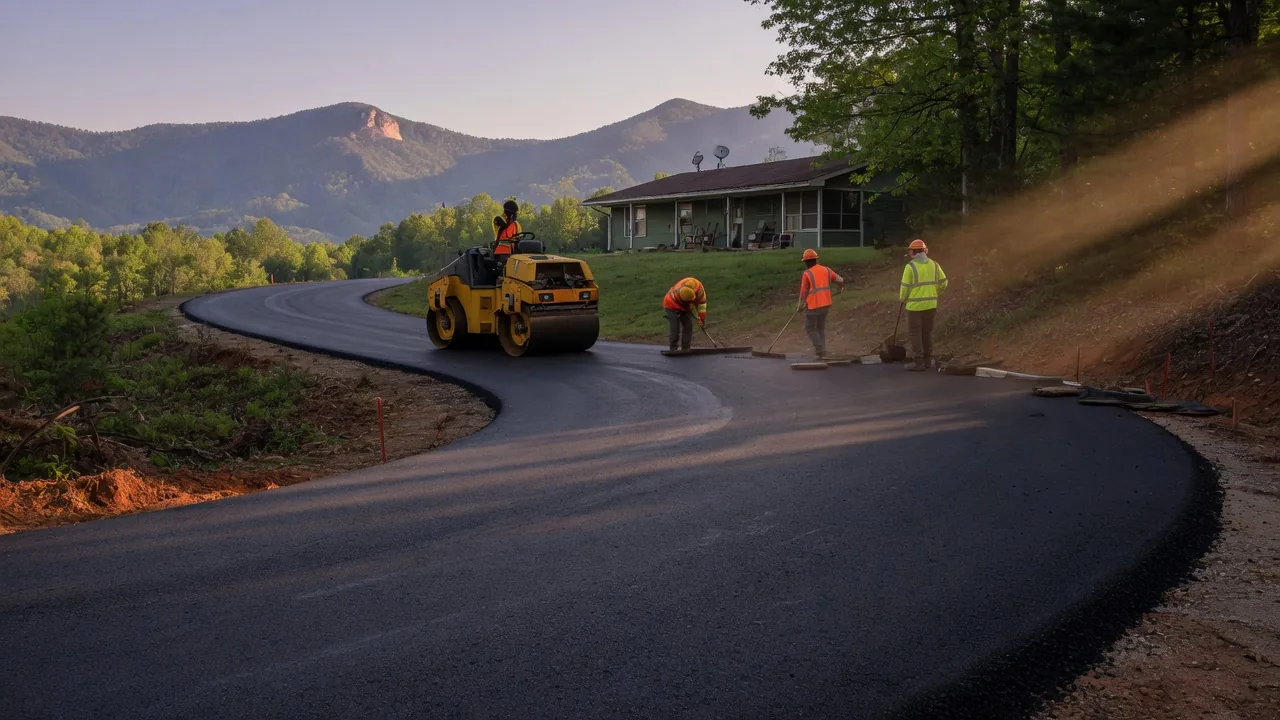
Drive a stretch of Vanderbilt Road or the lanes feeding off it and the pattern is obvious: the driveway is rarely a short, straight pad in front of a garage. It is a long, curving ribbon laid around old-growth hardwoods and rolling grade, sometimes shared as a private drive between two estate parcels. That geometry is what separates a Biltmore Forest paving job from a typical Asheville proper driveway. In the city grid, a crew can back a paver down a straight apron and be done. Here, every bend means hand work at the transition, extra edge restraint to hold the mat against the curve, and a machine that has to maneuver around trunks, low canopies, and tight turnarounds.
The pavement itself reflects the housing stock. A great deal of it is decades old and was poured wide, because these lots were built for long approaches rather than tight suburban parking. Resurfacing here is less about spreading a fresh coat and more about preserving a long asphalt ribbon that carries real share of the property's value. When a lane like that fails, it is not a cosmetic problem; it is the primary route onto the estate.
Shade is the other local factor. Dense mature canopy keeps the pavement damp long after a rain, and in the mountains west of Asheville that lingering moisture feeds the freeze-thaw cycling of a Buncombe County winter. Damp asphalt that freezes and thaws repeatedly cracks faster than sun-exposed pavement, which is why shaded estate lanes here often show raveling and crack networks earlier than their age would suggest.
The inspection that decides whether an overlay will hold
An honest resurfacing quote begins with the base, not the surface. Aged blacktop over firm soil can be renewed with a 1.5-to-2-inch overlay and hold for years. Failing asphalt over settled ground is a different animal; an overlay there hides the problem for a season and then inherits the failure. On a wooded Biltmore Forest lot, three conditions deserve a close walk before anyone prices anything: root-lifted edges where forest trees meet the asphalt, alligator cracking that signals a soft spot without enough base beneath it, and low spots that pond water long after the rain stops.
Those three are not cosmetic. Root heave lifts a slab and opens the joint where water enters. Alligator cracking means the base has lost load-bearing capacity and the new mat will crack in the same pattern within a year or two. Ponding points mean the grading is already sending water where it should not go, and an overlay laid over a pond simply raises the waterline. A contractor who quotes a number without walking the edges and poking a few soft spots is guessing.
Drainage is the second half of the inspection. On a graded lot, water should leave the pavement where grading and gutters direct it, not sheet across the lane into a neighbor's drive or a shared private road. Handling base repair and drainage correctly is what lets a resurfaced driveway reach its expected service life. Skipping either is how a driveway gets resurfaced twice in a decade.
How scope turns into a price band in Buncombe County
Paving in Biltmore Forest prices like the county it sits in, and the full Buncombe County cost breakdown carries the working table for comparison. Locally, the numbers shake out roughly like this:
| Scope | Typical range |
|---|---|
| Spot repair plus crack fill and sealcoat | $400–$1,200 |
| Single-lane driveway overlay, moderate prep | $2,500–$5,500 |
| Long estate lane, 1.5–2″ overlay with edge work | $6,000–$9,500 |
| Full-depth rebuild on failed base | $10,000–$18,000+ |
A driveway that looks identical to its neighbor can land in two different bands depending on how much repair sits underneath and how many linear feet of curving edge need restraint. That is why a phone estimate is nearly useless here. If a bid lands below the low end of the band matching your scope, the fair question is not whether it is a bargain; it is which line item was left out. Tack coat, edge restraint, depth of base repair, and disposal of milled material are the usual omissions, and each one shifts the real cost back onto the homeowner later.
For readers weighing overlay against rebuild, the resurfacing work itself is usually the lower-cost path only when the base passes inspection. When it does not, a rebuild is the honest recommendation, even though the number is larger.
The paper trail North Carolina expects on larger paving jobs
North Carolina draws a clear line at $40,000 on construction work, driveway paving included, above which a contractor must hold a license from the NC Licensing Board for General Contractors. Larger Biltmore Forest estate projects cross that threshold, so ask for the license and verify it directly with the board rather than taking a number on a truck door at face value. There is no separate state paving license for asphalt, which means insurance and references do the screening on smaller jobs. Ask for a certificate of insurance covering general liability, and ask for addresses of local jobs you can drive past in daylight, particularly ones with curves or slope.
Where work touches the right-of-way, road drainage, or a driveway apron, permits may surface. The NCDOT handles driveway and street access permits through its Connect portal, and the town's own ordinances apply inside its limits. Stormwater that leaves the property can also draw attention under state environmental rules administered by the NC Department of Environmental Quality. A contractor who has paved here before knows which approval belongs to whom and will not hand that homework to the homeowner.
Root heave, shade, and the maintenance rhythm that keeps a lane alive
An asphalt driveway is not a one-time expense; it is a rhythm. The three sensible intervals on a wooded Biltmore Forest lot: fill cracks and sealcoat within a couple of years of a new or resurfaced mat to keep water out, stay alert for root heave and edge deterioration around mature trees, and plan resurfacing when the surface is worn through to the aggregate or cracked by more than about a quarter inch. Around here, that usually means a roughly 15-to-20 year cycle for pavement that has been looked after.
Miss the rhythm and water finds the base, and the friendly resurfacing conversation becomes a rebuild conversation. That is also the argument for using a crew that has worked graded, wooded ground before, because compaction and edge restraint matter more on a slope than on a level lot. If you have not yet decided whether to overlay or rebuild, the Biltmore Forest paving contractor guide walks through what to look for and what to ask before anyone quotes.