What makes Pisgah Forest driveways their own job
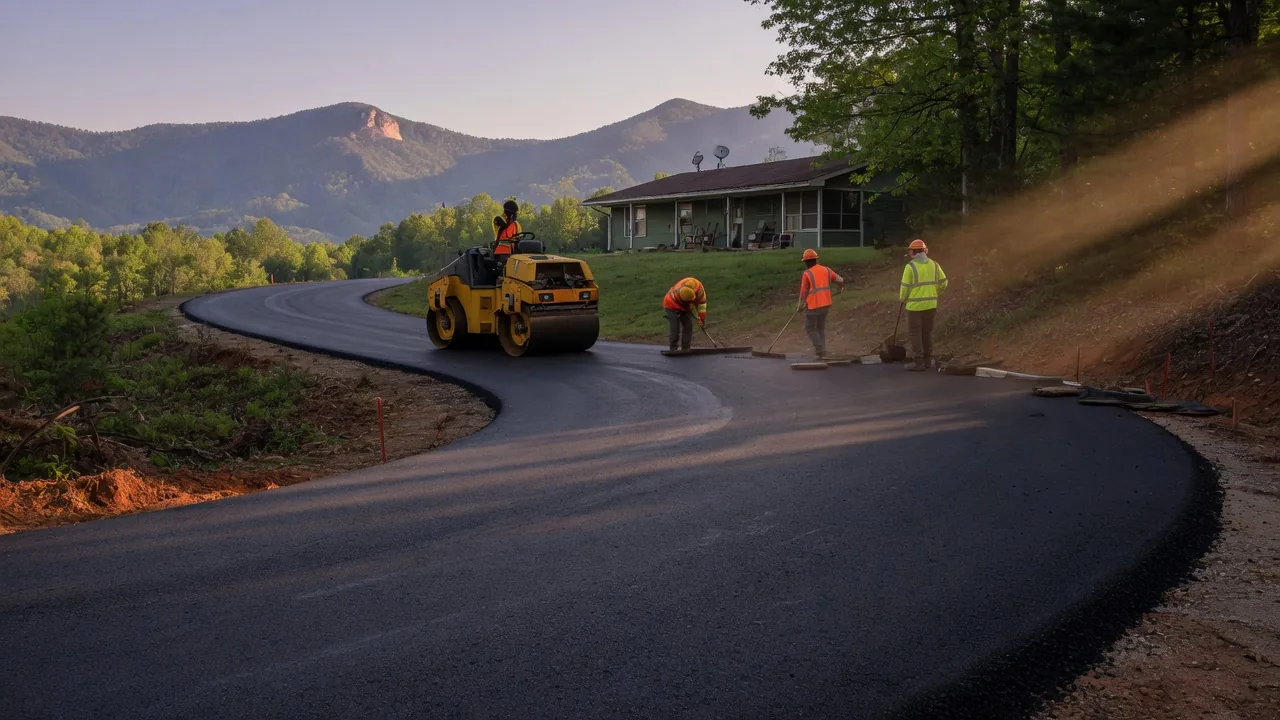
Driveways in Pisgah Forest tend to be long, sloped, and hidden under a canopy. That combination changes asphalt resurfacing from a simple overlay into a drainage and access problem. A quarter-mile gravel-to-paved run off a forest service road in the Pisgah Forest area sees tree litter, shade that keeps the surface damp, and runoff that would pool on a flat suburban slab in Hendersonville. Where a lot in town might take 30 feet of approach, a lot here often takes 100 to 300 feet of driveway, so the same per-square-foot number feels different at the mailbox.
Transylvania County's older mountain roads and small subdivisions also mean aging pavement on uneven subgrade. The original build may date to the 1970s or 1980s, laid over soil that has shifted with freeze-thaw and seasonal groundwater. The right resurfacing strategy starts with whether the base is still moving, because an overlay on a failing subbase fails with it.
The neighborhoods here look different from Asheville proper in ways that matter to a paving crew. In the Pisgah Forest area, you're more likely to find a driveway that climbs at 10 to 15 percent, curves between hardwood trunks, and dead-ends at a home set well back from the road. There's no curb, no gutter, no storm drain at the bottom of the hill. Water finds its own path, and after a long rain the bottom of a sloped drive can turn into a channel. A crew that mostly paves flat Hendersonville lots will bid this work as if it's the same job. It isn't.
The tree canopy is another local factor. Shade keeps the surface from drying, which means moss, algae, and a persistently damp asphalt surface that oxidizes differently than sun-baked pavement. The leaf drop in fall adds organic material that holds moisture against the binder. Homeowners here often notice their driveway staying slick longer after rain than a friend's driveway down in town. That's the canopy, not a paving defect.
How to tell if your asphalt actually needs resurfacing or replacement
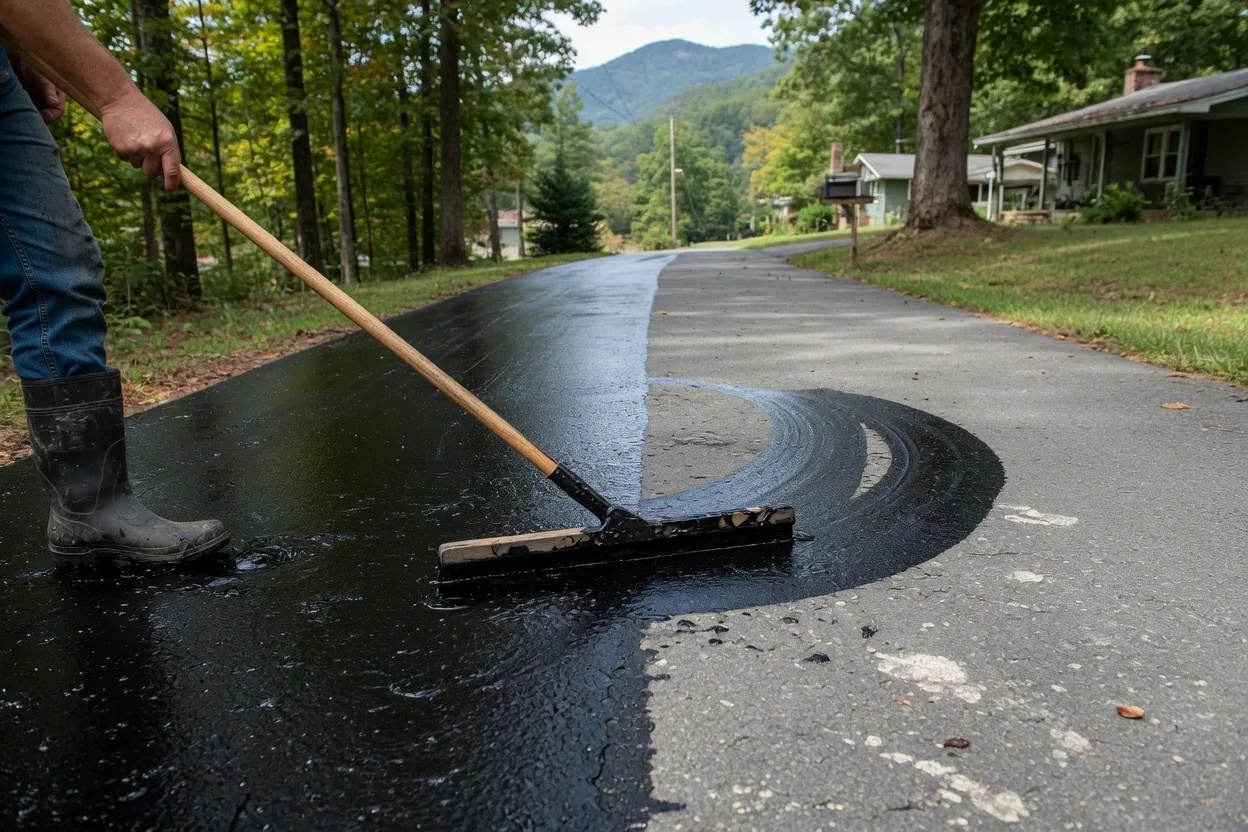
Alligator cracking and potholes deep enough to catch a tire mean the surface is failing from below, and a standard resurfacing will crack through in a season or two. What justifies a true overlay: hairline cracking that hasn't spread, surface oxidation, faded aggregate, and pavement that has lost its binder but still sits level. A driveway with clear structural failure needs repair first, then resurfacing, see the resurfacing service guide for how that sequencing works.
Drainage is the deciding factor in this county. Water that sheets across a slope erodes the edges and saturates the base. The NC Department of Environmental Quality treats stormwater and runoff as a regulated concern for good reason, and the same physics applies at driveway scale: if water can't leave, the pavement won't last. On a mountain drive with no curb, that means the crown and the cross-slope do the work a gutter would do on a town street.
Walking a Pisgah Forest driveway to judge it, a contractor looks at a few things in order. First, where does water go when it hits? If it runs down the middle and off the low edge, you have a grading problem that resurfacing alone won't solve. Second, are the edges crumbling into the woods or the yard? Edge loss on a slope signals the pavement is losing its shoulder support. Third, is the cracking localized to a few spots or spread across the whole run? A short overlay can address a sound drive with oxidized surface; a drive with structural failure spread over a hundred feet is a different conversation.
Because the two conditions often appear on the same driveway, a fair bid separates repair from resurfacing. A crew that quotes one lump number without noting the failed sections is either planning to bury them or hasn't looked closely.
The Transylvania County price picture
Steep, long, and tree-shaded driveways carry a premium because the equipment has to fit, the edges have to be built up, and the prep takes longer. Use the Transylvania County cost page for the full working table. The short version: resealing a short flat drive can run in the low hundreds, a standard overlay on a mid-length driveway lands in the low-to-mid thousands, and full-depth rebuild on a steep quarter-mile run can push well past five figures.
Below is a working scope table for the ranges that show up most often on Pisgah Forest and Transylvania County driveways. These are regional bands, not quotes, and every driveway gets its own inspection before a real number.
| Scope | Typical range | What drives the number |
|---|---|---|
| Crack fill and sealcoat on a sound, short flat drive | Low hundreds | Length, number of cracks, prep cleaning |
| Standard overlay on a mid-length driveway in fair shape | Low-to-mid thousands | Square footage, edge condition, tack and compaction |
| Overlay with localized base repair on a sloped run | Mid thousands and up | Number and depth of failed sections, access for equipment |
| Full-depth rebuild on a steep quarter-mile drive | Well past five figures | Excavation, new base stone, re-grading, drainage |
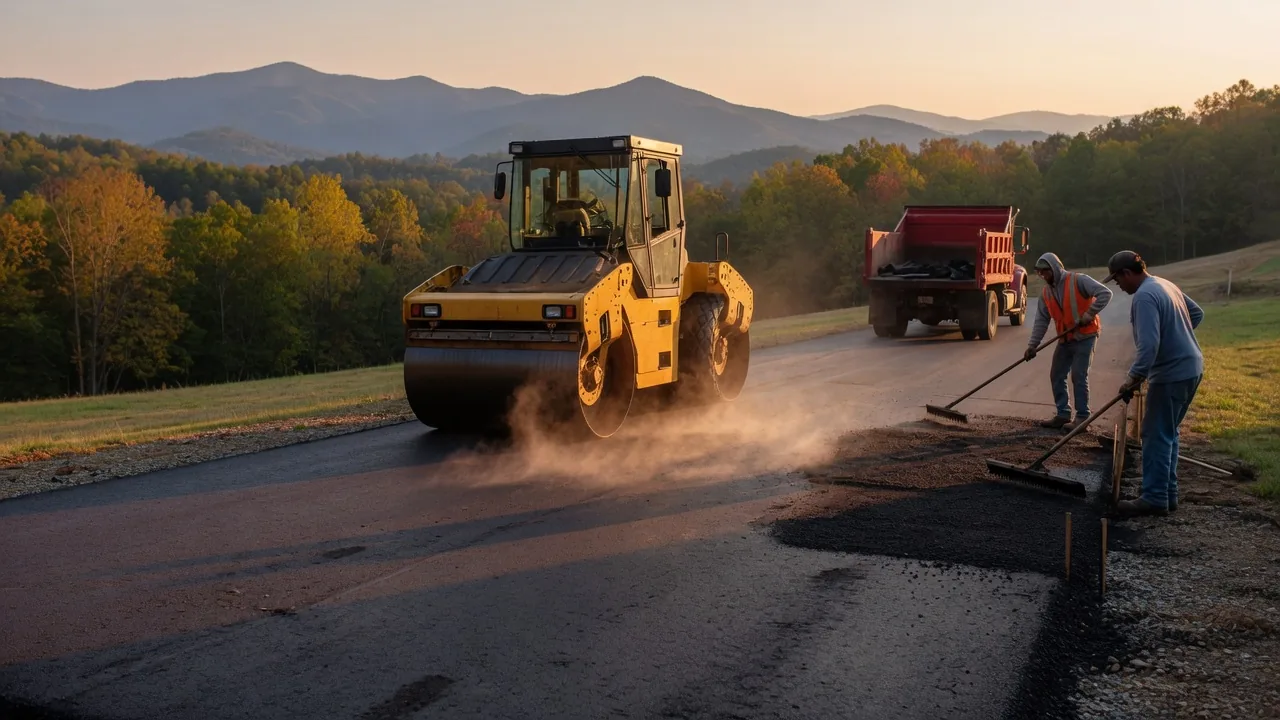
One detail that shifts price in this county but rarely shows up on a town quote: access. A long drive with a tight turn or a canopy of low limbs can slow a paver or a dump truck to a crawl, and some drives are too steep for a loaded truck to climb safely. That reality is why two driveways of the same square footage can come back thousands apart. Prep time and equipment fit, not just area, set the price here.
Who shows up and what they should bring
Ask about the base: how they'll verify it's sound before overlay. Ask about edges: how the pavement will be contained on a slope without a curb. Ask about the mix: whether the asphalt spec suits the temperature swings Transylvania County sees, hot summers, winters that crack poorly placed mix, and frequent rain. The NC Licensing Board for General Contractors sets the threshold for when a paving contractor must be licensed, and the National Weather Service's regional forecasts explain why paving season here runs from early spring to late fall, not year-round. When comparing bids, the Pisgah Forest paving contractor directory covers what a serious estimate should include.
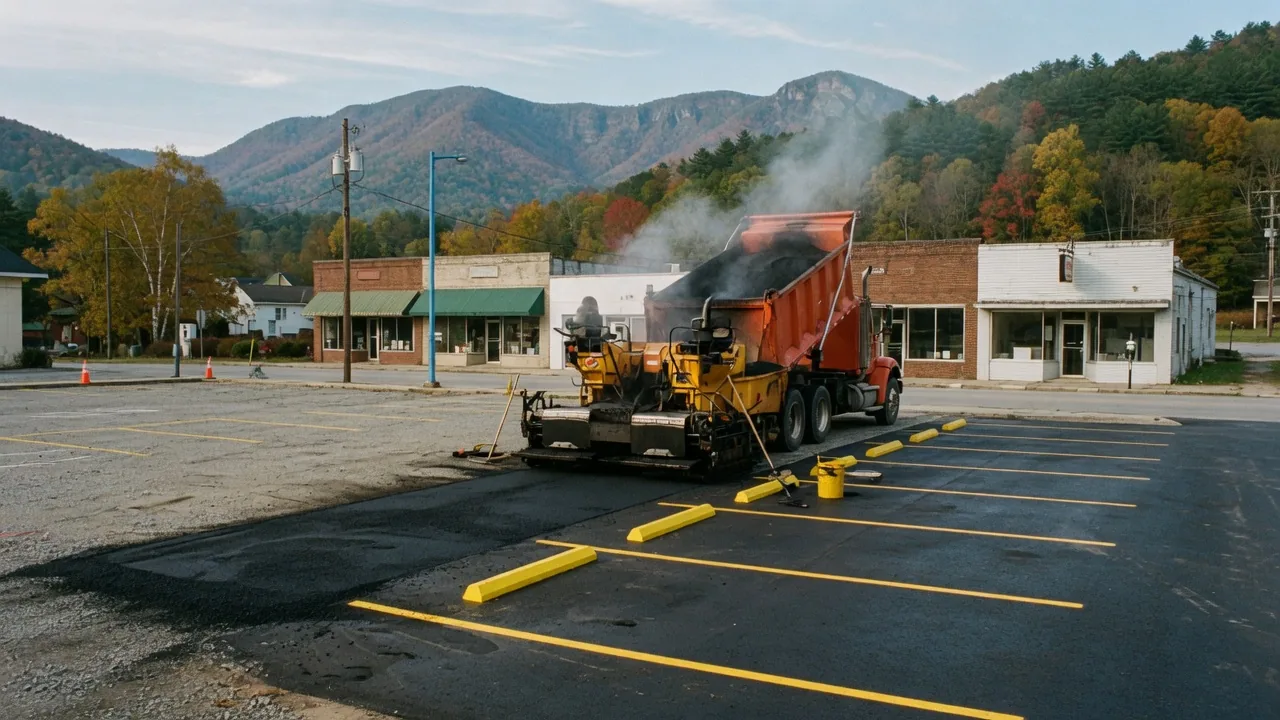
A serious estimate for a mountain driveway also accounts for hauling. The asphalt plant serving this part of Transylvania County is a drive away, and on a long, slow-access driveway the crew has to think about how many loads the job requires and whether the mix stays workable from plant to paver. A bid that ignores haul time on a shady, steep run is a bid that may fall apart on the day, not on the paper.
The other thing to watch for is whether the estimate mentions drainage in writing. On a slope with no gutter, drainage is the job. A contractor who talks through grade, crown, and where water will be directed is usually the one who understands why the last resurfacing failed in the first place. The EPA publishes guidance on managing runoff that homeowners find useful for understanding why a driveway's water has to go somewhere deliberate.
Timing, water, and the storm record
The Pisgah Forest area sits under some of the wettest skies east of the Rockies. Federal disaster records show 16 declared events touching Transylvania County spanning 1993-2026, and most of those are flood and storm family, events that push runoff across driveways and wash out edges. That history isn't abstract: it's the reason an overlay scheduled before a wet winter tends to perform worse than one poured into a dry window with a properly graded crown. If a driveway already handles runoff poorly, the storm record says that poor drainage will get tested, and resurfacing without fixing grade is a subscription rather than a repair.
Timing the work also means watching the shoulder seasons. Asphalt needs warm air and a dry base to compact well, so a late-fall pour that goes in just before the first cold rain is a gamble. On the other end, a hot midsummer window gives the mix time to set properly, though crews here often prefer to start early in the day before the afternoon mountain showers that build across the ridges. A driveway scheduled with a little margin for weather will usually come out better than one squeezed into a single narrow window.
After the work, the maintenance question is local too. Between the shade, the leaf litter, and the runoff, a Pisgah Forest driveway tends to need its edges watched more than a flat town driveway. Keeping the low edge from eroding and keeping organic debris off the surface in wet months extends the life of a good overlay. None of that is glamorous, but it's how the money spent on resurfacing actually stays spent.