Which way the rain leaves your lot decides the job
Most Lake Junaluska area drives sit on ground that is either falling toward the lake, cut into the toe of a ridge, or perched on a bench above a neighbor. That means water almost never has an easy exit, and gravel has been quietly hiding the problem for years. Read the ruts: gravel that washes at the crown, a fan of stone spilled onto the apron, soft spots holding puddles a day after rain. Each one is telling you where the asphalt will fail first if the grading underneath doesn't change.
A conversion done right re-establishes three things before a single ton of mix is laid. The crown, so water sheds to one or both edges instead of pooling in the middle. The shoulders, so the pavement edge stays supported instead of crumbling into loosened stone. And a defined outlet, a ditch, a swale, a catch point, where the runoff actually goes once it reaches the edge of the drive. On these lots that outlet often has to be built, not found. Skipping it is the single most common reason a fresh driveway here looks tired in three years.
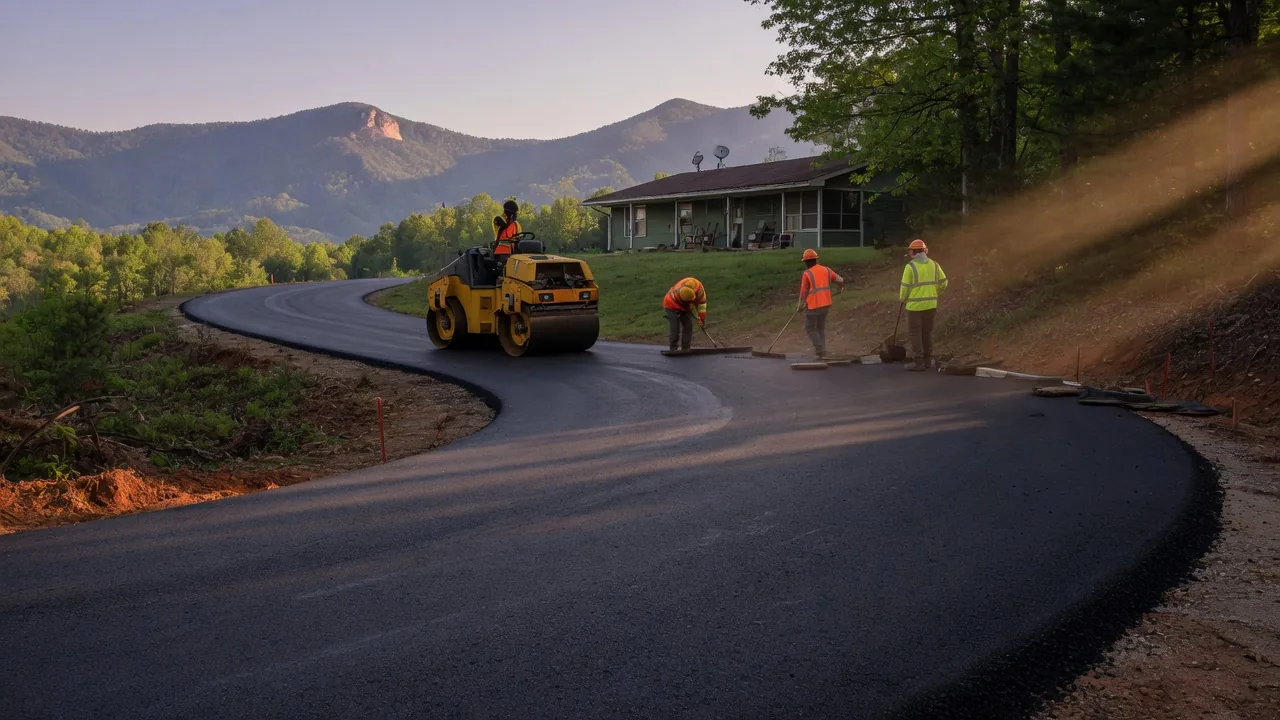
Consider the typical Junaluska cottage lot: a narrow drive threading between a stone retaining wall on the uphill side and a drop-off to the neighbor's yard on the downhill side. The wall sheds water onto the drive. The drop-off gives it nowhere to go but sideways. If the original gravel base was crowned to shed toward the house, that water has been soaking the foundation footer for decades. A conversion is the moment to reverse that crown and cut a shallow swale along the uphill edge, catching sheet flow off the wall before it ever reaches the pavement. That single grading change is often worth more than any upgrade to the asphalt mix itself.
On the flatter benches closer to the lake, the problem flips: there's no slope to move water at all, so the drive becomes a shallow pond after a summer thunderstorm. There, the fix is a gentle cross-slope, sometimes only an inch or two across ten feet, combined with a daylighted outlet at the low corner. Contractors who pave these lots without checking which way the ground already tilts are the ones whose customers call back after the first big rain.
What's actually under the gravel
Gravel drives get cheap base courses. That's usually why the owner is converting. The existing stone is often too thin, too round, or contaminated with the clay and silt that washed in over the years. Asphalt needs a compacted, angular, well-graded base of the right depth, and how much you need depends on how the drive is used and what's under it. A short, flat, car-only drive may be fine with modest preparation. A long, sloping drive that takes a boat trailer or a contractor's truck needs real depth, real compaction, and honest drainage, or the first loaded spring will tell you about it.
Because the trade of prep is where the money goes, expect that line to dominate the estimate. See the working ranges in the Haywood County cost breakdown, and treat a quote that is mostly asphalt with almost no prep as a number, not a plan.
Haywood County's native soils run heavy in clay, and that matters more than most homeowners realize. Clay holds water, swells when it's wet, and shrinks when it dries, which means a base built directly on clay without a separation layer will pump and shift season after season. The good local crews bring in a woven geotextile fabric or a coarse crushed stone blanket to break that capillary pull, then build their compacted base on top of it. It's an extra line item, and it's the difference between a drive that stays flat and one that develops a spiderweb of cracks around the third winter.
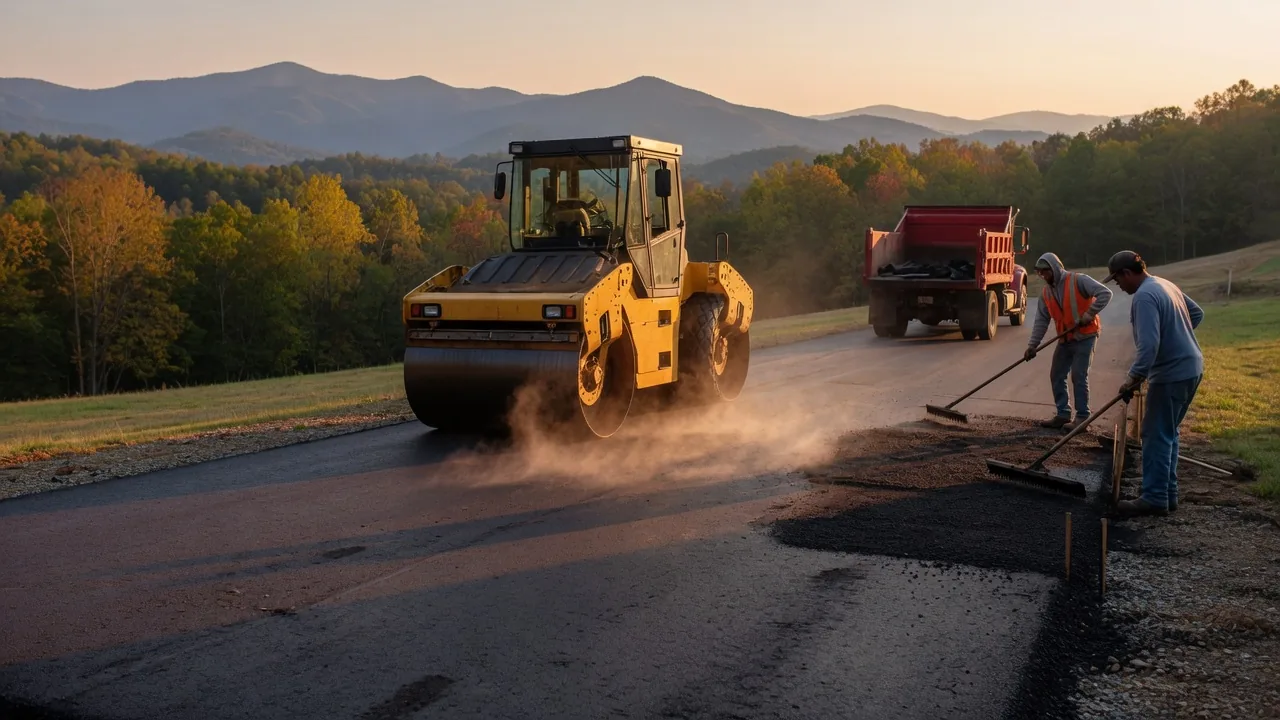
Depth matters too, and it's driven by use, not by length. A standard passenger-car drive in this area typically wants four to six inches of compacted base over the fabric. A drive that carries a boat, a camper, or a delivery truck wants six to eight, sometimes more if the subgrade is soft. When a contractor walks your drive and simply says 'we'll add some stone,' ask how many inches, what gradation, and how they'll compact it. The answer tells you whether you're getting a base or a gesture.
The price picture for a conversion
Ranges below are regional and honest. Your grade, length, base depth, and outlet point move the final figure far more than the thickness of the surface course.
| Scope | Typical price range |
|---|---|
| Regrade, compact, and seal existing base (light prep) | often $1,200-$3,000 |
| Add and compact new base stone | typically $2,000-$6,500 depending on depth and length |
| Drainage: swale, ditch, or edge outlet work | usually $600-$3,500 |
| Asphalt surface course, residential drive | commonly $3.00-$5.50 per sq ft installed |
| Full conversion, normal residential drive | typically $4,200-$11,500 all-in |
| Long, steep, or heavily loaded drive | frequently $12,000-$20,000+ |
Anything above a modest threshold of site work pulls in general contracting rules, and that's a good moment to verify your contractor against the NC Licensing Board for General Contractors. New impervious surface can also trigger stormwater and driveway connection requirements under the NC code officials and the state's access rules at NCDOT, so ask who owns that approval before work starts.
One number homeowners here consistently underestimate: haul-off. The old gravel, the excavated clay, the spoil from cutting a new swale, all of it has to leave the site unless it can be reused elsewhere on the property. On a tight Junaluska lot with no room for a spoil pile, that's truck after truck down a narrow drive, and it adds cost that a flat, open lot in the county wouldn't see. Ask your contractor where the spoils go and whether disposal is in the quote. A bid that looks low often just moved that line somewhere it doesn't show.
The other variable worth pricing separately is the apron where the drive meets the county or state road. That connection point takes the hardest beating of the whole drive and is the first place a conversion fails if the transition isn't cut and compacted correctly. It's also the spot most likely to require an access permit, so handle it deliberately rather than as an afterthought.
Why gravel was failing first
Look at the federal record for this county and the pattern is clear: 19 declared events touch Haywood County across 1973-2026, and they lean storm and flood family. That is the whole argument for converting with drainage in mind rather than just capping what's there. Northwest-flow storms dump hard on these ridges, and a drive that already washes its gravel will send that same water somewhere once asphalt closes the surface. The National Weather Service's local data at weather.gov shows how quickly this region can turn a dry ditch into a running one.
There's a specific local pattern worth knowing. These mountains can drop a lot of rain in a short window when tropical moisture rides up from the south and stalls against the ridges. The French Broad and Pigeon River drainages that bracket this county are famous for how fast they rise. A gravel drive handles that by letting water seep through and spread. Asphalt doesn't seep, so every drop that used to soak into the drive now has to run somewhere, and if that somewhere is your neighbor's slope or your own foundation, the conversion just relocated the problem instead of solving it.
So the sequence matters. Fix where the water goes. Rebuild the base. Then pave. Contractors who want to do it the other way are selling a surface, not a driveway.
This is also why the honest local contractors spend as much time standing at the bottom of your drive as they do at the top. Watching where the water exits during a storm tells them more about the job than any measurement. If a contractor never asks to see the property after a rain, or never walks the full length of the drive to its outlet, that's a signal worth noting.
Sequencing the conversion around mountain seasons
Asphalt needs warm, dry conditions to place and compact properly, and Haywood County's shoulder seasons are short. Late spring through early fall is the honest window for a full conversion. That doesn't mean a winter start is impossible, just that cure times stretch, and a cold-weather mistake in the surface locks in problem cracking long before it would otherwise appear. Ask any contractor how they intend to handle the finish if a cold front pushes through mid-job.
Elevation plays a role here that it doesn't in the flatlands. Lake Junaluska sits lower than the ridge communities above Waynesville, but a drive climbing toward the surrounding hills can gain several hundred feet and with it a meaningfully shorter warm season. The higher up the slope your drive runs, the more important it is to get the job done in the heart of summer and to let the base dry thoroughly before paving. Trapped moisture under new asphalt is one of the quiet killers of a conversion.
Order the work in this order every time: water first, base second, surface third, then edge and shoulder dressing. The crews that do it in that order in this county are usually the same ones you can verify through our Lake Junaluska paving contractor page, and they're the ones whose drives still look right after five seasons. If you're still comparing whether a conversion is worth it, the gravel-to-asphalt guide lays out when it pays and when it doesn't.
One last piece of local honesty: a conversion is not always the right call. On a very short, very flat drive that drains well on its own, fresh gravel and a proper crown may serve you for years at a fraction of the cost. Asphalt earns its keep on slopes, on loaded drives, and on lots where the gravel is constantly washing or rutting. A good local contractor will tell you which situation you're actually in rather than selling you the bigger job by default.