Hot mix cools on the way to your hill
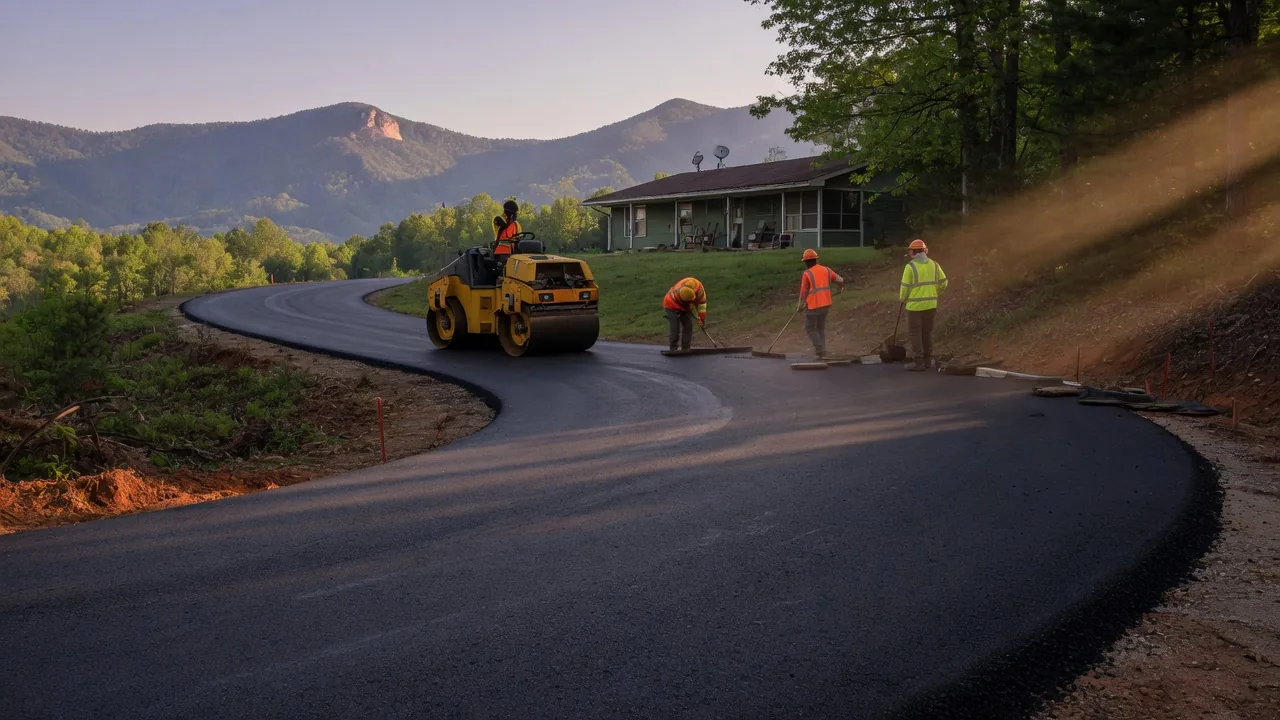
Every load of asphalt that lands on a Leicester driveway has been losing workable temperature since it left the plant. Buncombe County's hot-mix producers sit down in the valley, and Leicester's driveways climb off NC 63 and the Newfound Road corridor into hollows and ridges where the last mile is often the steepest, narrowest, and slowest mile of the whole haul. That travel time is not trivia; it's the reason a job that prices at one number on flat ground in the county prices at another on a 300-foot grade with a switchback in it. A crew that can't get the mat down and rolled before the mix stiffens either wastes loads or asks you to accept a coarser finish. When you see a driveway in this area with a rough, open texture and early raveling, temperature loss on a long or slow haul is a common culprit. The asphalt driveway repair guide walks through how a proper crew stages for it.
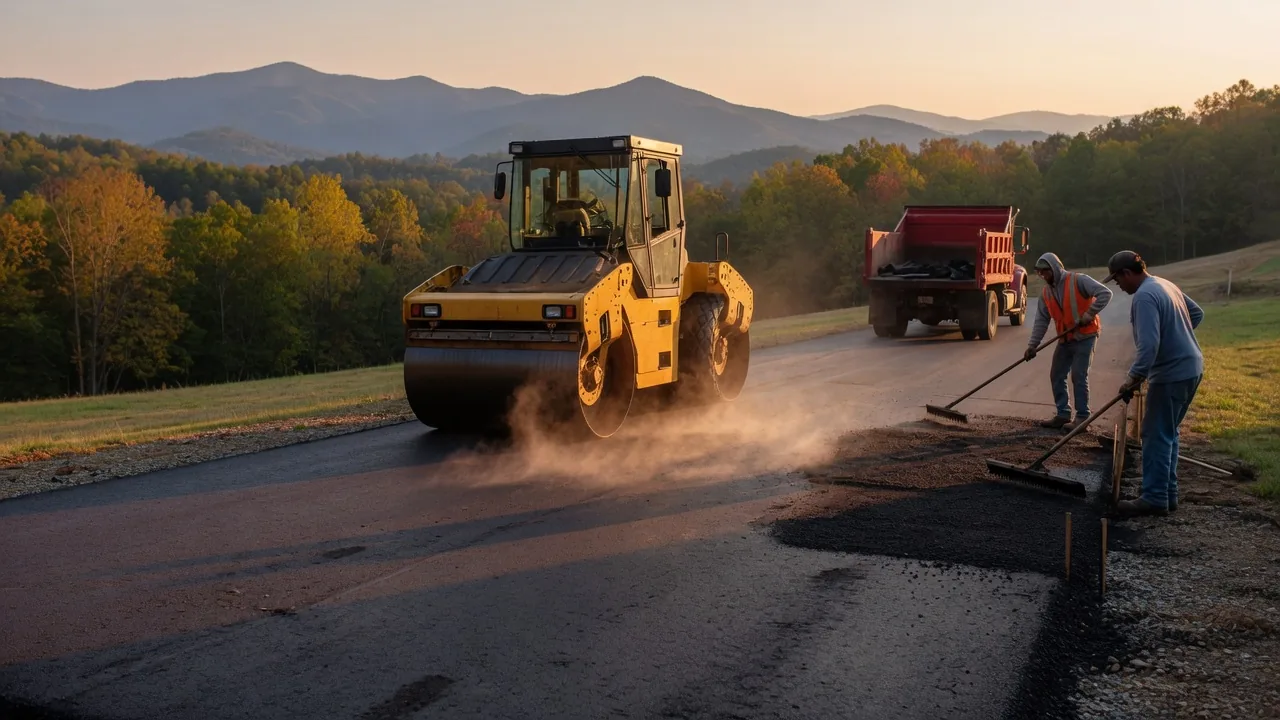
Weather adds another layer to the haul math. The mountains around Leicester can run ten degrees cooler than the valley floor, and afternoon thunderstorms roll in fast off the Pisgah ridges. A crew that started a load at 9 a.m. in the valley may be racing a storm cell by the time it reaches a ridge-top turnaround. That's why experienced local outfits often schedule Leicester hill work earlier in the day than a flatland job, and why they may bring a second roller or a smaller track machine to keep compaction tight without losing the window. The National Weather Service mountain forecasts are a routine planning tool for these crews, not an afterthought.
Haul distance also affects how many loads make sense per day. On a tight, winding drive, each truck may take significantly longer to reach the paver and return for the next load, which can cut daily production. When a bidder tells you they'll need two days instead of one for a job that looks like a one-day job, that's often the honest answer, and it shows up in the price. The key is to ask how many loads they'll run and where the plant is; a vague answer usually means they're reselling someone else's mix and don't control the schedule.
What a Leicester driveway actually faces
The town is rural-leaning Buncombe County, and most private drives here drain uphill toward the house rather than away from it. Graded gravel transitions, exposed mountain clay, hemlock and hardwood litter, and freeze-thaw cycles that work the edges all season long are the normal condition. The failures follow: edge cracking where the shoulder loses support, alligator cracking where water has been sitting under the surface, depressions at the culvert or turnaround, and transverse cracks that open every spring. Long drives on steep grade also shed a surprising amount of aggregate surface, which builds up at the bottom and starves the upper sections. That pattern is nearly universal on Leicester hillsides and rarely shows on flatter county properties.
The mountain clay under many Leicester drives is a particular challenge. It holds water, swells when saturated, and shrinks in dry spells, which moves the pavement above it. A driveway that looks fine in August can show new cracks by March because the subgrade heaved and settled differently under each season. This is why a repair that only addresses the surface often fails within a year or two, and why a contractor who wants to probe the base before quoting is usually the one worth hiring.
Tree canopy is another local factor. Many Leicester properties sit under mature hardwoods that drop leaves and small branches, and shade keeps pavement cooler and slower to dry after rain. Moss and algae can take hold on shaded sections, and organic debris in cracks accelerates breakdown. A driveway tucked into a north-facing cove will dry out far more slowly than an exposed ridge drive a mile away, even though they're in the same ZIP code. That difference affects both how long repairs last and how soon you should schedule them.
Repair scope versus price range
Ranges below reflect the haul and access premium a Leicester crew has to fold in. Exact quotes should always be a physical inspection, but the numbers here give you a working shape. For a countywide comparison, see the Buncombe County cost breakdown.
| Scope | Typical price range | Notes |
|---|---|---|
| Crack filling and spot patching | $450–$1,800 | Best done before winter; direct access assumed |
| Full-depth patching (pothole, sub-base failure) | $1,400–$3,800 | Requires removal of failed section, not just a surface skin |
| Surface overlay / resurface | $2,200–$6,500 | Assumes sound base; uphill drives need extra rolling time |
| Tear-out and full replacement | $8,500–$16,000+ | Length, grade, and haul distance are the primary movers |
| Edge repair and shoulder rebuild | $700–$2,400 | Common on steep Leicester drives after a wet season |
Two other line items quietly move the number on Leicester jobs: drainage correction and driveway width. If the bid includes re-grading a shoulder, resetting a culvert, or adding a turnout so a truck can back in safely, expect the price to climb above the base range for that scope. Extra width matters because a 10-foot drive that works for a passenger car may be tight for a loaded dump truck, and a contractor will either price the access risk in or ask you to widen the apron.
Water, slopes, and why repairs return
A driveway crack that comes back within a year almost always means water is still reaching the sub-base. Leicester sits in a county with a heavy federal disaster record — 19 declared events across 1973-2026, dominated by storm and flood categories. Each of those events rewrote the drainage assumptions of the yards it touched. Before selling you a patch, a serious crew will want to know where runoff from the uphill neighbor goes, whether the culvert at the road is undersized, and whether the grade sheet-drains or ponds. The National Weather Service warns repeatedly that mountain flash flooding strikes small drainage areas first; a driveway built on a fall line is exactly that kind of drainage area. One legitimate code backstop: any paving near a stream or wetland may trigger stormwater or erosion-control review, and the EPA maintains the regulatory guidance that local offices draw from.
Practical signs of a drainage problem in Leicester are not hard to spot. Standing water in the turnaround after a storm, a soft spot that squishes underfoot weeks after rain, or a gravel apron that washes out every spring all point to the same underlying issue. Fixing those before paving is often cheaper than paving over them and repairing again in two years. If the driveway crosses a swale or a small seasonal creek — common on larger Leicester tracts — the crossing itself needs attention, and that's the kind of work that may need a closer look from the county or state before a crew starts.
Slope management is the other half of the equation. On a drive pitched toward the house, water that reaches the slab should be directed to a defined channel or dispersion area rather than allowed to sheet across the surface. Some Leicester homeowners add a shallow swale along the uphill edge or a small berm to deflect runoff, and a good contractor will suggest those moves as part of the repair rather than waiting for the next failure. Skip that step and the same cracks will reappear in the same places.
Access, permits, and who to hire
Leicester driveways that meet a state-maintained road usually need a driveway permit from NCDOT for the point of access, and the application process and thresholds live at NCDOT Connect. This matters more than most homeowners expect: a repaving job that widens or shifts the driveway apron can require a new or amended permit even when the paving itself is fine. On the contractor side, North Carolina licensing rules kick in once a project crosses the state threshold; the NC Licensing Board for General Contractors publishes the current cutoff and lets you verify a license number. Ask any bidder how many loads their crew will run, where the plant is, and how they handle a load that shows up too cool to place. The answer tells you whether you are hiring a paving operation or a reseller. For vetted local options, see paving contractors in Leicester NC.
Access details on Leicester properties often drive the bid as much as square footage. Narrow gravel approaches with a sharp turn at the top may need a smaller paver or a track machine, and trucks may have to stage on the road rather than in the yard. Bridges, culverts, and gate posts all create constraints that a contractor has to see in person. That's why a phone quote on a Leicester driveway is a starting point at best, and why a site visit is worth insisting on before you sign.
Finally, think about timing and payment. Local crews often book out weeks in advance during the paving season, and deposits are normal, but a deposit should tie to a written scope with a start window. If a bidder won't put the scope, price, and schedule in writing, that's a warning sign. The NC Department of Insurance - Engineering & Codes and the International Code Council both maintain references for building and site standards that can be useful when a question about code comes up during planning.