Where the rain goes decides the job in Brevard
Most Brevard driveways leave the pavement and land in one of three places: the crown throws it to the downhill edge, the edge drops it into a shoulder ditch, or nothing is graded and it pools against the garage slab. On the steep lots that climb off the French Broad bottomland and the terraced cuts on the ridge sides, that path is short — water crosses a 15-foot drive in a hurry. On flatter lots near the county seat, the path is long and slow, and that is where crown matters most. Sealcoating in Brevard starts with reading that path: which way the sheet flows off the crown, whether the edge is a true edge or a crumbling lip, and whether the ditch at the bottom is actually lower than the pavement. If any of those three is wrong, sealer is being applied to a surface that will still crack from underneath, and the homeowner has paid for a finish on a failing base.
The fix order rarely changes: crown first, edge second, ditch third, sealer last. The NCDOT regulates where a driveway can discharge onto a state-maintained road and the driveway permit application captures that detail for any new tie-in, which is a useful reminder that discharge direction is a design decision, not an afterthought.
Walk a Brevard drive in February and you can see the whole story. The uphill side of a steep cut has a dry strip where sun hits first; the downhill apron stays wet into mid-morning because it faces north and the ridge shadows it. That north-facing apron is where the freeze-thaw damage starts, and it is also where a sealer coat will peel first if the surface was damp when it went down. When a crew quotes sealer here, the honest ones ask about shade and sun exposure before they ask about square footage. A drive that runs east-west across a south slope drains and dries differently than one that runs straight up a north-facing hollow, even when the two are the same size and the same age.
Hendersonville, the county seat, sits on flatter ground than most of the unincorporated county, and the driveways in town reflect that. Lots off the bypass and around the older neighborhoods have gentler grades, longer runs, and more of a chance for water to sit in the middle of the drive rather than run off one edge. Out toward Etowah, Penrose, and the Lake Toxaway side, the grade changes and so does the problem: water leaves fast, and the risk shifts to the downhill edge washing out and the ditch below the drive silting in. Same trade, two different failure modes, and the quote should reflect which one applies.
What sealer can and cannot repair on a mountain drive
Sealer is a surface treatment. It restores color, fills hairline checking, and slows oxidation from UV and from Transylvania County's wet-season freeze-thaw cycles. It does not restore structure. No amount of sealer fixes a base that has pumped, an edge that has lost its shoulder, or a crack that has opened wide enough for a finger. The honest test is a screwdriver and a hose: probe the crack edges for softness, then run water and watch the direction of travel for 30 seconds. A driveway that fails the water test gets a conversation about patching, edge repair, or a partial rebuild before anyone quotes sealer.
The distinction matters more here than in flat country because the base is often doing more work. A drive cut into a hillside has a fill side and a cut side, and the fill side settles at its own rate. That shows up as a long crack running parallel to the drive, not across it, and that crack is a base movement signature, not a surface failure. Sealer over it will bridge for one season and then re-open. The sealcoating overview walks through the prep sequence that separates a surface crack from a structural one, and it is worth reading before you decide which problem you have.
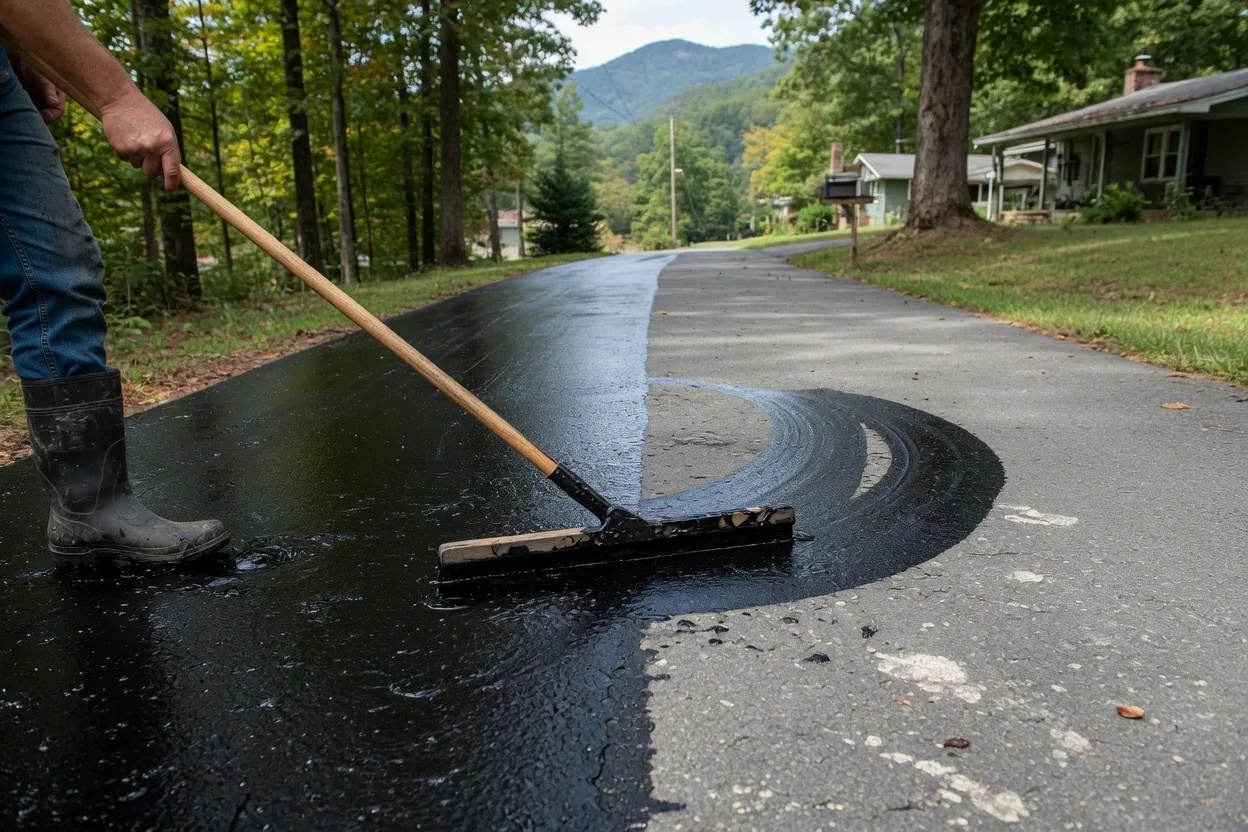
There is also a slope threshold to think about. Steep aprons hold sealer differently than flat pads; a squeegee coat on a grade wants to travel, and a crew that has worked mountain drives will manage the application rate rather than flood the surface and let it run to the edge. That is a technique question, not a product question, and it is one reason a low bid from a crew that mostly works flat commercial lots can look good on paper and disappointing on a hillside.
What sealcoating costs here, by scope
Transylvania County pricing tracks the work, not the postcard. A short, sound drive that only needs cleaning, a squeegee coat, and a clean edge lands at the low end. Add crack routing and fill, an edge rebuild, or a culvert correction and the number climbs accordingly. The table below is a working range for the market, not a bid; the Transylvania County cost breakdown shows how those line items stack for a drive that also needs paving work. For a drive in good shape, most homeowners here should expect the sealer line to be the smallest number on the page.
| Scope | Typical range | What drives the number |
|---|---|---|
| Clean, squeegee coat, clean edge only | $0.20-$0.26 per sq ft | Square footage, access for the rig, surface condition |
| Sealer plus routed and filled cracks | $0.24-$0.31 per sq ft | Linear feet of cracking, depth, whether cracks are working |
| Sealer plus edge rebuild and shoulder work | $0.28-$0.35 per sq ft | Linear feet of failing edge, haul-in of shoulder material |
| Sealer plus ditch or culvert correction | Priced as drainage, then sealer | Grade change, culvert size, outlet location, NCDOT tie-in if applicable |
The reason drainage is priced separately is that it is a different trade task with different equipment and different risk. A crew can squeegee a drive in a morning; correcting a crown or resetting a culvert may take a day and a machine. Bundling those into a single per-foot sealer number hides the real cost and makes quotes impossible to compare. Ask for the breakdown, and ask which line items are labor and which are material.
Timing and weather across the Brevard seasons
Sealcoating wants a dry surface and curing temperatures above about 50°F. In Brevard that window opens in spring and runs through early fall, with the best stretch being the dry weeks after the spring green-up. Freeze-thaw in the higher elevations is hard on fresh sealer, and the National Weather Service forecast for the plateau often shows overnight lows well below what the day's high suggests, so scheduling the last coat of the year is a real decision. Most crews here stop scheduling sealer in late fall and pick up again after the ground dries in spring. Federal disaster history in this county — 16 declared events since 1993-2026, mostly storm and flood related — is a good reason to look at drainage during the same visit as the sealer quote.
Rain in the Brevard area does not arrive evenly. Late summer convective storms drop a lot of water in a short time, and that is exactly the condition a marginal driveway cannot handle. A crown that sheds a gentle soak fine may still fail during a two-inch afternoon storm, sending sheet flow over the edge and into the shoulder. That is why the fall is a good time to inspect: you have just been through the storm season, and the damage is visible. Seal in the spring, inspect in the fall, and let the pavement tell you what the water did.
Humidity matters too. The plateau stays damp longer than the Piedmont, and sealer that would cure in a few hours east of here may take most of a day in the shade of a north-facing cove. Scheduling flexibility is worth more than a rock-bottom price when the weather window is narrow.
How to read a Brevard sealcoating quote
A quote worth comparing names the surface preparation, the number of coats, the sealer type, and the edge treatment. It also addresses drainage: whether the existing crown is adequate, whether an edge will be rebuilt, and whether the ditch will be cleaned so water leaves. The North Carolina Licensing Board for General Contractors sets the threshold above which a project becomes a licensed general contracting job, and the board's site is where to confirm whether the contractor you're considering is properly credentialed. A one-line quote with a single number and no prep description is a warning, not a bargain. When you're ready to compare, the paving contractors in Brevard page is the place to start if the drive needs more than sealer.
Read the quote for what it does not say. If it does not mention cleaning, ask how the surface will be prepped. If it does not mention the edge, ask whether the shoulder will be touched. If it does not mention water, ask where the runoff is expected to go. Those three questions separate a real scope from a coat of paint, and they cost nothing to ask.
One more thing specific to this county: many drives here tie into a private road or a shared easement rather than a state-maintained route, and that changes who is responsible for the ditch and the culvert. If your drive meets a private road, the NCDOT access rules may not apply, and the maintenance obligation may sit with the homeowners' association or the easement holders. Knowing which situation you are in before the crew arrives saves an argument later, and it is the kind of detail a local contractor will already understand.