Spring plant startup and the gorge's short paving window
Hot Springs sits at the bottom of a gorge where the French Broad cuts through Madison County, and that geography dictates everything about asphalt work. The hot-mix plants that serve this corner of the county typically fire up in late March or early April, and they wind down when the first hard frost settles into the valley floor. Between those two dates, a paving crew has maybe seven usable months, and the shade in the gorge steals another hour or two at each end of the day. On Spring Creek Road or Bridge Street, where the ridge line blocks the low winter sun, shade can hold pavement surface temperatures below the compaction threshold even when the air temperature looks fine on a weather app.
What that means for a lot owner: any crew promising hot mix in deep winter here is really offering cold patch or thin overlay. Both have their uses, but neither is a new parking lot. Real paving orders should land between roughly late March and early November, and they should be scheduled with rain-flexibility, because a lot graded ahead of a three-day rain sits saturated long after the sun returns. The National Weather Service forecast for the French Broad valley is worth checking before you let a crew start grading, because a tropical system that stalls over the Blue Ridge can dump half a month's rain in two days and push your base work back a week.
Asphalt compaction is a temperature game more than a calendar game. The mix leaves the plant hot, and the crew has to place and roll it before it cools below the working range. In a flatland county, that gives you a comfortable cushion. In Hot Springs, the mix cools faster in the shade, and crews working a sloped lot have to move quickly to keep the roller on the mat before it stiffens. That is why experienced mountain crews size their loads to the day's shade pattern, not just the square footage.
What the mountain does to a small-town commercial lot
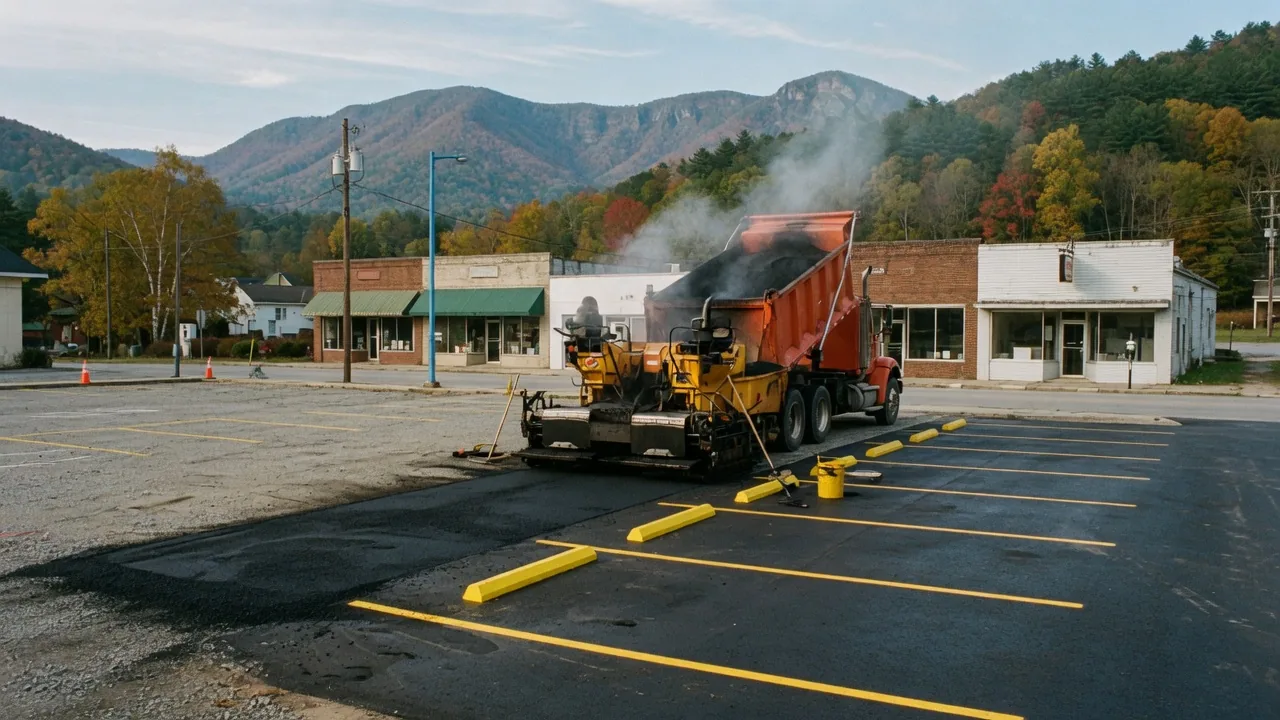
Most Hot Springs lots serve a handful of businesses: the spa and resort trade, river outfitters, small storefronts, a church or two, and the municipal parking that supports them. That means most lots are small, angled, and graded hard against a hillside or the riverbank rather than laid out flat on a parking field. A lot with a 6% cross-slope drains fast but also pushes water toward one corner, and the corner is usually where the failure starts. On the hillside side, a cut bank that sheds water onto the lot surface will undermine the base at the top edge before the middle of the lot shows any distress at all.
The recurring problems we see on Madison County lots: cracked edges where the base wasn't wide enough for the load, alligator cracking in the wheel paths of a lot that has never been sealcoated, and rutting near a dumpster pad or a river-outfitter trailer turnaround. None of those are asphalt failures from bad mix. They are base and drainage decisions made a decade earlier. The parking lot paving guide walks through the base-depth math, because a lot on fill behaves completely differently from one on the native hillside.
River-adjacent lots have their own pattern. When the French Broad crests, water pushes silt and debris into the low corner of the lot, and that fine material works its way into the base course over time. After a few flood cycles, the base can lose its load-bearing capacity even though the surface still looks intact. A core sample or a small test pit tells you more than a visual inspection ever will. If your lot has flooded since it was built, that history should be part of the paving conversation from the first site visit.
The price picture for a parking lot in Madison County
Nobody quotes asphalt from a photo. But scope bands here are real, and a Hot Springs lot lands in one of four tiers. See the Madison County asphalt cost page for how residential and light-commercial pricing tracks locally.
| Scope | Typical range | What drives it |
|---|---|---|
| Small lot, gravel to 2 in. asphalt | $2,900–$4,800 | Tonnage, base prep, access |
| Mid-size commercial lot, new build | $8,500–$22,000 | Square footage, base depth, drainage |
| Overlay on sound existing asphalt | $1.80–$3.50 per sq. ft. | Mill/level, crack repair, thickness |
| Larger or engineered-fill lot | $22,000–$38,000 | Fill, retaining, striping, engineering |
Any bid that skips the base question is not cheap, it is incomplete. Tear-out, haul-off, and a fresh stone base can double the visible cost of a small lot, and every square foot of parking here sits on ground that has been moving water downhill since long before anyone parked on it. Access is the other hidden cost driver. A lot at the end of a narrow lane off a bridge-side street may not accommodate a full-size dump truck and a paver at the same time, which means more hand work and a slower production rate. Crews that have worked in Hot Springs factor that in. Crews that have not may bid low and then ask for a change order when they see the approach.
Stormwater and the rules that actually apply
Madison County's NC Department of Environmental Quality stormwater rules matter if a lot is being expanded or rebuilt in a way that changes runoff, a real concern in a river town, and one worth checking before design rather than after. The EPA also publishes guidance on managing stormwater from commercial sites that is useful background when you are thinking about where the water goes after it leaves your lot. For anything touching a state-maintained street, an NCDOT driveway or entrance permit is generally required; the NCDOT Connect portal handles those applications. Larger commercial scopes trigger the general contractor licensing threshold published by the NC Licensing Board for General Contractors, which is a reasonable question to ask before signing a mid-five-figure paving contract.
Federal disaster history also shapes how water moves through this county. 21 declared events touch Madison County across a 1978-2026 record, mostly storm and flood-driven. If a lot sits near the river and has flooded before, drainage design should account for that rather than pretending the last flood was a one-off. That means grading the lot so the low corner has a clear escape path, sizing any catch basins for the flow they will actually see, and thinking about where debris will collect when the water recedes. These are not abstract engineering questions. They are the difference between a lot that survives the next high-water event and one that needs base repair three years after it is paved.
Choosing a crew that understands mountain paving
The honest differentiators in this market are schedule realism and base work. A crew that tells you the plant window, the compaction temperature they will hold, and how they will grade a sloped lot before bidding is more informative than any brochure. The Hot Springs paving contractor list covers what to verify, licensing, insurance, and references on lots your size, and asking for at least one reference on a slope-graded lot will separate crews who live here from crews who drove in for the season.
Ask specifically about how they handle a lot that gets shade for most of the day. A crew that has paved in the gorge will have a stock answer about load sizing and rolling timing. A crew that has only worked in Asheville or the flat river valleys may not have thought about it. The other good question is what they do when rain interrupts a job mid-grade. On a sloped lot, a half-graded surface can channel water into places it would not otherwise go, and the recovery plan matters as much as the original plan.
Finally, think about the long game. A parking lot in Hot Springs will see freeze-thaw cycles every winter, and the pavement will move. A crew that sets you up with a realistic sealcoating schedule and a clear idea of when to call them back for crack repair is giving you more value than a low bid from someone who will be hard to reach next spring. The mountain is patient with pavement, but only if the base was built for it.