Asphalt paving and sealcoating, Maggie Valley NC

Tar and Chip Driveways in Maggie Valley, NC

Tar and chip driveway Maggie Valley NC: how build thickness, lift count and stone mix handle mountain grades. Also in Maggie Valley: asphalt driveway paving, asphalt driveway repair and asphalt resurfacing. Hot-mix asphalt, tar and chip and sealcoating for mountain driveways, lots and private roads across five Western North Carolina counties.

  • Free on-site estimate, price in writing
  • Asphalt binder with stone chips rolled in
  • Roughly half the cost of hot mix on long lanes
  • Illustrated below: what the finished job looks like

Pictured: illustration: a tar and chip lane, stone chips pressed into the binder. An illustration of the work, not a job photo.

Get a free estimate

Tell us about the driveway, lot or road. We measure it, check the base and the water, and put a real price in writing.

Free, no obligation. A written price after the site visit.

Free on-site estimateA real number, in writing, after we measure and check the base.
Base first, then blacktopCompacted stone, drainage, then hot mix, in that order.
Five countiesBuncombe, Haywood, Henderson, Madison and Transylvania.
Straight answersWe say when a patch or an overlay is the honest fix.
Quick answer
Tar and Chip Driveways in Maggie Valley, NC

A tar and chip driveway in Maggie Valley typically runs $3.50-$6.00 per square yard for a standard two-lift, two-inch job, and $6.00-$9.00 when truck traffic, steep grade, or a wider apron calls for a three-inch build. Most residential driveways here land between $2,400 and $8,500 total depending on length, gravel base condition, and how much grade the county gives you.

19
federal disaster declarations on record in Haywood County
Hurricane Dorian
most notable event in the federal record
1973–2026
span of the declaration record
Waynesville
Haywood County hub

Why the grade, not the square footage, sets the spec

Most driveway conversations start with the size of the apron. In Maggie Valley they should start with the slope. A lot off Soco Road or up a hollow behind the valley floor can give you fourteen feet of fall in a hundred feet of run, and that number decides almost everything else: how much stone the binder has to hold, whether two inches survives or three is the honest minimum, and whether the job goes down in one lift or needs two passes with a cure in between.

Flat ground forgives a thin driveway. A grade does not. Under braking and turning load, binder at two inches on a ten-percent slope will ravel at the crown before a three-inch build on the same hill. The extra inch is not an upsell here. It is the difference between a surface you re-chip in eight years and one you re-chip in three. Steep valley driveways also shed water fast, and fast water is what strips chip off a binder that was laid too thin to begin with.

Two inches or three, one lift or two

The build spec comes down to four questions, and every one of them has a Maggie Valley answer. Local traffic is pickup trucks and trailers, not just sedans, so point loading at the wheels is heavier than most flatland driveways see. Turning load at the apron and any switchback concentrates stress in a way straight runs never do. The winter chip program, salt, and freeze-thaw cycles at valley elevation work the surface from both ends. And the base under the chip matters more than the chip itself.

Two inches of compacted coverage in a single lift is fine for a short, gentle, car-only driveway with a solid gravel base. Three inches, laid in two lifts, is the honest call when the driveway carries a loaded trailer, has any real grade, or runs over base that has never fully consolidated. Where the NCDOT maintains the street you empty onto, the apron must meet the paved edge cleanly, and a clean apron needs its own build depth even if the driveway behind it is thinner. If the work crosses or ties into a state-maintained road, the NCDOT driveway permit process runs through NCDOT Connect, and the paperwork is real.

Maggie Valley price picture

Numbers below are per-square-yard working bands for residential work in Haywood County, not bids. Length, run, base condition, and the town's accessibility for a spreader or a steel-wheel roller all move the final number. Full line-item view lives on the Haywood County cost breakdown.

ScopeTypical range (per sq yd)When it fits
Two-inch, single lift, car-only driveway$3.50-$4.75Gentle grade, solid existing gravel base, no trailers
Two-inch, two lifts, residential$4.50-$6.00Moderate grade, occasional trailer, mixed use
Three-inch, two lifts, truck/trailer apron$6.00-$9.00Steep run, turning apron, loaded trailer traffic
Gravel base rebuild (add to above)$2.50-$5.00Soft or unconsolidated base, prior pothole history

Beware any quote that gives one number with no thickness stated. Two inches and three inches are not the same job, and the difference shows up in year four, not year one.

Water on the uphill side has to be answered first

Haywood County sits in the federal disaster record for a reason. 19 declared events touch this county across 1973-2026, and the family is storm and flood. On a mountain driveway, water arrives from above you as often as it falls on you, and a tar and chip surface laid over a driveway that sheets from an uphill neighbor's lot will fail at the edges no matter how thick the binder is. The fix is not more chip. The fix is a crown, a swale, or a diversion ditch upstream, and it is cheaper than the re-chip it prevents.

The EPA's stormwater guidance at epa.gov is written for larger sites, but the principle transfers: keep concentrated flow off the surface you paid for. That is also the practical answer to why some driveways in the valley last twenty years and others fail in six.

Choosing a crew that reads the hill

Three checks before signing. First, ask what thickness they are quoting and in how many lifts. The answer separates a real spec from a sales line. Second, ask whether the job pulls a state general contractor license. The North Carolina Licensing Board for General Contractors publishes the threshold, and any paving scope above it needs a license. Third, ask how they handle the transition at the apron and at any culvert or driveway pipe. That detail is where most of the callbacks come from.

Our own network and coverage for the town lives at paving contractors in Maggie Valley, and the service background for this surface is on the tar and chip overview. Read both before you take a quote, because a Maggie Valley driveway is not a flatland job and should not be priced like one.
Haywood County, NC: the storm record

Federally declared disaster events19
Named storms in the recordHurricane Dorian, Hurricane Florence, Hurricane Helene, Hurricane Ian, Hurricane Isaias, Hurricane Ivan
Incident typesFlood, Hurricane, Severe Storm, Snowstorm, Tropical Storm
Record span (fiscal years)1973–2026
Source: FEMA OpenFEMA disaster declarations. County-level federal declarations, not individual claims.
More in Maggie Valley

Everything we build in Maggie Valley, NC

Questions people ask

Straight answers

How much does a tar and chip driveway cost in Maggie Valley NC?
Residential work here typically lands between $3.50 and $6.00 per square yard for a two-inch, two-lift build, and $6.00 to $9.00 per square yard where a three-inch build is the honest spec. Most driveways finish between $2,400 and $8,500 total. See the county cost table for the line items.
Do I need three inches instead of two?
If your driveway carries loaded trailers, has real grade, or sits over base that has never fully consolidated, three inches laid in two lifts is the honest spec. Two inches works on gentle, car-only driveways over solid gravel.
Does a tar and chip driveway need a permit in Haywood County?
If you are only resurfacing an existing driveway inside your own property, usually not. If the work changes the apron or the connection to a state-maintained road, the NCDOT driveway permit applies and runs through NCDOT Connect.
How long does tar and chip last on a mountain driveway?
A properly built three-inch surface on a drained, well-based driveway can go fifteen years or more with occasional top-dressing. A thin job on a steep, undrained run can fail in three to five.
When is the best time of year to lay tar and chip in Maggie Valley?
Late spring through early fall. Binder needs warm, dry curing weather, and scheduling before the first frost avoids a surface that never fully sets into the base.
Do you handle steep driveways?
Yes, and they are the reason we lead with thickness and lift count instead of square footage. Steep runs are where a three-inch, two-lift build pays for itself.
Our work

Our work

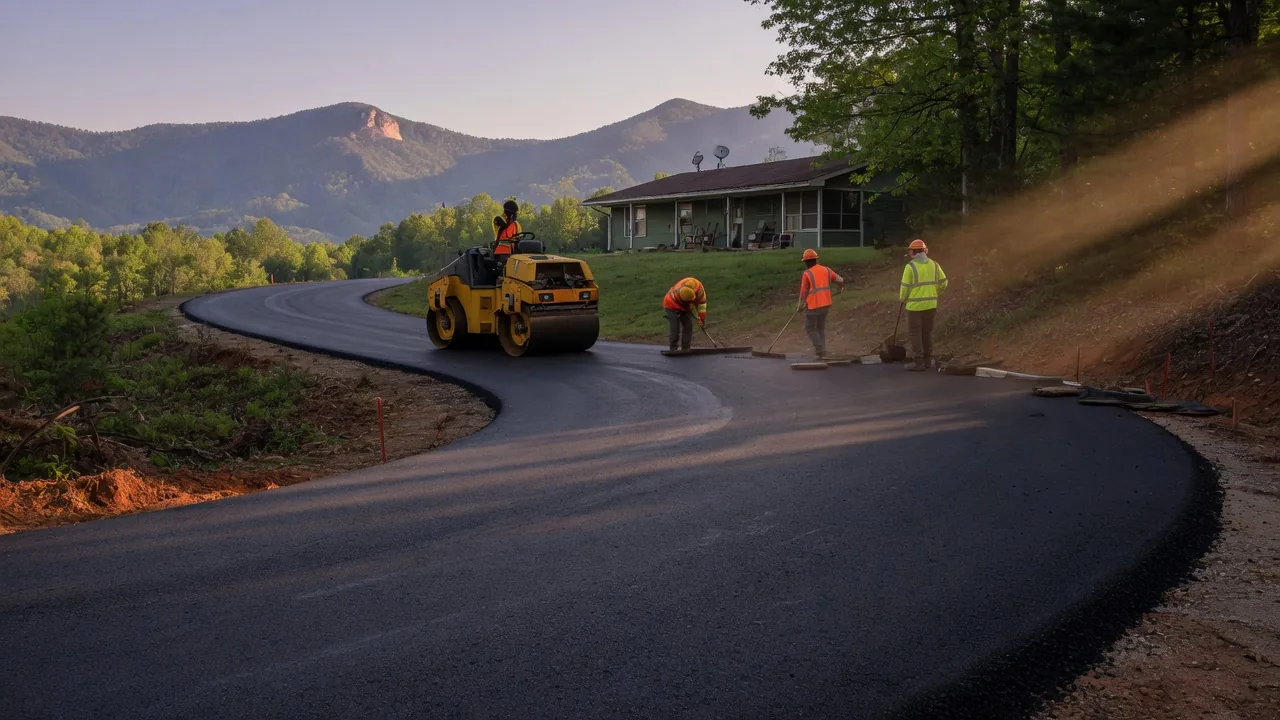
Illustration: fresh black asphalt on a driveway curving up a wooded mountain lot. Built by Mountain Asphalt Paving.
Illustration: fresh black asphalt on a driveway curving up a wooded mountain lot.
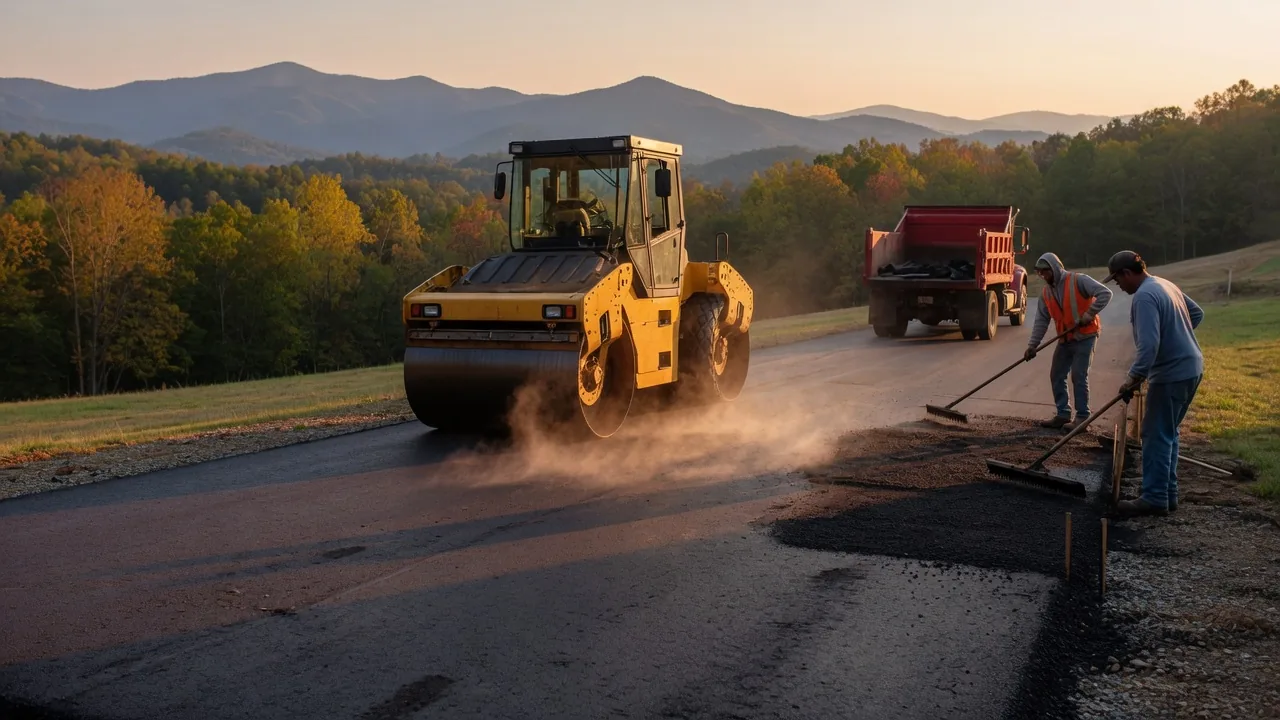
Illustration: a roller compacting hot-mix asphalt on a residential driveway. Built by Mountain Asphalt Paving.
Illustration: a roller compacting hot-mix asphalt on a residential driveway.
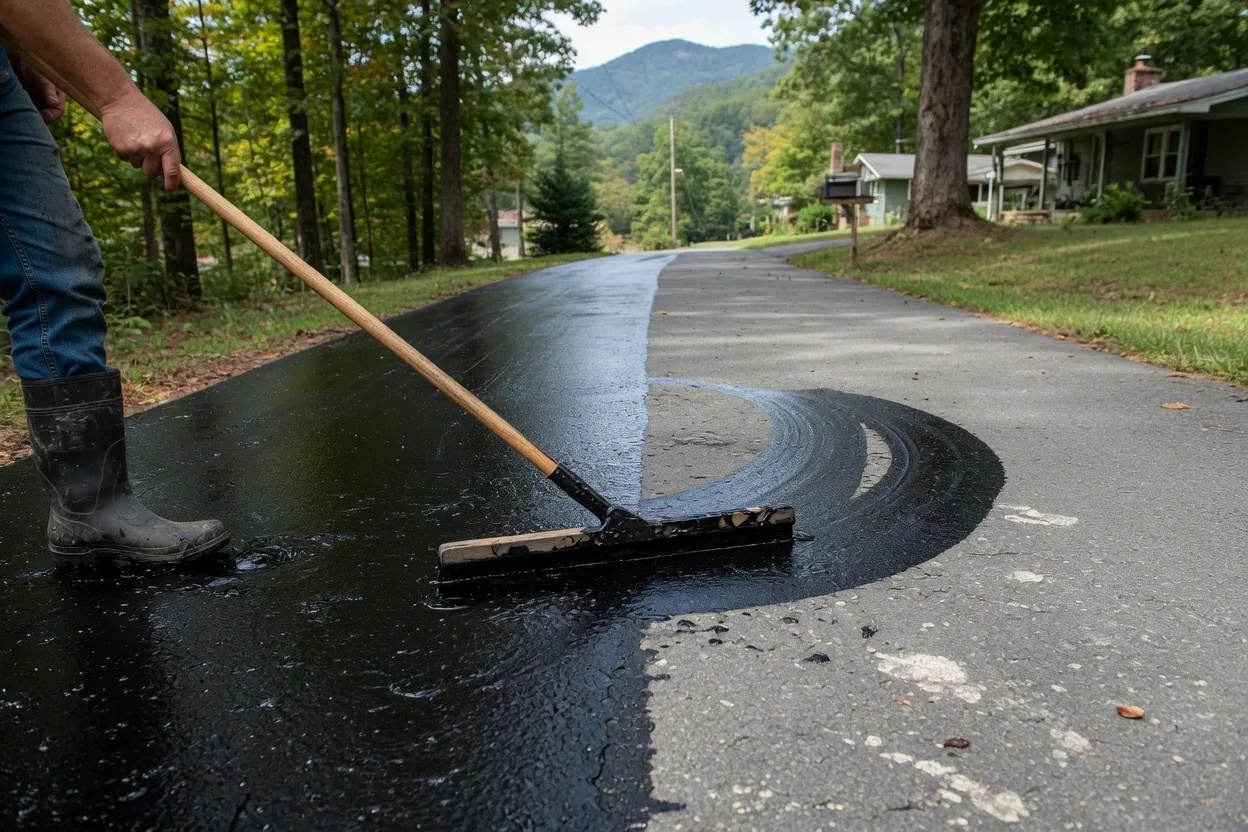
Illustration: sealcoat going down by squeegee, the treated half glossy black beside the faded half. Built by Mountain Asphalt Paving.
Illustration: sealcoat going down by squeegee, the treated half glossy black beside the faded half.
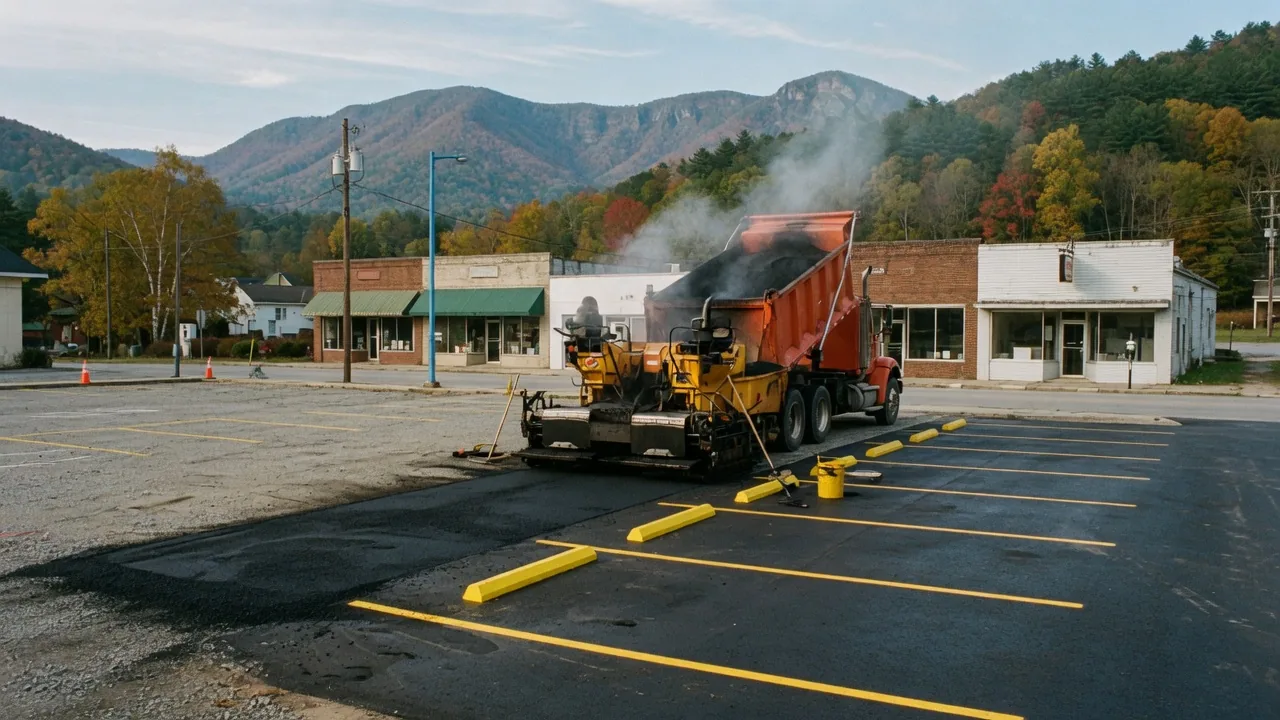
Illustration: a small parking lot being paved, with fresh striping on the finished half. Built by Mountain Asphalt Paving.
Illustration: a small parking lot being paved, with fresh striping on the finished half.
Get a quote

Tell us about your project. We price it straight.

Where it is and what you need — that's all it takes to start. You get a clear scope and an honest number, and your info never gets sold to a list.

Get a free estimate

Free, no obligation. A written price after the site visit.