Before you seal, read the driveway
The retreat and lakefront homes around Lake Junaluska sit on some of the steepest residential pavement in Haywood County, and the driveways show it. Water leaves the road up near the Christian Assembly grounds, gathers speed on a concrete or asphalt run, and hits the flat pad by the garage with nothing to slow it down. What looks like a sealcoating job is often a drainage story.
Walk the driveway before you call anybody. Hairline cracks that spiderweb across the surface are sun and age; they take a sealcoat fine. Cracks wider than a pencil, cracks that mirror themselves at a 45-degree angle, or a soft, spongy spot that gives underfoot mean the base is moving, and sealcoat over a moving base peels within a year. Potholes that keep coming back in the same place are a base failure, not a surface one. Crumbling edges, where the asphalt has lost its shoulder, are the other tell that a sealcoat alone will not hold.
What sealcoating actually buys you in Haywood County
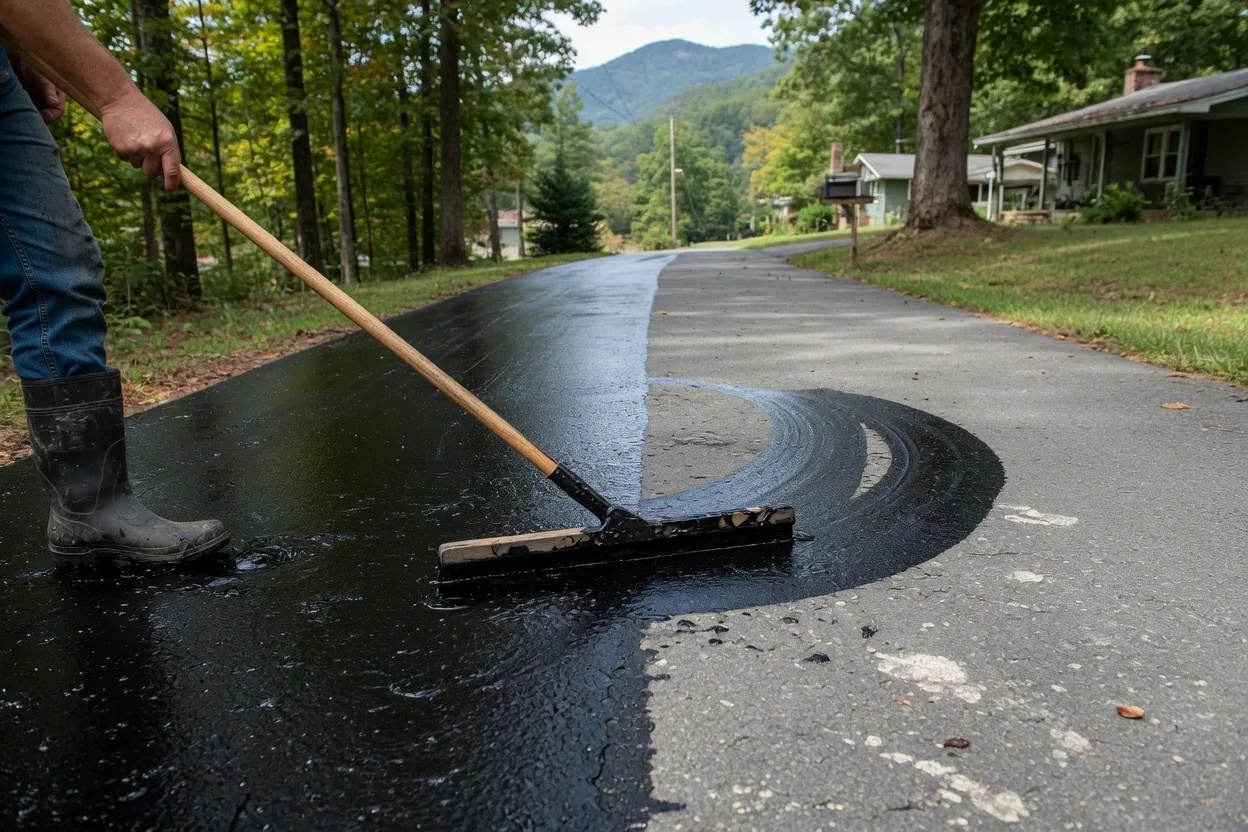
Sealcoat is a wearing layer, not a structural one. Done right, on a sound driveway, it restores the black finish, slows oxidation from the sun, and keeps water from soaking into the aggregate. Done wrong, on a failing driveway, it does none of those things and costs you the money twice.
The honest sequence is: repair the cracks, fill the potholes, correct the edge, deal with the water, then seal. That order matters on the slopes around the lake, where a sealcoat applied before the drainage is fixed gets pushed and pooled by the next heavy rain.
Repair, overlay, or tear out: the price ladder
The right call depends on how deep the failure goes. The table below is the working range for this corner of Haywood County. Exact numbers depend on square footage, slope, access, and how much prep the driveway needs.
| Scope | What it fixes | Typical range |
|---|---|---|
| Sealcoat only | Sound asphalt, cosmetic refresh | $0.20-$0.35 / sq ft |
| Crack fill + sealcoat | Hairline and moderate cracks, minor prep | $450-$1,200 per driveway |
| Pothole / edge repair + sealcoat | Localized base failure, crumbling shoulders | $900-$2,800 per driveway |
| Asphalt overlay | Widespread surface failure, sound base | $2.00-$4.50 / sq ft |
| Full tear-out and repave | Failed base, repeated potholes, drainage rework | $4.50-$9.00 / sq ft |
For a fuller breakdown of driveway paving costs in this county, see the Haywood County cost guide. The short version: patching is cheap, resurfacing is mid-range, and repaving is the one you buy when the base is gone.
The slope and water question at the lake
Lake Junaluska sits in a bowl, and the residential streets that ring it climb. A driveway that runs downhill toward the house needs different treatment than one that runs flat. Water that sheets across a sealed driveway with no place to go will find the low spot and sit there, and the sealcoat will lift at the edges first.
Before any sealcoat goes down, the contractor should be able to tell you where the water goes when it rains hard. If the answer is vague, that is your signal. The National Weather Service keeps local rainfall records at weather.gov, and western North Carolina gets enough of it that drainage is not a hypothetical.
The federal disaster record backs that up: 19 declared events have touched this county over 1973-2026, most of them storm and flood related. Every one of those events put water on driveways that were not built for it. That history is why sealing over a drainage problem in this county is a short-term fix at best.
Hiring a crew that will tell you the truth
The single best test for a sealcoating contractor is whether they will tell you "don't seal it yet." A crew that walks the driveway, points out the soft spot at the edge, and quotes the repair before the seal is doing the job right. A crew that quotes a flat per-square-foot seal over a driveway with three potholes and a crumbling edge is selling you a look, not a fix.
On public right-of-way work where a driveway meets a state-maintained road, NCDOT controls the approach and may require a permit; the application path runs through NCDOT Connect. Interior driveways on private property are a different matter, but a contractor who knows the difference is a good sign. For larger paving contracts, licensing thresholds are set by the NC Licensing Board for General Contractors.
Sealcoating itself is not a licensed trade in North Carolina, so the references and the driveway walkthrough are your real filter. If you want to compare full-service paving contractors in the area, the Lake Junaluska paving contractors page covers what to look for. For the service itself, the sealcoating overview explains what proper prep looks like from the homeowner's side.
Timing it around the season
Sealcoat needs warm, dry weather to cure. In Haywood County that window runs roughly from late spring through early fall, and the shoulder season is a gamble. A crew that will seal on a cold, damp morning in October is a crew that will not be back when the seal fails next spring.
If your driveway is sound, seal it in the warm months and plan on every two to four years. If it is not sound, fix it first, let the repair cure, and seal the following season. That order is what keeps the money you spend on sealcoating from being money you spend twice.