Asphalt paving and sealcoating, Lake Junaluska NC

Parking Lot Paving in Lake Junaluska, NC

Parking lot paving Lake Junaluska NC: 2-inch vs 3-inch asphalt, one lift or two, honest $1.75-$3.50/sq ft bands, truck-load answers. Also in Lake Junaluska: asphalt driveway paving, asphalt driveway repair and asphalt resurfacing. Hot-mix asphalt, tar and chip and sealcoating for mountain driveways, lots and private roads across five Western North Carolina counties.

  • Free on-site estimate, price in writing
  • Paved, striped and drained for real truck traffic
  • Sealcoating and re-striping on a schedule
  • Illustrated below: what the finished job looks like

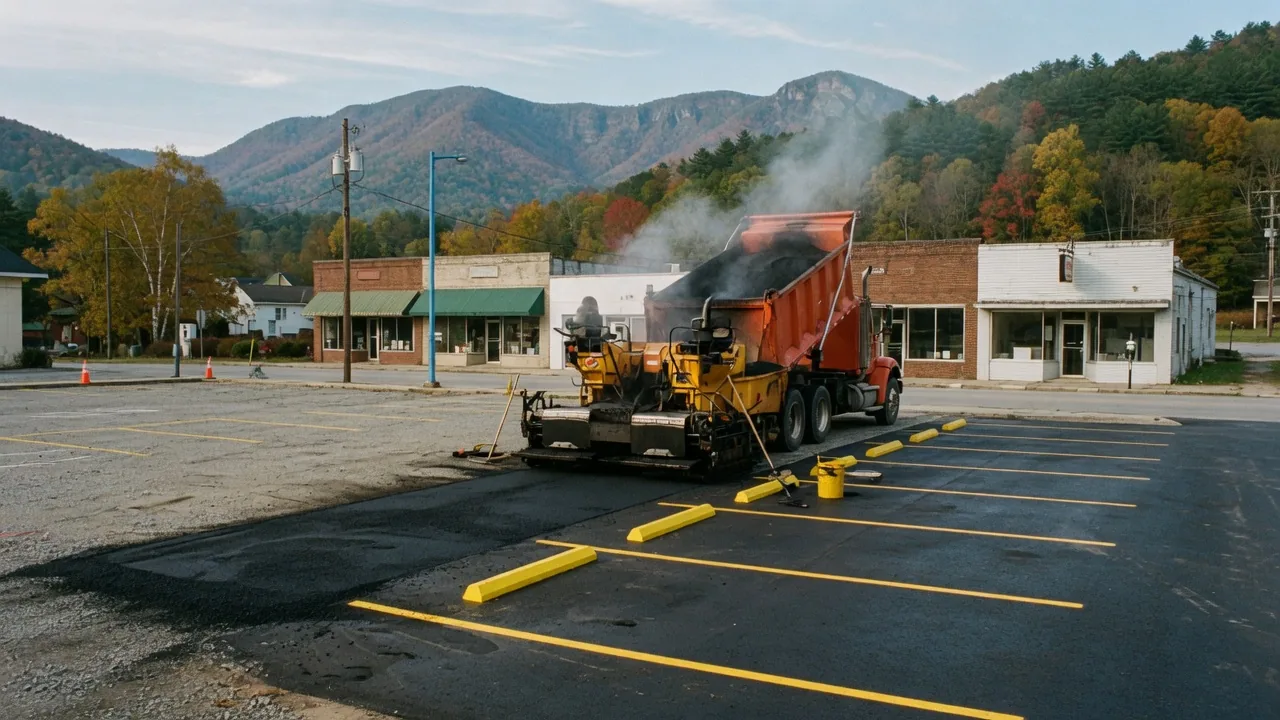
Pictured: illustration: a small parking lot being paved, with fresh striping on the finished half. An illustration of the work, not a job photo.

Get a free estimate

Tell us about the driveway, lot or road. We measure it, check the base and the water, and put a real price in writing.

Free, no obligation. A written price after the site visit.

Free on-site estimateA real number, in writing, after we measure and check the base.
Base first, then blacktopCompacted stone, drainage, then hot mix, in that order.
Five countiesBuncombe, Haywood, Henderson, Madison and Transylvania.
Straight answersWe say when a patch or an overlay is the honest fix.
Quick answer
Parking Lot Paving in Lake Junaluska, NC

Parking lot paving in Lake Junaluska, NC typically runs $1.75 to $3.50 per square foot for mill-and-overlay work, with full-depth reconstruction on soft ground landing between $4 and $7 per square foot. The price movers here are asphalt thickness, base condition, and whether the lot takes delivery trucks or just Sunday-morning sedans.

19
federal disaster declarations on record in Haywood County
Hurricane Dorian
most notable event in the federal record
1973–2026
span of the declaration record
Waynesville
Haywood County hub

Why Lake Junaluska lots ask a different asphalt question

Most paving quotes in Haywood County get argued over on thickness, and in Lake Junaluska that argument matters more than the price tag. The lots around the lake sit close to the water table, and they serve two traffic patterns that pull in opposite directions. A church lot fills and empties in twenty-minute bursts on Sunday, then sits empty all week. A boat ramp or conference center lot takes trailers, shuttles, and delivery trucks with rear axles that dig in on the turn. Two inches of compacted asphalt handles the first lot fine for years. It will rut and shove on the second one inside of a season, especially at the corners where trucks turn.

The honest answer to "two or three inches" is: match the thickness to the load, not to the bid. Two inches of compacted surface course over a sound base is the standard for light passenger parking. Three inches of compacted asphalt, placed in two lifts so each layer compacts before the next, is what comes up when the lot sees loaded trucks, dumpsters, or bus traffic. A single lift of three inches does not compact the same as two lifts of 1.5 inches, no matter how the crew words the ticket.

The thickness and lift table, in plain numbers

These are working ranges for residential and commercial lots in the Haywood County market. Actual numbers depend on the square footage, base condition, and how much edge and drainage work the lot needs. The Haywood County asphalt cost breakdown covers residential driveways; the table below is for parking lots specifically.

ScopeWhat it meansTypical range
Sealcoat onlyCleaning, crack fill, one sealer coat$0.15–$0.30 / sq ft
2" overlay, one liftLight passenger traffic, base already sound$1.75–$2.75 / sq ft
3" overlay, two liftsTrucks, dumpsters, shuttle or bus traffic$2.75–$3.50 / sq ft
Mill and overlayGrinding down before repaving, preserves curbs and grades$2.50–$4.00 / sq ft
Full-depth reconstructionRemove asphalt and failed base, rebuild from stone up$4.00–$7.00 / sq ft
StripingStalls, arrows, ADA spaces$0.10–$0.40 / sq ft, layout-dependent

A full-depth rebuild is not a sales pitch. It is what the lot needs when the subgrade under the asphalt has gone soft or the base stone was undersized to begin with. Laying new asphalt over a failed base is the single most common way money gets wasted on a parking lot.

Water, slope, and why half of all paving calls start there

Lake Junaluska sits in a basin, and Haywood County's federal disaster record shows it: 19 declared events touch this county across 1973-2026, overwhelmingly storm and flood family. Every one of those events pushed water at pavement that was graded for a drier assumption. A lot that does not shed water will fail no matter how thick the asphalt. Standing water at the low corner, a spring that keeps the base wet, an uphill drive that dumps runoff onto the lot, all of these shorten the life of a new surface fast.

Before anyone quotes a repave, the drainage question has to be answered: where does the water go, what is the grade, and are the catch basins or swales sized for a real storm? The NC Department of Environmental Quality regulates stormwater in ways that matter for commercial lots, and the surface that drains to the lake is held to a higher standard than a lot draining to a ditch. Skipping the drainage line item is not a cheaper lot. It is a lot that gets repaved again in five years.

Permits, access, and the paperwork that sits under the pavement

Any lot that changes its curb cut, driveway apron, or connection to a public street needs a driveway permit from NCDOT before a single load of asphalt shows up. Applications run through NCDOT Connect, and the main NCDOT site has the driveway and street access rules. This is not a formality. Paving over an unpermitted access point, or widening a lot entrance without one, is the kind of thing that gets caught at resale or when the property is reviewed for a change of use.

Beyond the access permit, larger grading and stormwater work may pull in additional county and state review. The NC Licensing Board for General Contractors sets the dollar threshold above which a paving or grading job requires a licensed general contractor, and that threshold is lower than most property owners assume. Ask the contractor which license applies to your job before you sign anything. A crew that cannot answer that question is not the crew for a commercial lot.

What separates a ten-year lot from a five-year lot

Three things move a Lake Junaluska parking lot from ten years to five: base prep, compaction, and thickness. Base prep means the subgrade is proof-rolled, any soft spots are cut out and replaced, and the stone is graded and compacted before asphalt goes down. Compaction means each lift is rolled to spec, which is what the two-lift thickness requirement is actually buying. Thickness means the load-bearing capacity matches the traffic.

All three cost more up front. All three are invisible a year later, and all three are the difference between a lot that holds and a lot that cracks along the same seams it cracked along last time. When you are comparing bids, compare the section detail, not just the price per square foot. More on how this trade is scoped and priced sits on our parking lot paving overview, and our local paving contractors page covers who is working in the area right now.
Haywood County, NC: the storm record

Federally declared disaster events19
Named storms in the recordHurricane Dorian, Hurricane Florence, Hurricane Helene, Hurricane Ian, Hurricane Isaias, Hurricane Ivan
Incident typesFlood, Hurricane, Severe Storm, Snowstorm, Tropical Storm
Record span (fiscal years)1973–2026
Source: FEMA OpenFEMA disaster declarations. County-level federal declarations, not individual claims.
More in Lake Junaluska

Everything we build in Lake Junaluska, NC

Questions people ask

Straight answers

How much does it cost to pave a parking lot in Lake Junaluska NC?
Most repaves land between $1.75 and $3.50 per square foot, with full-depth reconstruction running $4 to $7 per square foot. The big movers are thickness, base condition, and how much truck traffic the lot sees.
Do I need two inches or three inches of asphalt?
Two inches of compacted surface course is the standard for passenger parking over a sound base. Three inches placed in two lifts is what trucks, dumpsters, and bus traffic call for. A single lift of three inches is not the same as two lifts totaling three inches.
Can I just overlay the existing asphalt?
Only if the base underneath is still sound and the drainage is fixed. Overlaying over a failed base or wet subgrade is the most common way a parking lot repave gets wasted. A mill-and-overlay is the middle option when the surface is worn but the base holds.
Do I need a permit to repave or widen a parking lot?
If the curb cut, driveway apron, or street connection changes, you need an NCDOT driveway permit through NCDOT Connect. Larger grading and stormwater work may pull in additional review. Ask before the crew shows up.
Is a licensed contractor required for parking lot paving?
The NC Licensing Board for General Contractors sets a dollar threshold above which a general contractor license applies, and commercial paving and grading jobs often cross it. Verify the license matches the scope before you sign.
How long before I can park on new asphalt?
Passenger traffic is usually fine within a few days of the final lift, but trucks and heavy loads should stay off longer, often a week or more, depending on weather and mix. Let the surface cure before you bring trailers or shuttles back onto it.
Does stormwater at the lake change the rules for my lot?
It can. Lots draining toward Lake Junaluska may face stricter stormwater requirements through the NC Department of Environmental Quality. Drainage and detention should be part of any commercial lot repave discussion, not an afterthought.
Our work

Our work

Illustration: fresh black asphalt on a driveway curving up a wooded mountain lot. Built by Mountain Asphalt Paving.
Illustration: fresh black asphalt on a driveway curving up a wooded mountain lot.
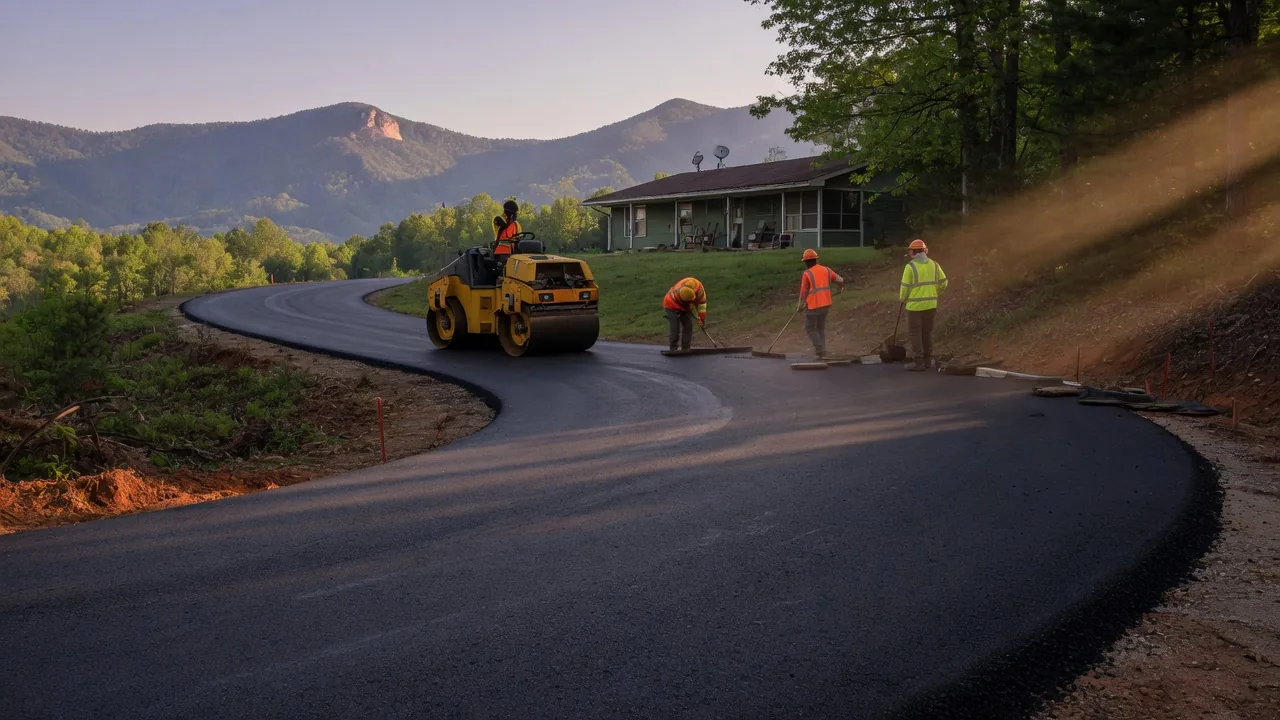
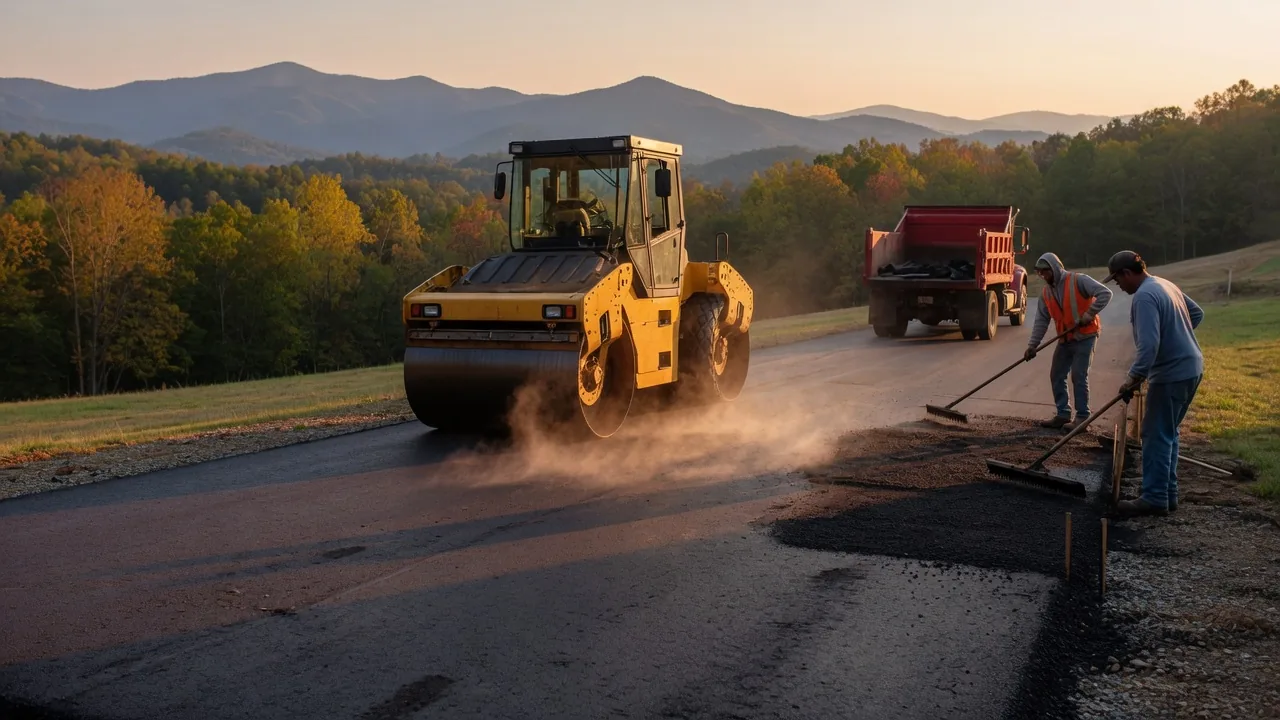
Illustration: a roller compacting hot-mix asphalt on a residential driveway. Built by Mountain Asphalt Paving.
Illustration: a roller compacting hot-mix asphalt on a residential driveway.
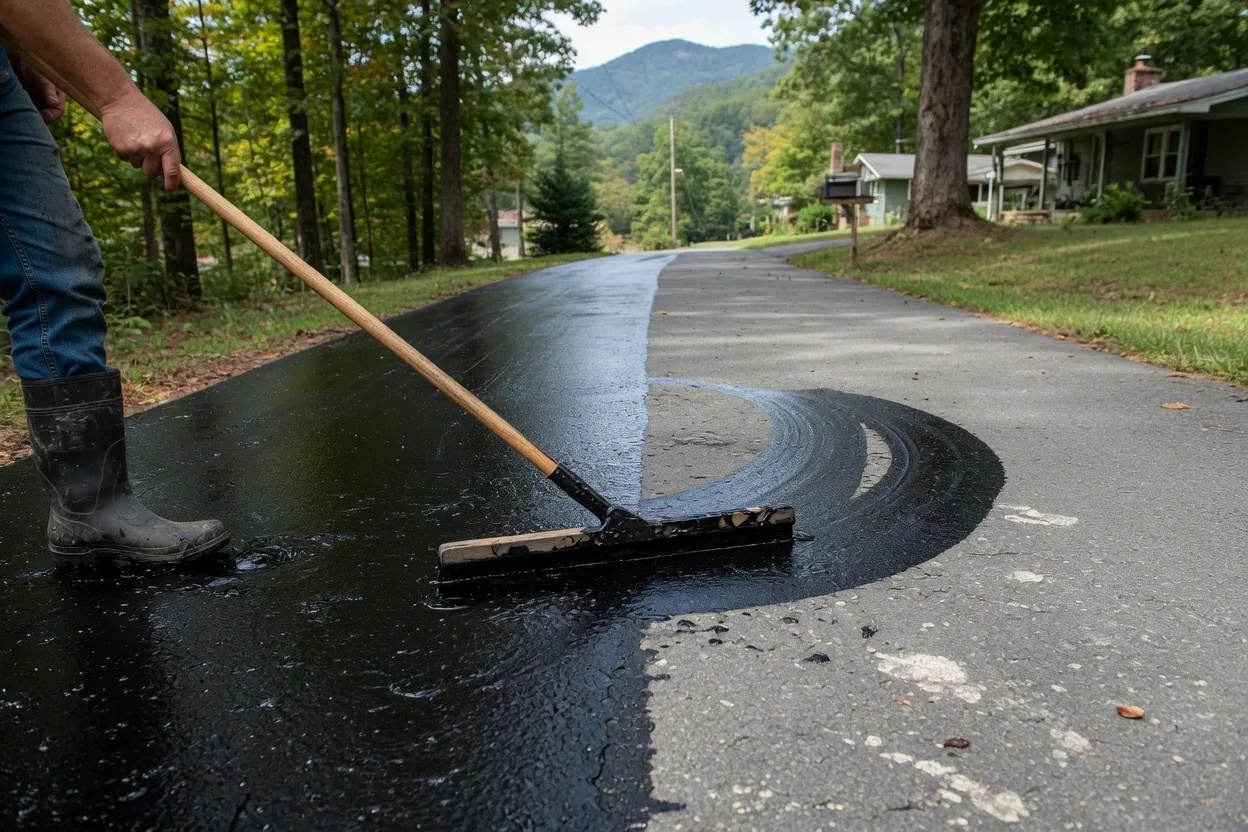
Illustration: sealcoat going down by squeegee, the treated half glossy black beside the faded half. Built by Mountain Asphalt Paving.
Illustration: sealcoat going down by squeegee, the treated half glossy black beside the faded half.
Illustration: a small parking lot being paved, with fresh striping on the finished half. Built by Mountain Asphalt Paving.
Illustration: a small parking lot being paved, with fresh striping on the finished half.
Get a quote

Tell us about your project. We price it straight.

Where it is and what you need — that's all it takes to start. You get a clear scope and an honest number, and your info never gets sold to a list.

Get a free estimate

Free, no obligation. A written price after the site visit.