Where the money actually goes on a Buncombe County extension
Almost nobody is paying for asphalt alone. On a typical Asheville-area widening, the blacktop is often the smallest slice of the bill. The larger numbers live underground and on the edges: grading and cut-and-fill on a slope, a retaining wall where the driveway had to be benched into the hillside, drainage that keeps runoff off the new surface, and the gravel base that asphalt needs to survive a mountain freeze-thaw cycle. That's why two neighbors on the same road can get bids thousands of dollars apart for what looks like the same job. The per-square-foot cost breakdown on this site walks through the math; this page is about which line items blow up the total when the lot is not flat.
Drive through West Asheville, Haw Creek, or the roads climbing out of Black Mountain and you can read the same story in the pavement. Drives that were cut into the hillside decades ago have settled, cracked, and heaved at the toe. The repair isn't a new layer of blacktop; it's a rebuild of what's underneath. When a homeowner asks for an extension to add a parking pad or a second vehicle, the honest answer is often that the extension and the rebuild are the same conversation, because the new asphalt has to tie into a base that may already be failing.
Buncombe County's housing stock makes this worse. The area has a deep inventory of mid-century homes with narrow, short drives built for one car, on lots that were never graded for modern vehicles. Adding a third parking space to a 1960s ranch on a slope means either cutting back the hill or building out over it, and both of those choices carry real structural costs before a single load of asphalt is ordered.
Line items that move the number hardest
Slope and benching. A driveway that has to be cut into a gradient requires excavation and possibly a retaining structure. The steeper the hill, the more engineered the fix. On a lot with more than about a 10% grade, benching is often the only way to get a stable surface, and benching means moving dirt, compacting fill in lifts, and dealing with the spoils.
Base depth. Mountain soils and frost movement mean a deeper compacted stone base than a flatland job. Skipping it is the single most common reason a new apron cracks within a couple of winters. In the clay-heavy soils common around the French Broad River valley, base depth and drainage are inseparable: water that can't drain through the subgrade will sit against the asphalt and work it loose.
Drainage. Water off an uphill slope has to be intercepted and routed before it reaches asphalt, not after. Culverts, swales, and ditch work are real costs, and they are non-negotiable in this climate. A driveway that runs downhill to the street needs a way for storm flow to cross it without eroding the shoulder or flooding the garage.
Access and haul distance. Wide equipment and dump trucks need somewhere to turn around. Tight residential grades in Asheville's older neighborhoods slow the crew and add labor hours. A job on a switchback road with no turnaround can add a day of labor just in equipment shuffling, and that cost shows up in the bid whether it's itemized or not.
Connection and encroachment. Joining new asphalt to an existing drive requires saw-cutting and a proper seam. A driveway apron that meets a public street likely requires an NCDOT or local encroachment permit, which adds engineering time before any asphalt is laid. A qualified paving contractor will sort the permit question out early; North Carolina licensing and permitting expectations for site work and roadway access are set at the state and county level, and NCDOT covers the state-road side. For work that crosses into building-code territory, the NC Department of Insurance and Building Code Council is the baseline reference.
Scope vs price, in one table
Ranges below are installed cost per square foot for a driveway extension or widening in the Asheville area, all-in: grading, base, asphalt, and standard cleanup. Steep lots with retaining walls, deep utility cuts, or tight access push toward the top. Add 10–25% for a curved or heavily benched layout.
| Scope | Typical per sq ft | Notes |
|---|---|---|
| Widen existing asphalt, flat lot, good base | $6–$9 | Cleanest case; new asphalt ties to existing with a saw-cut seam |
| Full extension, mild grade, new base | $9–$12 | Standard mountain-lot job; deeper stone base than flatland |
| Steep drive with benching and drainage | $12–$16 | Cut, compacted fill, swales or culvert included |
| Extension requiring retaining wall | $16+/sq ft | Wall priced separately by height and length; geogrid likely |
| Turnaround or parking pad addition | $8–$14 | Area drives cost more than a simple straight run |
For a fuller picture of what a new or widened surface should look like when it's done, see the asphalt driveway overview on this site. It's worth reading before you take bids, because it gives you the vocabulary to ask contractors specific questions about base depth and seam treatment instead of just comparing a single per-square-foot number.
One more wrinkle specific to this market: the western North Carolina paving calendar is shorter than most homeowners expect. Asphalt plants need sustained warm temperatures to produce and place mix, and the mountain microclimates around Asheville mean the season can open and close at different times depending on elevation. A job scheduled for late fall at 3,000 feet may not be viable two weeks later, which can compress the bidding window and tighten contractor availability. Booking early in the spring is the practical move if you want a choice of bids rather than whatever fits.
Permits, drainage rules, and why they matter here
Buncombe County and the City of Asheville regulate driveway aprons, stormwater runoff, and right-of-way encroachment, and the rules tighten as slope and drainage risk increase. Adding impervious surface to a hillside lot can trigger stormwater review, especially near waterways or where runoff crosses a neighbor's property. The state sets the baseline for construction work through the NC Department of Insurance and Building Code Council, and larger site-work and stormwater thresholds are administered by NC Department of Environmental Quality. Before any asphalt is ordered, confirm three things: whether a permit is required, how runoff will be handled, and who owns the seam where new asphalt meets street or existing drive. The NC driveway permit rules page answers the first of those in plain language.
The stormwater piece deserves special attention in this watershed. Buncombe County drains into the French Broad River and its tributaries, and the region has been under increasing pressure to manage runoff from new impervious surfaces. For a homeowner, the practical implication is that a widening project on a sloped lot may need to show where the added water goes and how it slows down before it leaves the property. That's a design task, not a paperwork task, and a contractor who doesn't ask about it early is probably not the right contractor for a mountain lot.
Contractor licensing is the other piece worth checking. North Carolina doesn't require a general contractor license for every small residential project, but the thresholds exist, and the North Carolina Licensing Board for General Contractors is where to verify whether a bidder is properly licensed for the scope of work. For anything involving drainage structures or site work that crosses into regulated areas, the licensing question is not optional.
Why a wet season is the real stress test
This part of the state has a well-documented history of federally declared disaster events (19 declarations across 1973-2026), and the pattern is consistent: saturated ground, heavy runoff, and quick damage to driveways with weak base or missing drainage. An extension built in July on a dry slope with no water management is a repair waiting to happen by the next spring. That is not a scare tactic; it is the reason serious asphalt contractors in the Asheville area budget drainage and base depth up front rather than quote the cheapest per-square-foot number on the phone. The National Weather Service tracks the local precipitation record if you want to see the trend.
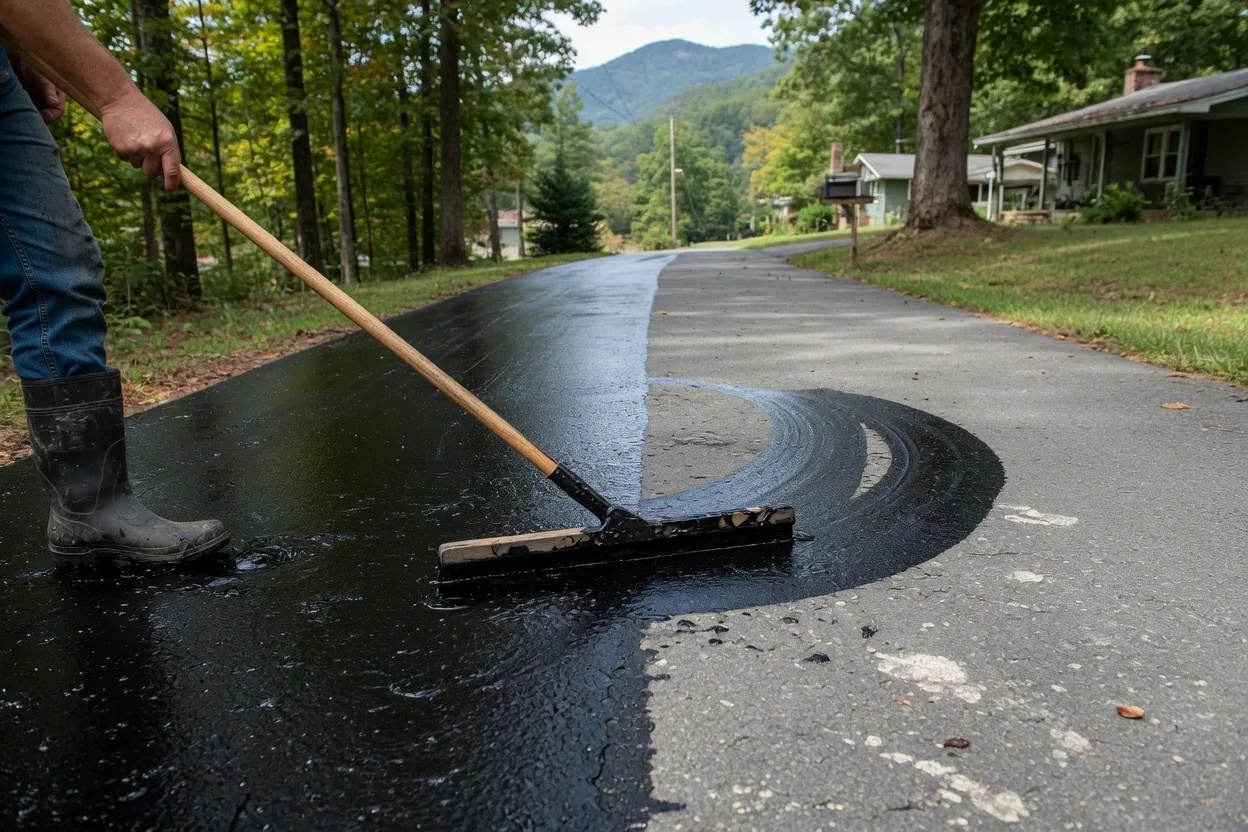
There's a specific failure mode worth knowing about if you're planning a widening in the Asheville area. It happens where new asphalt meets an older drive on a slope. If the seam isn't saw-cut and keyed properly, water gets into the joint, freezes, and pries the two surfaces apart. Within a couple of seasons you have a crack that runs the length of the seam and a repair bill that undoes whatever you saved on the original bid. The fix is not complicated, but it requires the contractor to cut back the old asphalt rather than just overlay the edge, and that's a line item you should see in the estimate.
Retaining walls are the other long-term item to think about. A wall that looks fine in year one can start to lean by year five if the drainage behind it isn't handled. Geogrid reinforcement, proper backfill, and a way for water to escape the wall face are what keep it vertical. In a climate with this much rain and this many freeze-thaw cycles, a wall is a drainage project first and a structural project second.