Two inches or three: what actually decides it here
Drive through a Weaverville hollow or up a Black Mountain switchback and you can usually spot the driveways that were built one bag of mix thin: alligator cracking at the base of the hill, ruts on the outside of every curve, gravel poking through the mat by year three. Asphalt thickness is not a preference. It is a load calculation wearing a number, and the number changes the moment your driveway climbs.
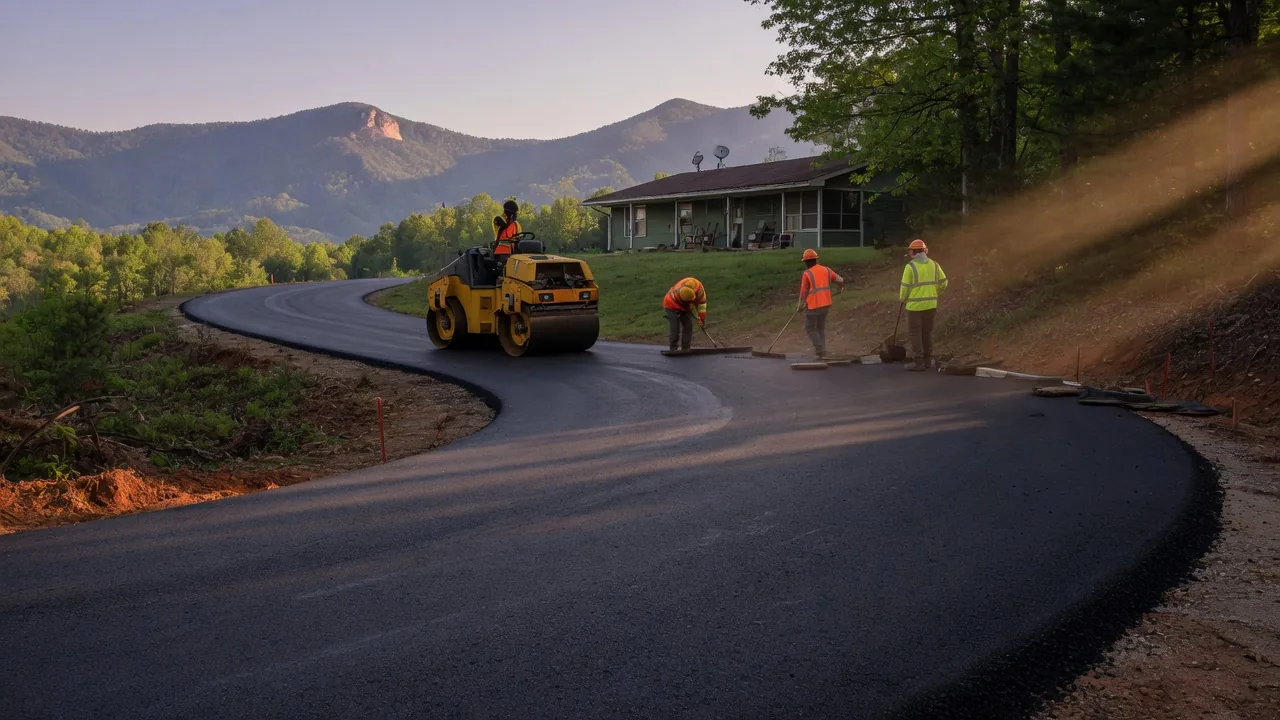
The working rule for this county: 2 inches of compacted asphalt is the floor for a flat, car-only drive over a properly built base. Add a third inch when the drive rises more than about a 10 percent grade, when it dead-ends at a turnaround that gets three-point turns, or when anything heavier than a half-ton pickup parks on it. On steep subdivision drives off Elk Mountain or Town Mountain Road, that third inch is not upsell — it is the difference between a mat that flexes and one that shears.
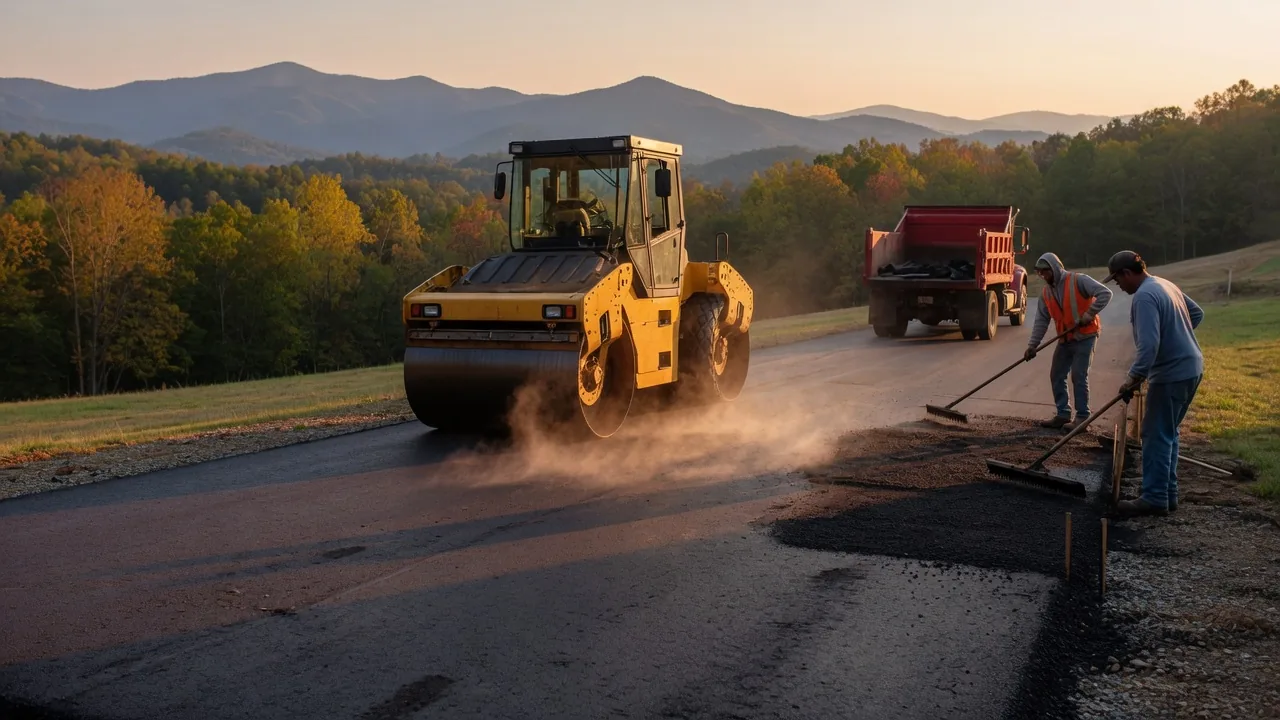
The construction type matters as much as the number. Two inches placed in a single pass by a small paver compacts unevenly and often finishes closer to 1.5 inches under the roller. Three inches placed in two lifts, 1.5 to 2 inches each, compacts to spec and bonds layer to layer. Ask which one the bid describes.
What drives the number: trucks, turns, and the grade at your mailbox
Asheville-area residential drives see more truck traffic than most homeowners expect. Delivery trucks, septic pumpers, propane trucks, and the occasional loaded trailer back up mountain driveways every week. A drive designed for a sedan will rut under a loaded box truck even if the truck only visits twice a year.
Three pressure points to check before you settle on a thickness:
Turning loads. A vehicle turning at low speed scrubs the surface — that is where the heaviest shear happens. Any drive with a turnaround, a culvert crossing, or an awkward pull-in needs the thicker mat at that location, not uniformly.
Grade. Water moves fast on a mountain grade, and so does a truck brake. Steep drives need thicker asphalt and a heavier base to resist the shove that develops in the mat over years of braking.
Drainage. Water sitting at the edge of a drive softens the base more than any single load event. The state's storm record for this county — 19 declared events across 1973-2026 — is mostly water events, and every one of them pushed runoff at driveways built for a drier assumption. Thickness cannot fix a base that stays wet. Fix the grading first.
Scope vs. price: what Buncombe County drives actually cost
Prices below are typical regional bands, not quotes. Every drive is measured and priced individually — the table shows what drives the number on each scope. For a deeper per-foot breakdown, see our cost per square foot guide.
| Scope | Typical range | What it covers |
|---|---|---|
| Overlay on sound existing asphalt | $1.75-$3.00/sq ft | 1.5-2 inch scratch course over a drive that is not base-failing |
| New 2-inch drive over new base | $3.00-$5.00/sq ft | 6-8 inch compacted crushed base + 2 inch asphalt in one or two lifts |
| New 3-inch drive in two lifts | $4.50-$7.00/sq ft | 8-10 inch base + two asphalt lifts; standard for steep grades and truck traffic |
| Full tear-out and rebuild | $6.00-$10.00/sq ft | Remove failing asphalt and base, regrade, rebuild to fresh base and 2-3 inch mat |
| Culvert crossing or drainage correction | $1,200-$4,500 per site | Pipe, headwalls, and grading work — priced separately from paving |
One note on stacking up a driveway from gravel: if you are moving from a gravel surface, our gravel-to-asphalt conversion page walks through what has to happen before any hot mix goes down. Skipping base prep is the single most common reason a new driveway underperforms its thickness.
What the state expects you to know before anyone paves near the road
Any driveway that ties into a state-maintained road needs a driveway permit from the NCDOT before work starts. The permit affects the apron width, sight distance, and where your culvert pipe sits relative to the shoulder — all things that can affect the driveway section right at the road. Paving crews who work this county regularly know the drill; ask directly whether the permit is your responsibility or theirs.
On any job above the general-contracting threshold, the contractor must be licensed through the North Carolina Licensing Board for General Contractors. Paving contractors are not always general contractors, but the licensing thresholds apply to the job, not the trade label. Ask for the license number and verify it.
Finally, asphalt work is seasonal here. Hot-mix plants operate on weather windows, and winter mix is a real product with real use limits. If you are quoted a full-depth new build in January, ask which mix specification the plant is supplying and why it suits the temperature.
Reading a bid: what a proper scope includes
The number that matters is not just thickness. A complete scope for a Buncombe County driveway names the base depth and compaction, the asphalt mix designation, the lift schedule, the edge treatment (stone shoulder, curb, or nothing), and the drainage corrections. If the bid just says "2 inch asphalt driveway" with one total price, you cannot compare it to anything.
Three questions that separate serious bids from thin ones: How deep is the base, and how is it compacted? How many lifts, and how thick is each lift before rolling? What is included for water — grading, culvert, or nothing? If the answer to the last one is nothing, and your drive has any history of puddling or edge erosion, budget the drainage separately before you sign. Our asphalt driveway overview lays out the full scope sequence from subgrade to finished mat.