Two inches or three? The thickness question decides your number
Most asphalt quotes in Madison County come down to one argument before a single ton of mix is laid: two inches or three. A two-inch mat over a sound existing base is the economical path — it's a wearing course, and on a lightly used driveway that's genuinely enough. Three inches, placed in two lifts, is what a driveway carrying a loaded truck or a steep grade actually needs. On the grades that run off the French Broad valley up toward Mars Hill and Marshall, turning loads and brake drag chew through a thin mat fast, and a one-lift three-inch pour traps weak spots the roller can't reach.
That debate plays out differently depending on what rolls over the driveway. A family car in a Woodfin hollow with a gentle apron can live happily on two inches for years. A driveway serving a working farm off a gravel county road, or a rental cabin up a switchback grade, sees a different load picture entirely: delivery trucks, propane trucks, the occasional equipment trailer, and the sheer rotational force of backing and turning on a slope. That's where mix design matters as much as depth, and where a stiff, angular surface mix earns its keep against the shoving and rutting that softer mixes develop on grades.
Here's how the scope breaks down by price:
| Scope of work | Typical Madison County range | What drives it |
|---|---|---|
| Two-inch overlay on sound base | $1.75 – $2.75 / sq ft | existing surface condition, prep needed |
| Three-inch new build, two lifts | $3.00 – $4.50 / sq ft | stone base depth, grading, compaction |
| Full driveway, 600–1,200 sq ft | $3,200 – $6,500 | length, width, turnouts, drainage |
| Long or steep mountain run | $7,000 – $11,500+ | grade, culverts, retaining, haul distance |
Those are working bands, not quotes. A driveway cut into a hillside needs a site visit before anyone can honestly price it, because base depth and drainage change the tonnage fast. A short gravel-to-asphalt conversion on flat ground near the county's main corridors can come in lower than the table's low end if prep is minimal; a long run with a switchback, a culvert, and a retaining wall goes the other way quickly. The honest answer is that the number is built from the site, not pulled from a chart.
Why mountain grades rewrite the math
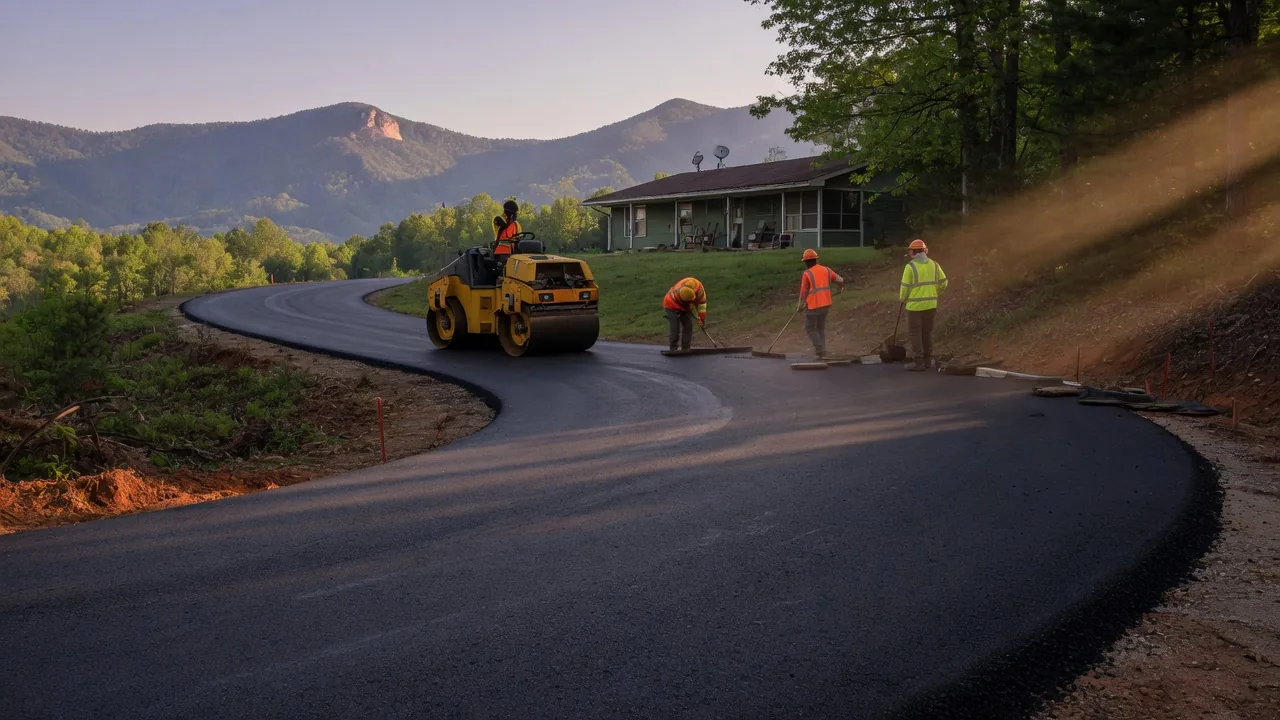
Madison County isn't flat driveway country. From the valley floor in Woodfin up to ridge lots outside Marshall and Mars Hill, grades routinely exceed what a Piedmont paving crew expects, and that has two consequences. First, the mix design has to hold up to shear — a stiffer, more angular mix resists the shoving and rutting that soft mixes develop on slopes. Second, water has to be controlled, because a driveway that sheds runoff onto a road, a neighbor's property, or a creek bed is a driveway that will be re-graded sooner than it should be.
The terrain here also shapes the housing pattern. Lots tend to be carved into hillsides rather than graded flat, which means switchbacks, cut-and-fill benches, and turnout widening at the top are common. Each of those features adds base stone, compaction passes, and haul distance — and haul distance in these mountains is not trivial. Material often comes up winding two-lane roads, and a loaded dump truck making those runs costs more than a flatland delivery. Add a culvert under the apron and a drainage swale along the uphill cut, and the scope creeps up honestly rather than artificially.
That water story is real here and it's documented: 21 federally declared disaster events have touched Madison County over 1978-2026, most of them storm and flood family. The National Weather Service tracks the rainfall patterns that drive that history (weather.gov), and it's why we build cross-slope and drainage into the quote rather than treating them as add-ons. A driveway that isn't designed to move water off the slope is a driveway that will need repair after the next heavy system. For the broader region picture, see asphalt driveway cost.
One lift or two: what compaction really costs you
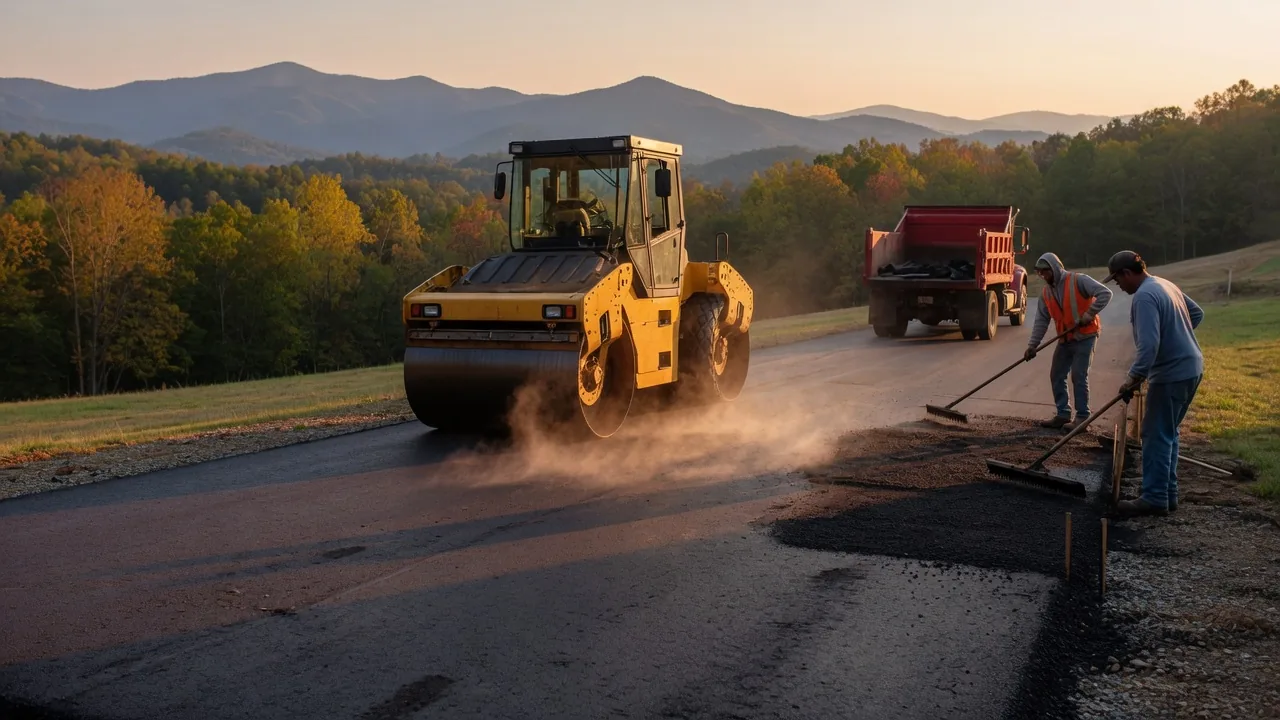
The single most common shortcut on cut-rate asphalt work is a single lift. A paving crew lays three inches in one pass, rolls it, and calls it a driveway. It looks fine for a season, then the roller's inability to compact the bottom of the mat shows up as a soft, rutting surface. Standard practice places thick mats in two lifts of roughly equal depth, rolling each before the next goes down. That's more labor and more time, and it's why an honest two-lift quote runs higher than the number from the guy who does it in one pass.
Compaction also depends on the base beneath the asphalt. Crushed stone placed and compacted in lifts, with any soft spots dug out and replaced, is what keeps the pavement from flexing. On the older roads and farm-access drives scattered through Madison County, the base is often the real project, and trying to pave over a failing one is money thrown away. A driveway that has been gravel for decades has usually settled unevenly, with ruts, potholes, and organic material mixed in; all of that has to be dealt with before the first ton of asphalt shows up. Proper base prep is the unglamorous part of the job that nobody photographs and everybody notices three winters later. Our asphalt driveways guide walks through what proper base prep looks like.
What NC permits and licensing mean for your job
Most residential driveway paving in North Carolina is a non-permitted improvement — but the moment your driveway meets a state-maintained road, the driveway apron and any culvert installation fall under an NCDOT driveway permit (ncdot.gov). If your driveway ties into a state road, ask the contractor who pulls that permit and whether the apron meets the state's sight-distance and drainage standard, because a poorly built connection is a frequent cause of rework. In a county where many driveways meet two-lane mountain roads with limited sight distance, that apron geometry is safety-relevant, not just paperwork.
Paving itself isn't a licensed trade in this state, but paving contractors performing general contracting work above the state threshold fall under the North Carolina Licensing Board for General Contractors (nclbgc.org). For larger commercial or multi-family paving scopes, that licensing question matters — verify the license before signing anything substantial. The NC Department of Insurance maintains the state building code that governs related site work (ncdoi.gov).
If your project involves moving earth near a creek or stream — common on these hillside lots — the North Carolina Department of Environmental Quality (deq.nc.gov) is the state agency to understand, because sediment and stormwater rules can apply to grading that alters drainage. Most residential driveways never trigger those thresholds, but a big cut-and-fill job near a waterway can, and it's worth asking before work starts rather than after.
How to keep a paving bid honest in Madison County
Three things to ask every bidder, and the answers tell you more than the price:
- How many lifts? If the answer is one for a three-inch or thicker mat, that's a shortcut you'll pay for later.
- How much base, and how is it compacted? The base is where a driveway is won or lost, especially on grades.
- Where does the water go? A bid that doesn't address drainage on a sloped driveway hasn't finished the job on paper.
Compare any quote against the range table above. If a bid lands well outside it, ask them to walk you through the tonnage, base depth, and grade work. Sometimes there's a real reason — long hauls on mountain roads are expensive — and how they explain it tells you whether the number is built or guessed. A bidder who can explain their tonnage math and where the runoff exits the property is a bidder who has actually thought about your site; one who can't is guessing at both the price and the job.
Timing matters too. Warm-season paving gives the mat the best chance to compact and cure correctly, and in this climate that window runs roughly late spring through early fall. Scheduling around the weather rather than fighting it usually produces a better driveway for the same money. For the Woodfin-area picture and the region-wide guide, see asphalt paving.