The red clay under every Buncombe County driveway is the real job
Stand anywhere on a graded lot in Buncombe County after a hard rain and you will see the actual construction problem: red clay that holds water on top and turns greasy the moment it is disturbed. Asphalt laid directly on that clay, or on a skim of old gravel that was never compacted, will crack within a season or two — not because the asphalt failed, but because the base moved beneath it. The mix is the visible 2 inches. The 4 to 8 inches of compacted crushed stone under it is what you are actually buying, and on steep Asheville-area lots that base is where the money goes.
This is why two quotes for the same driveway footprint can differ by thousands and both be honest. One contractor is planning to strip clay, haul it off, and build a proper stone section. The other is planning to feather asphalt over whatever is already there. Ask which one you are getting before you compare prices, because a driveway is a base problem wearing an asphalt coat.
Housing character matters here. A lot of Buncombe County driveways serve homes built on cut-and-fill pads — the house pad was leveled, and the driveway runs across the fill or drops down the cut slope. Fill that was placed and never compacted to a engineer's spec will consolidate under the weight of trucks and pavers, and the asphalt above it reflects every movement. On older Asheville neighborhoods like those off the river bottoms or on the slopes around town, it is common to find a driveway that has been gravel for decades, with clay pushed up through the stone by years of traffic. That is not a paving job. That is a subgrade job that ends with paving.
Slope adds another layer. A flat lot in the county can shed water with a simple crown. A driveway climbing a 12 to 20 percent grade off a mountain road needs the water directed to a ditch or a turnout before it ever reaches the asphalt edge. If it does not, the same red clay that supports the driveway becomes the thing that erodes it from below.
What the base actually requires before hot mix shows up
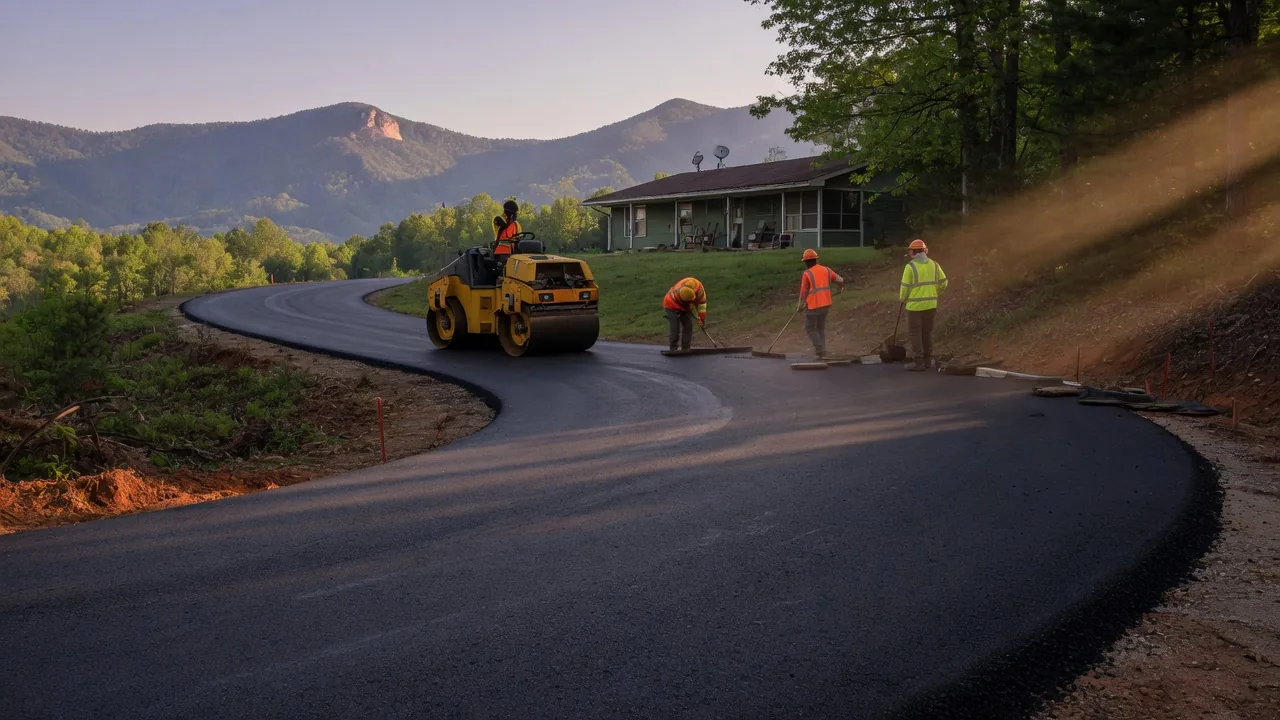
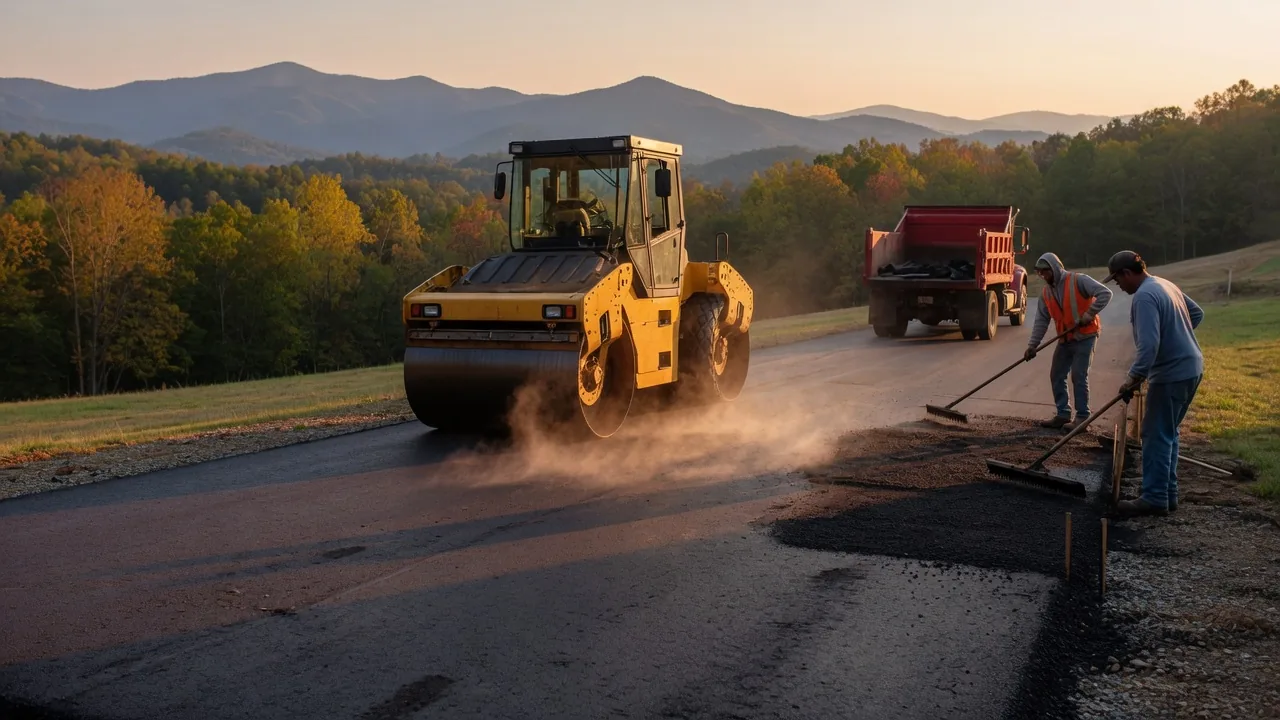
A driveway that lasts in this climate is built from the bottom: subgrade compacted and crowned to shed water, a geotextile separation fabric on expansive clay, then crushed stone in lifts, each one compacted before the next. Only then does asphalt arrive — a binder course and a surface course, placed hot and rolled while it is still workable.
Two practical tests you can run yourself: push a steel rod into the finished stone base — it should resist, not sink — and look at the edges. A driveway with no stone shoulder or graded ditch will pull water under the asphalt at the first freeze-thaw cycle. Buncombe County sits in a freeze-thaw zone, and water that gets into a base, expands, and refreezes is what breaks up most driveways around here. The asphalt driveway cost page on this site breaks base depth against price, because that is the honest way to compare bids.
The stone itself is not mystery material. Most local driveways use a crushed stone gradation that locks together when compacted — often called crusher run or a dense-graded aggregate. What matters is that it is placed in lifts of a few inches and compacted with a plate or roller before the next lift. Dumping a foot of stone in one pass and hoping traffic will compact it is how driveways get built that feel solid for a year and then rut. Ask your contractor whether the base will be compacted in lifts. It is a fair question and the answer tells you a lot.
Drainage is not separate from the base; it is part of it. On a lot where the driveway runs along a hillside, a small swale or a shallow ditch on the uphill side intercepts water before it crosses the pavement. Where a driveway crosses a natural drainage path, a culvert under the driveway carries water through instead of letting it pond at the edge. These are not expensive items, but skipping them is the most common reason a new Asheville-area driveway shows edge cracking within a few winters.
What paving costs here, by scope
These are regional bands, not quotes — slope, access, and base condition swing them. A steep driveway off a mountain road with limited truck access always prices higher than a flat one where a dump truck can back straight in.
| Scope | Typical range |
|---|---|
| Overlay existing sound asphalt (1.5–2 in) | $2–$4 per sq ft |
| New driveway, proper stone base included | $4–$8 per sq ft |
| Gravel-to-asphalt conversion (regrade + base + pave) | $5–$9 per sq ft |
| Base repair only (failed sections, no paving) | $3–$7 per sq ft |
| Sealcoat (existing asphalt, maintenance) | $0.15–$0.35 per sq ft |
A few things move those numbers: how much unsuitable clay must be excavated and hauled away, whether the grade needs a culvert or drainage swale, and whether trucks can reach the work area. If you are weighing a conversion, the gravel-to-asphalt guide walks through what changes when an existing gravel drive becomes a paved one — usually more base work than people expect.
Access is the silent cost driver in this county. A driveway that ends in a tight turn on a narrow mountain lane may require a smaller dump truck or a conveyor, and that slows the job. A long driveway — several hundred feet from the road to the house — multiplies every base and paving number by its length. Homeowners often budget for the asphalt they can see and are surprised by the stone and hauling they cannot. The cleanest way to compare bids is to ask each contractor for the base depth, the stone type, and whether clay will be removed or left in place. Those three answers explain most of a price gap.
The permit question most homeowners skip
Any time a driveway meets a state-maintained road, the connection point is regulated by NCDOT and generally needs a driveway permit — the application process is handled through NCDOT Connect, and the general requirements live at ncdot.gov. Widening, changing a driveway's grade at the road, or adding a culvert can all trigger that step. Inside Asheville city limits, the City of Asheville handles its own right-of-way rules. Skip this and you can end up with a finished driveway and a compliance problem, so the NC driveway permit rules page exists to sort out which authority applies to your address before work starts.
For the paving work itself, North Carolina sets a dollar threshold above which a project counts as general contracting and requires a licensed contractor — the current threshold and license verification are published by the NC Licensing Board for General Contractors. It takes two minutes to look up a license number, and a contractor who hesitates about giving it to you has told you something.
One more permit-adjacent point: if the driveway work changes how stormwater leaves the property, some jurisdictions care about that too. In Buncombe County, lots on slopes and lots near streams can have additional requirements. None of this is meant to scare anyone off a driveway project. It is meant to keep a finished driveway from becoming a paperwork problem, and to keep the work itself from sending muddy water where it does not belong.
Why storm history keeps coming up in driveway conversations
This county has a long record of federal disaster declarations — 19 events across 1973-2026 — and the pattern matters to paving. Heavy rain on saturated red clay is when marginal driveways fail: the subgrade shifts, the asphalt cracks, and a driveway that survived a dry year fails after a wet one. The National Weather Service's outlooks at weather.gov are worth watching if you are scheduling work, but the real lesson is structural. Drainage designed in from the start, and a base that can handle water, is the difference between a driveway that survives the next big rain and one that becomes next year's repair bid.
There is a seasonal angle too. Asphalt placed in cold weather does not compact the same way it does in warm weather, and local paving schedules tend to run from spring through fall for that reason. If a contractor offers to pave in the middle of a mountain winter, ask how they will handle temperature and compaction — it is a legitimate question, not a sign of distrust.
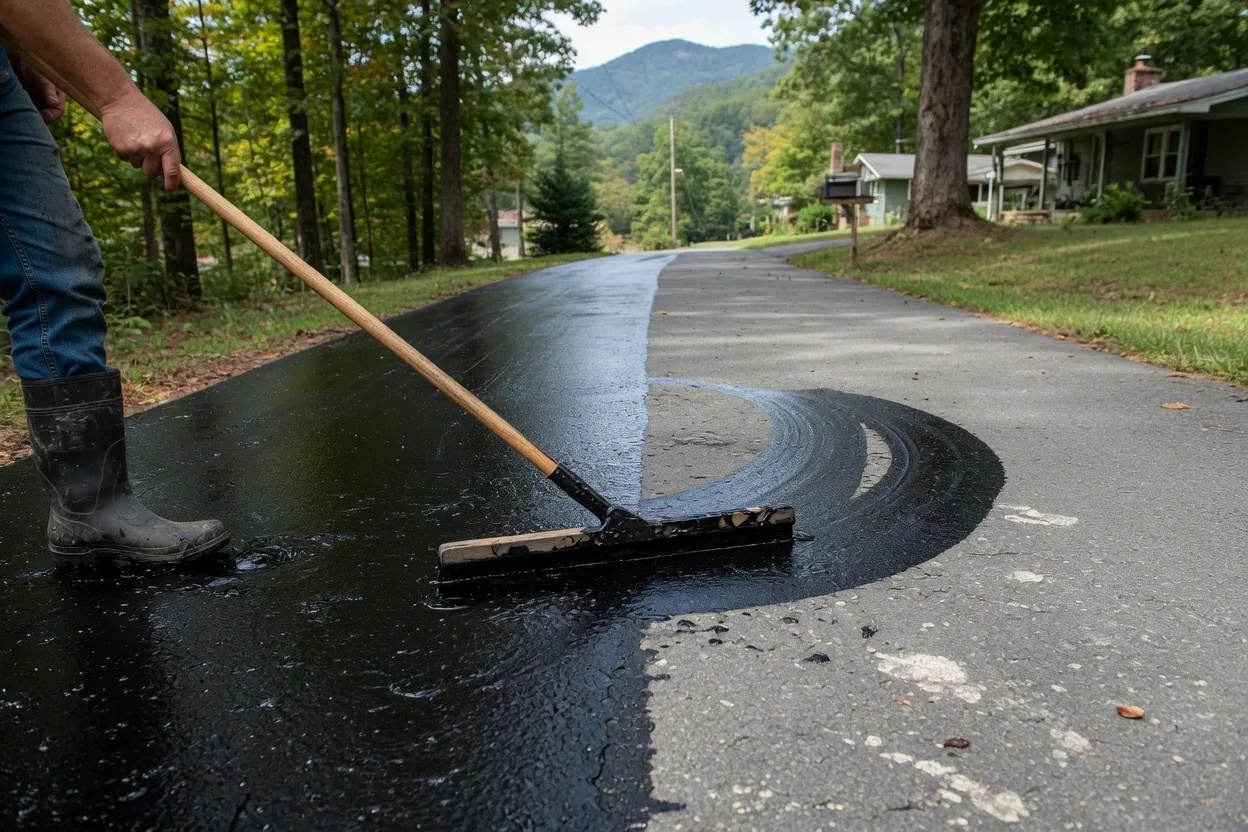
And maintenance does not undo a bad base. Sealcoat every few years protects the asphalt surface from sun and water, but it cannot stop a driveway whose stone was never compacted or whose ditch was never cut. Homeowners who understand the difference between maintenance and repair spend less over the life of a driveway, because they fix the base when it needs fixing instead of resealing over a problem. That is the whole argument of this page in one sentence: the asphalt is the last thing that goes down, and the first thing people talk about, but the base is what decides how long any of it lasts.