Why the calendar, not the crack, decides the job here
Driveways across Buncombe County spend winter doing a slow flex. Water sits in a hairline crack on a 40°F afternoon, drops into the twenties overnight, freezes, expands, and pries the asphalt apart a little more. By March, a crack you could barely see in October is a finger-wide channel full of grit. Sealing works because it keeps that water out — but only if the sealant actually bonds, and that bond is a temperature and moisture story. Most hot-pour rubberized sealants want pavement above roughly 50°F and rising, dry surface, and no rain in the near forecast. In Asheville that points hard at late summer into October, before the first real cold snap. It also explains why a fair-weather trade gets quiet in January: crews can still rout and fill in a stretch of mild weather, but the sealant cools too fast to flow into the crack walls, and what you get is a plug sitting on top instead of a seal inside. Mountain shade matters more than people expect. A driveway under a north-facing hardwood canopy in Fairview or Weaverville may not hit that temperature window until early afternoon, and the shaded half of a lot cures slower than the sunny half. Spring is workable too, but the ground is still shedding winter moisture, and a crack that looks dry on the surface can be weeping underneath. Fall is the cleanest window, and it's also the one homeowners book last.
What sealing actually does to a failing driveway
A crack is an entry point, not the disease. What kills Asheville driveways is water reaching the base course and the subgrade beneath it, softening the soil the asphalt is standing on. Sealed cracks keep that water on the surface and off the base. What sealing does not do is restore structure. If the crack has already widened into a web of connected breaks, that's alligator cracking, which means the base has failed and no amount of sealant will hold it together — the honest fix there is patching or replacement, not a tube of goop. Same story with a single long crack that's opened into a gap: that's usually a structural crack tracking a settlement or root line, and it will keep moving. Sealing it is still worth doing as maintenance, but it's maintenance, not repair. For driveways that are sound but drying out and graying, the right companion service is sealcoating — a surface treatment that protects the top layer, while crack sealing protects the joints.
What cracks cost to seal, and what pushes the price
Residential crack sealing in this region prices two ways: by the linear foot, or as a flat job price for a driveway the crew can walk and measure. Both are legitimate. What matters is that the bid names the linear footage, because that's the only number that makes two quotes comparable.
| Scope | Typical price range |
|---|---|
| Few isolated cracks, blown and filled | $250–$450 flat job |
| Average driveway, 100–200 linear feet | $0.90–$2.50 per linear foot |
| Routed and cleaned before filling | $2.00–$4.00 per linear foot |
| Long or badly deteriorated runs, larger lots | $1,000–$2,500+ |
| Parking lot or commercial apron | Quoted by square footage and crack density |
Routed work costs more because a router cuts a clean reservoir for the sealant to sit in, which is the difference between a seal that lasts several seasons and one that peels out by spring. Cracks packed with dirt and moss have to be cleaned before anything will stick — sealing over debris is the single most common reason a cheap job fails. On steep mountain driveways, access and slope add labor. Gravel-to-pavement transitions, drain inlets, and culvert edges are fiddly and often priced separately. One more line item worth asking about: whether the contractor handles driveway access permitting if your drive meets a state-maintained road, which is the North Carolina Department of Transportation's territory, not the paving crew's (ncdot.gov).
How the work is done, in the order it should happen
A residential crack sealing visit is usually a half day or less:
- Walk and mark. Crew flags every crack worth sealing and separates the ones that need patching instead.
- Dry and clean. Compressed air, sometimes a wire brush or router, to get the crack down to bare asphalt. If there's standing water, the job waits.
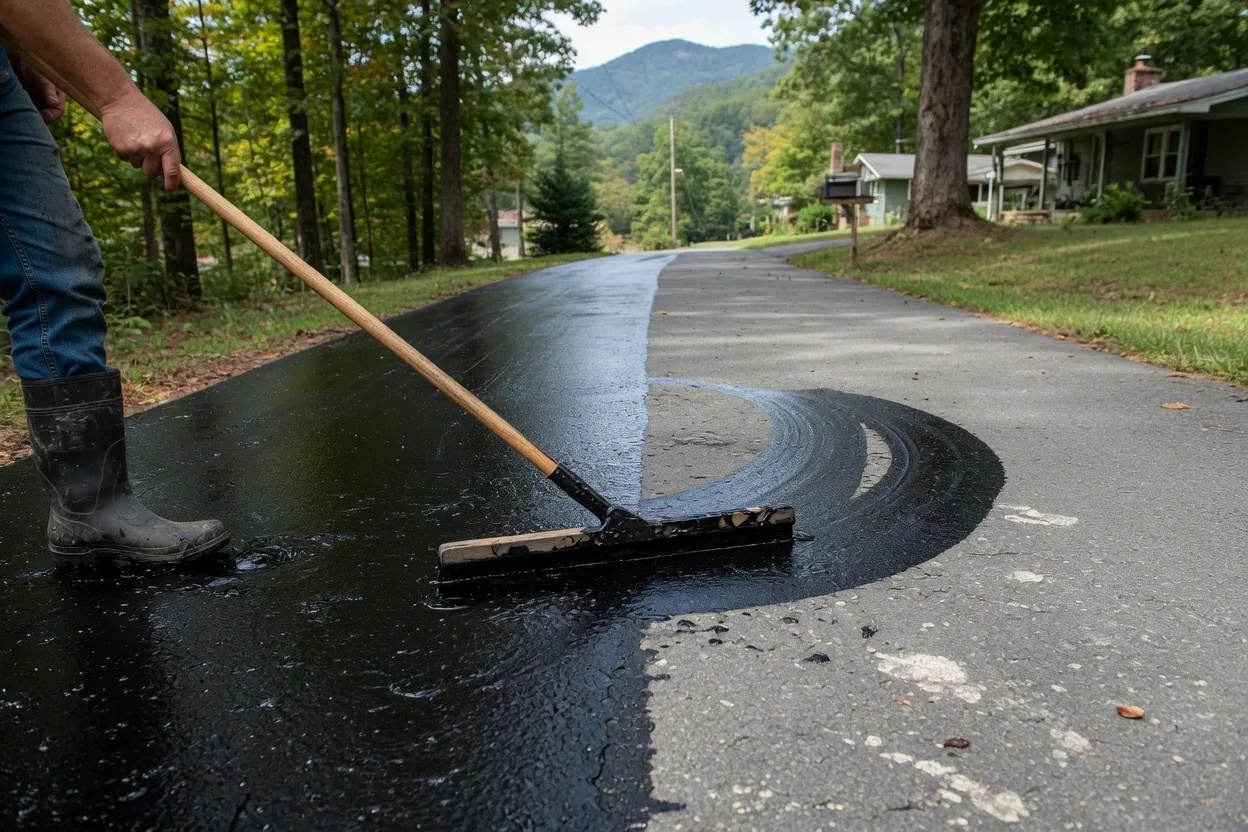
- Fill. Hot-pour rubberized sealant goes in at temperature so it flows to the crack walls, then gets shaped — slightly recessed or slightly proud, depending on the type. A squeegee or wand lets the material cool against the sides, not just the top.
- Set and open. Traffic stays off usually 30 minutes to a couple hours, longer in cool shade. Sand or a blotter coat is sometimes dusted over the fill so tires don't track it.
- Walk-through. You should get a look at what was sealed and a note on anything deferred to patching.
Prep is where the value hides. A crew that cleans properly and seals at the right temperature is doing a structural favor for your base; a crew that squeegees cold sealant over a dirty crack is just cosmetically filling a water trough.
Weather, frost depth, and why this county is hard on pavement
Buncombe County sits in a climate that gives asphalt a workout: warm humid summers, then repeated freeze-thaw cycles through winter, with the number of those cycles climbing as you gain elevation toward the Black Mountain and Weaverville edges. The National Weather Service keeps the freeze forecasts that crews plan around (weather.gov). Freeze-thaw is the mechanism that opens cracks in the first place, and water is the delivery system — which is why the county's federal disaster declaration record (19 declared events across 1973-2026) is less trivia than context for how much moisture this ground sees. The structural rules that govern driveway construction and drainage here live in the state building code, administered through the NC Department of Insurance (ncdoi.gov). On the hiring side, it's worth knowing that North Carolina requires a general contractor license for projects above a set threshold, and the NC Licensing Board for General Contractors is where you verify a license number rather than take a truck's word for it (nclbgc.org). Crack sealing itself is small work, but the contractor supervising a driveway rebuild or a commercial lot is doing licensable building work, and the license check applies.
Maintenance rhythm that actually pays off
Crack sealing is cheap, replacement is not. The move that saves Asheville homeowners the most money is a short inspection twice a year — once in late spring after the ground thaws and the visible damage from winter has settled, and once in early fall, right before the sealing window opens. Walk the drive after a rain and watch where water pools or lingers; those are the spots cracks are forming under. Seal small cracks while they're small, sealcoat sound pavement on an interval rather than every year, and treat any crack that's widening, faulting, or webbing as a diagnostic problem, not a cosmetic one. A driveway that gets routine sealing usually outlives one that doesn't, and in a county with this much slope and this much water, that margin is most of the cost difference. If the truck pulling in can't tell you the linear footage, the sealant type, the temperature at application, or why some cracks were skipped, that's not a quote — it's an estimate with the numbers left out.