The Weaverville season is shorter than the brochure says
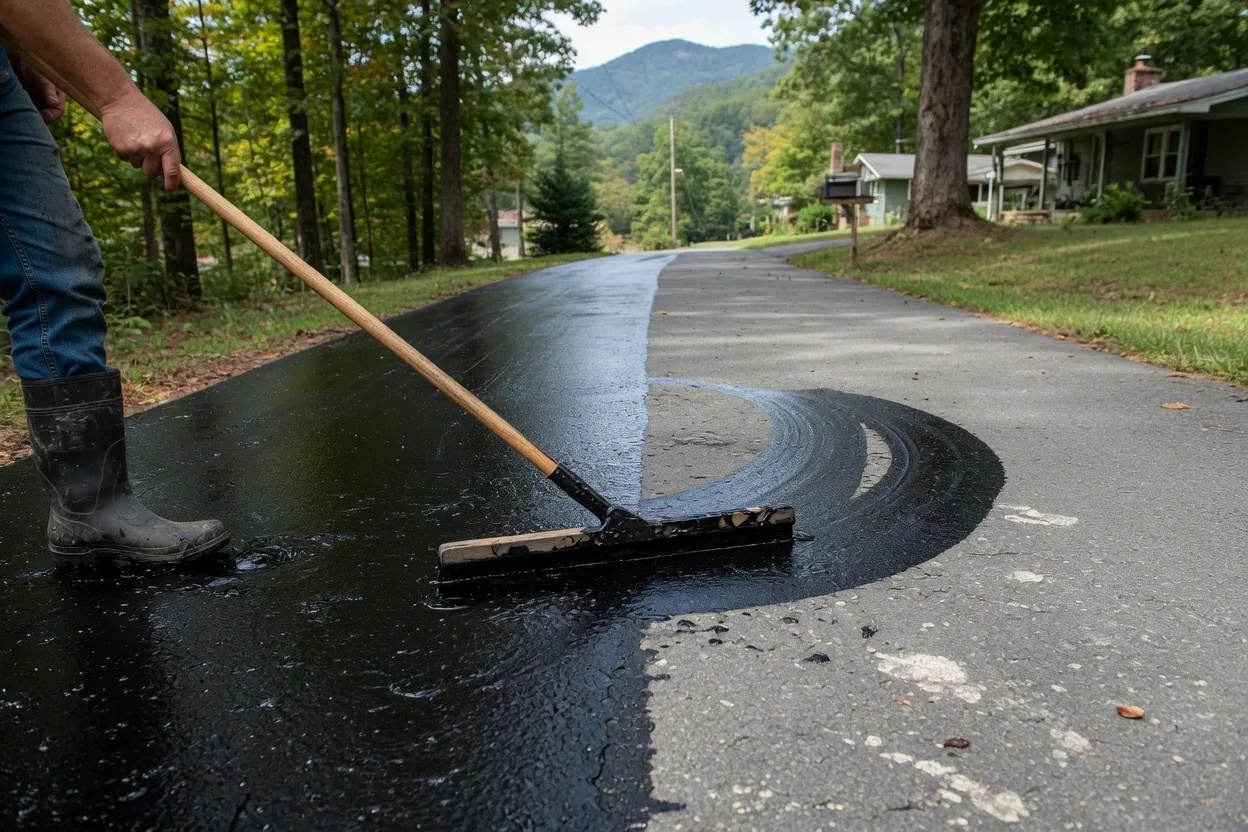
Weaverville sits in a valley that cools down earlier and warms up later than the flatland towns east of Buncombe County. Sealcoat is a water-based emulsion, and it needs to cure, not just dry. That means surface temps roughly above 55°F and, more importantly, overnight lows that do not drop into frost. In practice, the practical application window here runs from about mid-April, once the last frost has passed and the ground has warmed, through early October, before the first mountain frosts settle in. Crews that try to squeeze a job in during a cold snap usually get a coating that will not fully cure and will peel by spring. The National Weather Service frost advisories for the Asheville area are worth watching if you're trying to time a fall job.
Shade is the other local factor. A lot of Weaverville properties back up to tree cover, and a driveway that sits in the shadow of oaks or poplars most of the day stays cooler and holds moisture longer. That increases cure time and, in some cases, means the job should be split across two days rather than pushed through in one. A crew that knows the terrain will look at sun exposure before quoting.
What drives the number on a Weaverville driveway
Sealcoating is priced by square footage, but that headline rate is only the start. Crack filling, edge work, oil spot priming, and the number of coats all move the total. On Weaverville's older properties, and there are plenty of them along the main corridors and back roads, driveways often have significant cracking from freeze-thaw cycles that push water into the asphalt and split it open. Those cracks have to be cleaned and filled before any sealer goes down, or the coating bridges the crack and fails within a season.
See the full Buncombe County asphalt cost breakdown for the line-item detail. As a working table for this area:
| Scope | Typical price band |
|---|---|
| Basic sealcoat, single coat, minimal prep | $0.18-$0.25 per sq ft |
| Two-coat sealcoat with crack fill | $0.25-$0.35 per sq ft |
| Crack filling (linear feet, prior to sealing) | $1.50-$4.00 per linear ft |
| Oil spot priming and surface prep | $50-$200 per job, depending on damage |
| Full driveway, typical residential (800-1,500 sq ft) | $350-$1,400 |
A short gravel-to-asphalt driveway in the Reems Creek area and a long, cracked, shaded drive off a ridge road are not the same job. Any quote that does not ask about crack density and sun exposure is guessing.
Freeze-thaw is what actually kills driveways here
Buncombe County has a federal disaster record that is overwhelmingly storm and flood related: 19 declared events touch this county across 1973-2026. That history matters for sealcoating because water is the enemy. Mountain freeze-thaw cycles push water into every crack, and when that water freezes, it widens the crack. Sealcoating is not a structural fix, but it is the cheapest defense against water intrusion. The EPA has guidance on managing stormwater runoff that's relevant if your driveway drains toward a street or creek, which is common on Weaverville's sloped lots.
The sequence that works here: fill the cracks, seal the surface, and make sure water has somewhere to go that is not back under the asphalt. If a driveway is already failing structurally, alligator cracking, base failure, or a sunken section, sealcoating will not fix it, and a reputable contractor will tell you that rather than sell you a coating over a broken base. Structural paving is a different scope and a different budget.
Hiring a crew that knows this valley
Ask three things. First, whether the crew has worked in Weaverville or the surrounding valley before, because the shade and moisture profile is different from a job in Arden or Fletcher. Second, how they handle the cure window: if they are willing to spray on a cold morning in late October, walk away. Third, ask about licensing. North Carolina requires general contractors to be licensed above certain project thresholds through the NC Licensing Board for General Contractors, and while a straightforward residential sealcoat job may fall below that threshold, any outfit doing full driveway paving or structural work should be able to show credentials.
The sealcoating overview covers the maintenance schedule and what a proper job includes. For a broader list of local outfits, see the Weaverville paving contractor directory.
How often a Weaverville driveway actually needs it
Contractors push every two to three years. In Weaverville, the honest answer is closer to every two to four years for a well-drained, sun-exposed driveway, and more often for shaded driveways with active cracking. The way to tell is not the calendar; it's the surface. When the black is turning gray, when you can see the aggregate showing through, when small cracks are starting to web together, that's the window. Sealcoating before the cracks open is cheap; sealing after a hard winter has split the surface is not.
Spring and early summer are the best times here because the cure window is longest and the surface is warm. Fall jobs are possible but need to be scheduled with the frost risk in mind. If you're looking at a driveway already beyond sealing, the Buncombe County cost page has the paving numbers.