What actually drives the number on a Pisgah Forest driveway
If you ask five neighbors on a Pisgah Forest road what their driveway cost, you'll get five unrelated answers, because no two lots here are shaped alike. A drive off a wide stretch of Highway 64 near the Davidson River flattens out at the road; a cut running up toward the national forest boundary climbs at a grade that changes the driveway's whole anatomy. Paving is sold by the square foot in theory, but what you actually pay for is the line items underneath: tons of base stone, depth of cut, culvert and ditch work, and how many loads a truck can safely place.
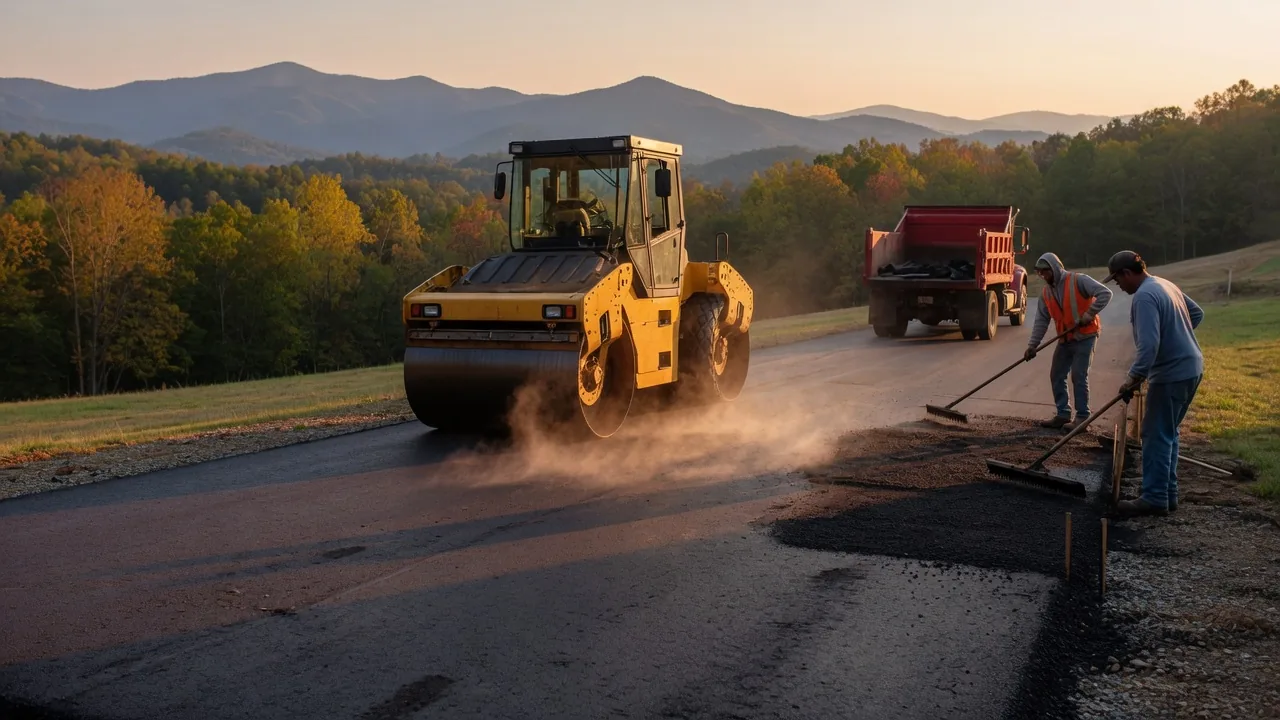
That is why the honest first answer is a range, not a rate. On typical Transylvania County residential drives, the full job — clearing what is left of an old gravel base, re-grading, compacting two lifts of stone, and laying 1.5 to 2 inches of hot mix — lands between $3,200 and $9,800. A short flat apron in town prices near the bottom. A long, steep, switchbacking drive on a wooded lot prices at the top or beyond it, and the difference is almost never the asphalt itself.
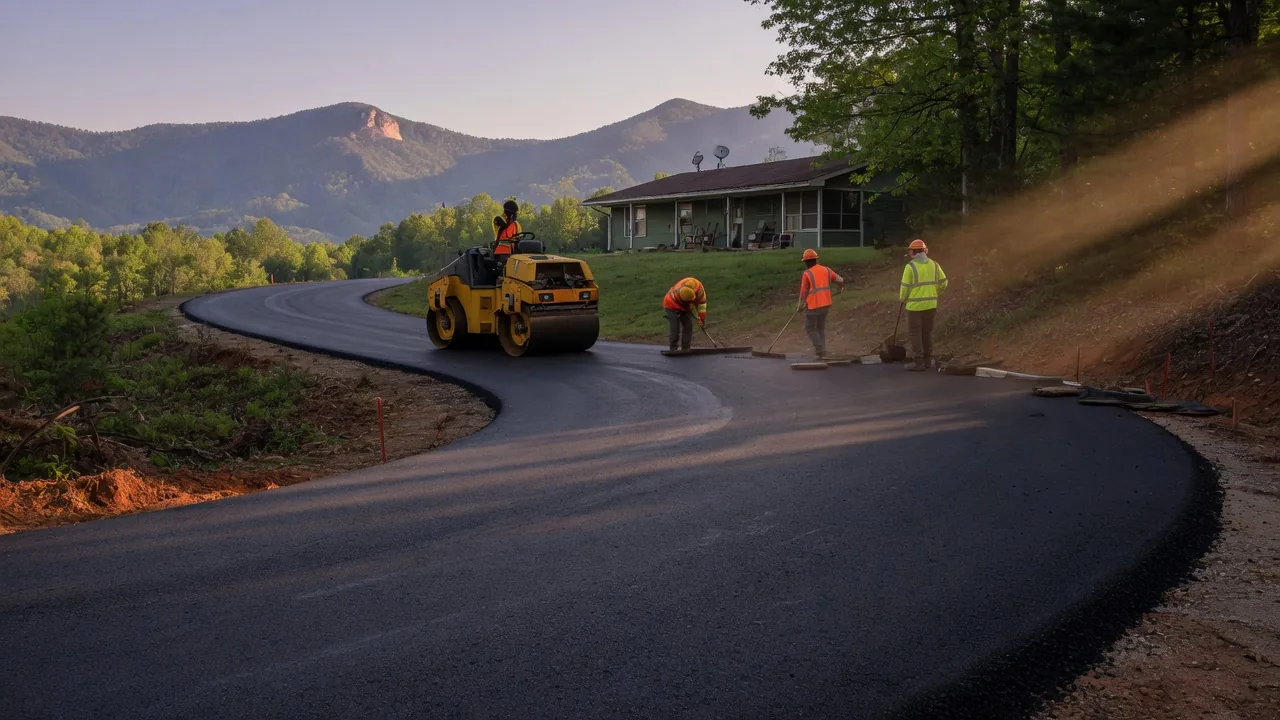
Driveways around Brevard and the Pisgah Forest area tend to fall into a few recognizable shapes, and each shape has its own cost personality. The flat in-town apron off a side street, where the driveway is maybe twenty feet and the grade is negligible, is the cheapest thing to pave here — almost all of the money goes to mix. The medium-length gravel conversion, maybe 60 to 100 feet climbing gently off a state road, is the bread-and-butter job: some grading, a little new stone, and a full mat of asphalt. Then there is the mountain-lot drive — long, benched into a slope, often with a switchback or two — where the asphalt is a small fraction of the invoice and the earthwork and stone dominate. Recognizing which shape your lot is before you get quotes is what keeps the range from feeling arbitrary.
The line items that move the price
Here is how the number actually assembles. Length and width set your square footage. Grade sets your stone — every extra foot of fall means more base depth to hold the surface, and holding steep drives is exactly where mountain jobs fail when they skip stone. Cut-and-fill sets your excavation: a driveway benched into a slope requires rip-rap and haul-off, and haul-off on a tight wooded lot with no turnaround can mean a smaller truck making more trips, which is a labor line, not a materials line. Water sets your drainage: uphill runoff has to be turned away from the driveway, not under it.
Two line items surprise people new to mountain lots. The first is the culvert. In flat country a culvert is a small pipe under the driveway; here it is often the difference between a driveway that survives a spring storm and one that washes out, and sizing it wrong is a mistake you find out about all at once. The second is the apron at the state road, where the driveway meets the shoulder and NCDOT's rules govern the grade and the sight lines. Neither is glamorous, and both show up on the invoice.
The table below is the working view; the full county picture lives on the Transylvania County asphalt driveway cost page.
| Scope | Typical price range |
|---|---|
| Gravel-to-asphalt conversion, short flat drive (under 800 sq ft) | $3,200–$4,800 |
| Standard residential drive, reclaimed base, new asphalt (800–1,500 sq ft) | $4,500–$7,200 |
| Long or steep drive with added base stone and drainage (1,500–3,000 sq ft) | $7,000–$12,500 |
| Culvert placement or ditch realignment add-on | $600–$2,400 |
| Rip-rap apron and slope stabilization on steep lots | $900–$3,500 |
| Overlay on sound existing asphalt (per sq ft) | $2.50–$4.50 |
Two structural facts sit underneath those rows. First, base depth is cheap relative to rework — a driveway paved thin over soft ground on a slope will have to be torn out, and that second job costs more than the first. Second, the driveway is where public access meets private property, and if your project touches the state road, NCDOT controls that interface: start at the NCDOT main site and its Connect portal where driveway permits are filed.
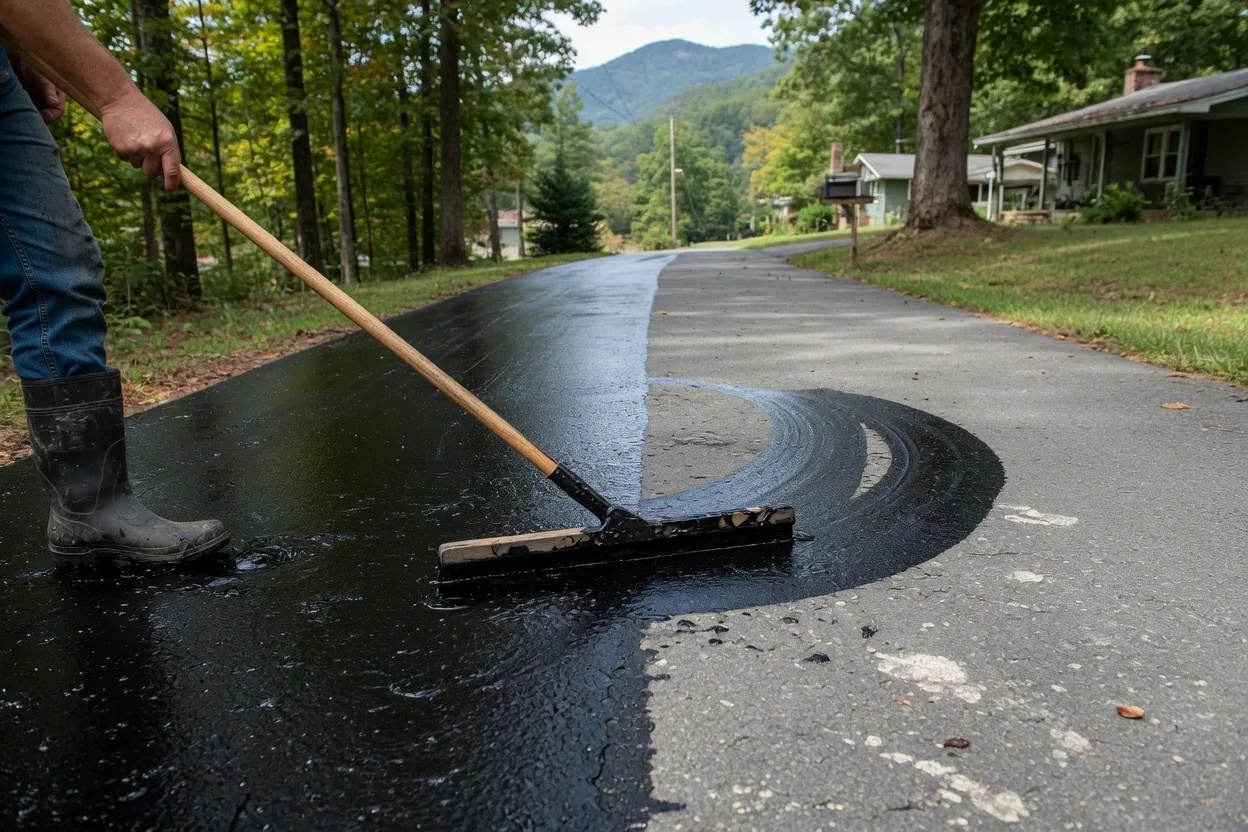
Overlays deserve a word of their own, because they are the most misjudged line on the table. On sound asphalt a 1.5-inch overlay is genuinely cost-effective and can add years to the surface. On a driveway that is already cracking and settling at the edges — the classic sign of a water problem underneath — an overlay just buries the symptom, and the cracks telegraph back up through the new mat within a season or two. On a mountain lot, the cheap overlay is only cheap if the base is dry and stable, which is a question answered by looking at the driveway after a hard rain, not by looking at the surface on a dry afternoon.
Paving on mountain ground is a drainage project first
This part of Transylvania County gets a lot of rain pushed against a lot of slope, and the federal record says so: 16 declared events touch this county across 1993-2026, storm and flood family in the overwhelming majority. A driveway cut into a hillside is a small dam waiting to happen if the water handling is an afterthought. Gutters that dump at the driveway edge, uphill runoff that sheets across the surface, and ditches that back up in a February thaw all attack asphalt from below, which is why the first real failures show up as cracking and settling at the edges and seams rather than in the middle.
The terrain here makes that concrete. Lots that back up toward the Pisgah National Forest are often steeper than the road they sit on, which means the water arriving at your driveway is not just the rain that lands on it — it is everything draining off the slope above it. That uphill water needs a path that crosses the driveway and keeps going, typically a ditch on the high side that feeds a culvert under the drive, sized for the flow you actually get and not for the flow on a sunny day. Skipping that plumbing is the single most expensive shortcut on this kind of lot.
For the environmental side, how runoff is managed and where it goes matters to the watershed as much as to your pavement; the EPA's nonpoint-source guidance at epa.gov is the plain-language reference. A good paving scope here reads like a drainage plan with asphalt on top, and grading that protects the subgrade is where the money belongs.
What separates a real paving quote from a lowball in this market
Three checks that matter on these lots. Ask for the stone depth in inches, not the word "proper base." Ask who handles the state-road permit if your driveway meets the highway, because that work goes by state rules and licensing thresholds are set by the NC Licensing Board for General Contractors. And ask how they protect the subgrade after rain before paving day, since half of what goes wrong on a mountain drive is scheduled around weather, not skill.
A lowball often skips base stone, paver depth, compaction, or the permit. Contractors who do this regularly are listed on the Pisgah Forest paving contractors page, and the general driveway guide at asphalt driveways walks through how a proper installation goes down. When you're ready, have the walk-through done before the quote, not after.
Timing is the other half of getting a fair price here. Mix plants in the mountains run warm-weather hours, and the window for good compaction is late spring through early fall; a job squeezed into a cold snap costs more and lasts less. If you are planning a gravel conversion, the most useful thing you can do is walk the driveway with a contractor while the ground is wet, so the soft spots, the uphill water, and the tight turnaround are all visible before anybody writes a number down.