Where the rain goes is the whole job on a Leicester driveway
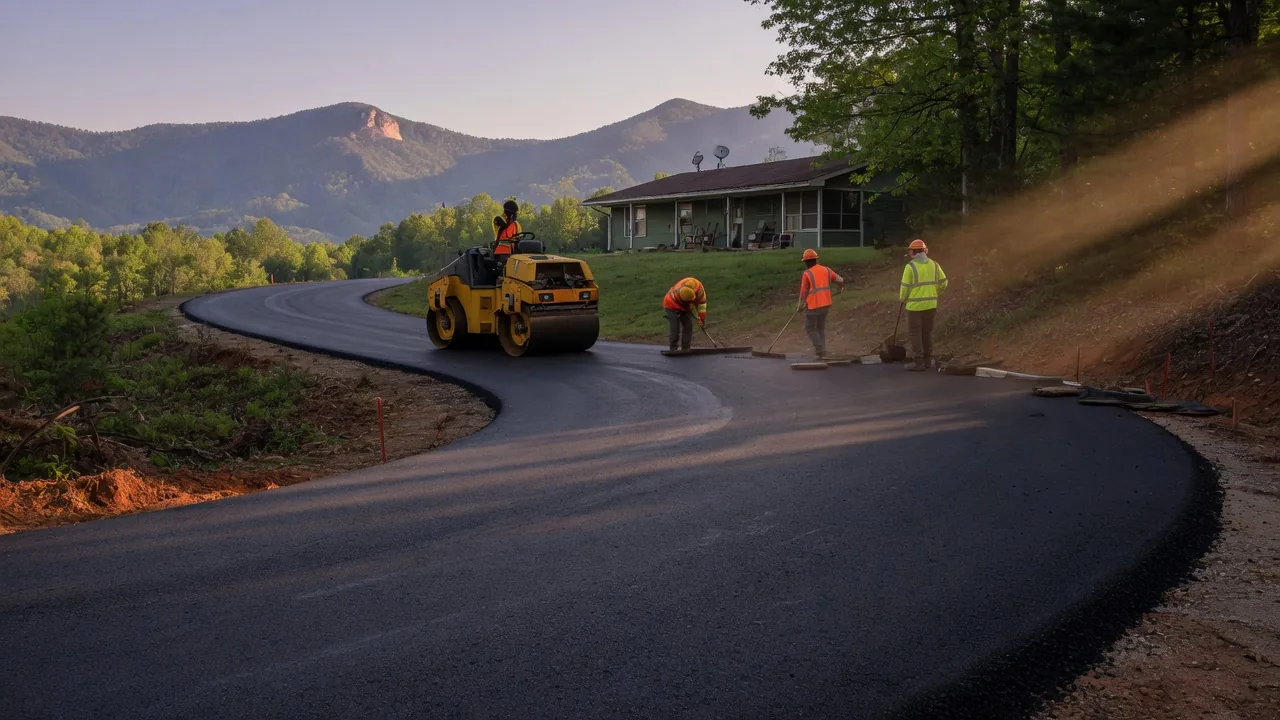
Most Leicester driveways climb. You're west of Asheville in the Newfound and Sandy Mush bottoms-to-ridges country, and the typical driveway cuts uphill off a county road at 8 to 15 percent grade, sometimes steeper on the last run to the house pad. On a grade like that, tar and chip lives or dies by which way water leaves. The crown has to sit dead center, the edges have to drop, and the uphill ditch has to carry storm runoff past the pavement instead of under it. Get those three wrong and the first March rain takes the chip seal with it.
What that means in practice: a Leicester tar and chip scope should always include shaping the subgrade, cutting or cleaning a shoulder ditch on the uphill side, and setting the crown so sheet flow crosses the surface in one direction. Flatland paving crews often skip the ditch line entirely. On these slopes, that line item matters more than the asphalt itself.
This is why the first useful conversation with a Leicester paving contractor isn't about price per square foot. It's about where the water goes when it leaves the county road culvert, whether your driveway cuts across a natural drainage swale, and whether the last 30 feet to the house pad flatten out or keep climbing. A driveway that crosses a swale at mid-slope needs a different crown schedule and usually a cross-drain or two — water that sheets down the pavement from above will hit that swale and try to turn under the chip seal.
Homes in the Leicester valley floor — the flat stretches along Newfound Road and the lower Sandy Mush bottoms — have the opposite problem. There, grade is minimal and the issue is standing water and slow-drying clay. Tar and chip on flat ground still needs positive drainage, just less aggressive ditching and more attention to base compaction so the surface doesn't rut under tires. Same material, different failure mode.
What tar and chip actually is, and why it suits this terrain
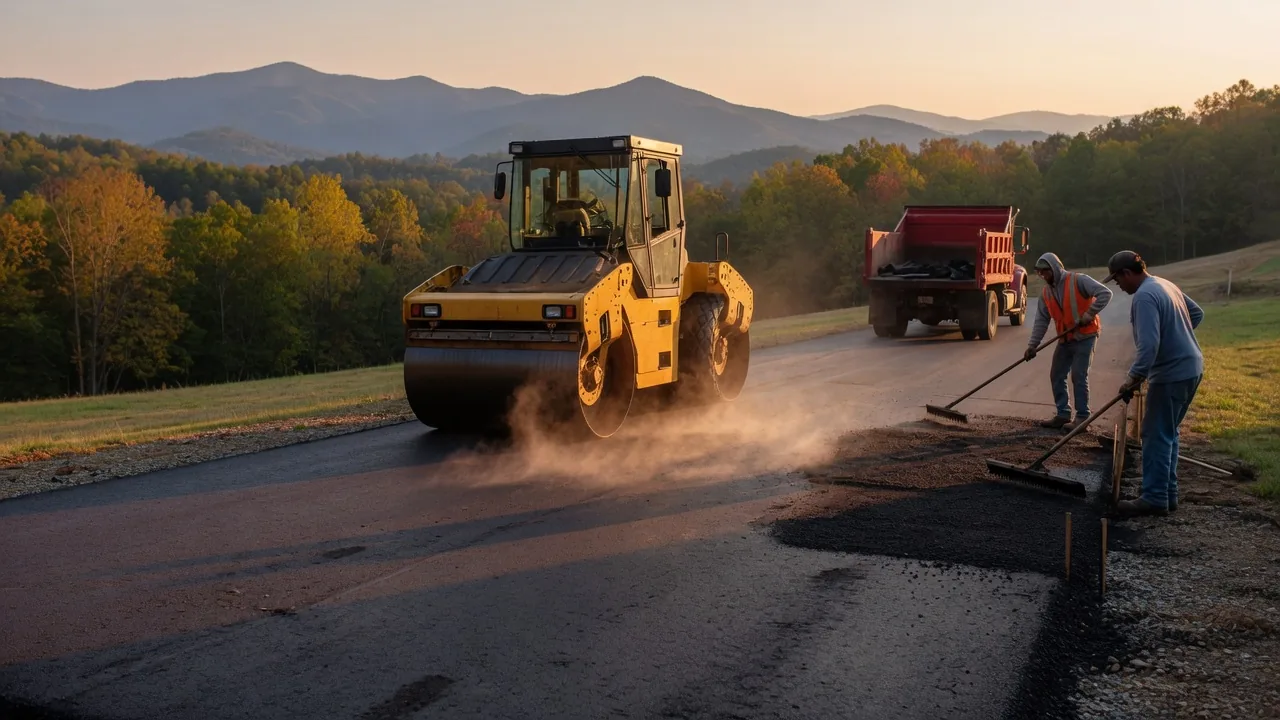
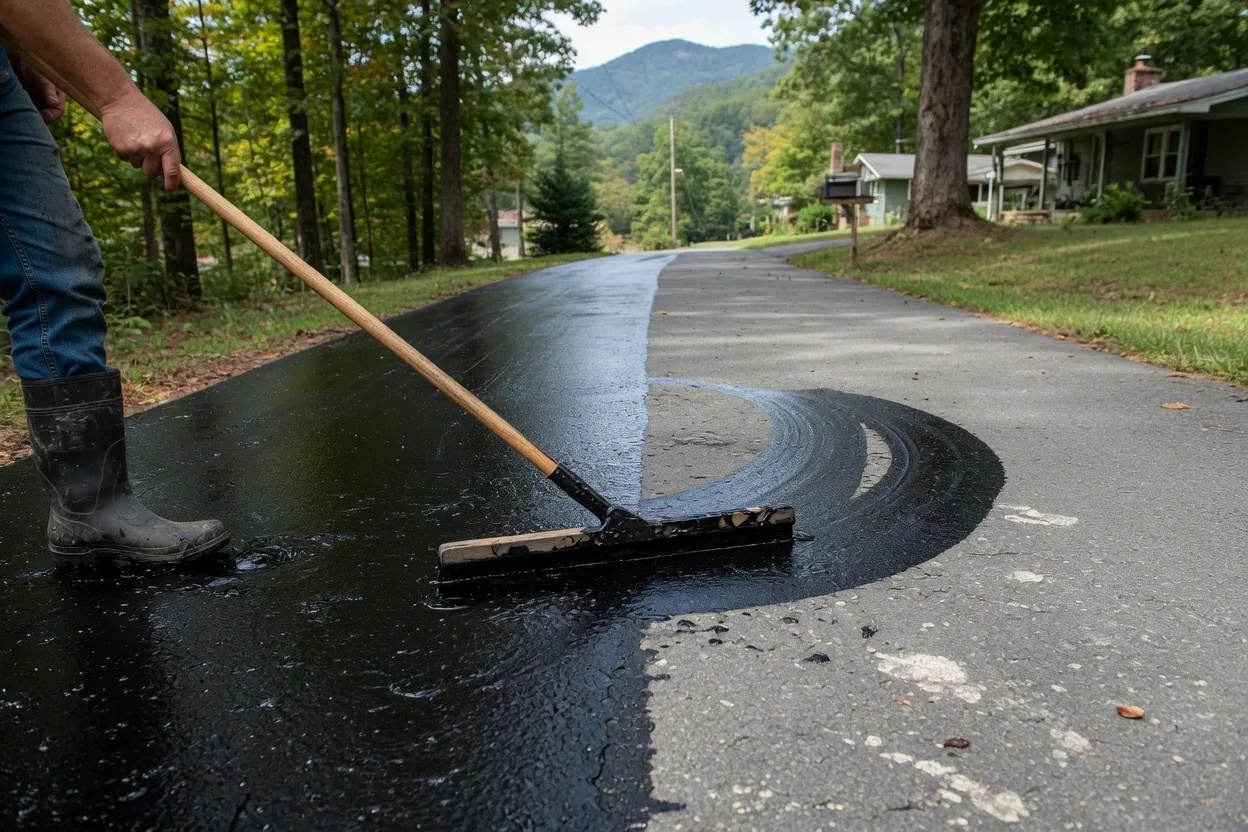
Tar and chip (also called chip seal) is sprayed asphalt emulsion followed immediately by crushed stone, then rolled. It costs less than hot-mix asphalt, holds up better against freeze-thaw movement, and grips well on a slope where a slick surface is a safety issue. For long mountain driveways here, it's usually the right call. The tradeoff is texture: it's a rougher, gravel-looking finish, and it wants a fresh chip layer every several years to stay tight.
If you want the smoother surface, our tar and chip overview walks through how the finish compares to a full asphalt overlay, and when each one earns its cost on a graded lot.
The freeze-thaw cycle in this part of Buncombe County is what drives the material choice. Leicester sits at the transition between valley and ridge, and soils here are a mix of residual clay over weathered rock, with pockets of colluvium on the slopes. Clay holds water, and when that water freezes, it lifts whatever's sitting on top. Hot-mix asphalt is rigid, so it cracks. Chip seal is slightly more flexible because the emulsion-and-stone mat can move a little without breaking. That flexibility is the whole reason it's the default driveway surface on graded lots west of Asheville.
Gravel alone isn't wrong here either, but on a 12 percent grade it migrates. Every heavy rain pushes the fines downhill and leaves the bigger stone behind, so within a couple of seasons you've got a rutted track and bare rock at the top of the slope. Tar and chip locks the stone in place. It won't stop the water from running, but it stops the surface from walking downhill a stone at a time.
Leicester tar and chip price ranges
Buncombe County pricing sits in the middle of the Western NC band. The Buncombe County asphalt cost breakdown has the full table for hot-mix comparisons; here's what tar and chip scopes run county-wide.
| Scope | Typical installed range |
|---|---|
| Single-layer chip seal over sound existing surface | $2.00-$3.50 / sq ft |
| Tar and chip with new crushed-stone base, standard grade | $3.50-$5.50 / sq ft |
| Tar and chip with base prep, ditch work, and crown reset on a steep lot | $5.00-$7.00 / sq ft |
| Double chip seal (heavier traffic, sharper turnarounds) | $6.00-$8.50 / sq ft |
| 600 sq ft pull-off or short driveway, all-in | $2,200-$4,500 |
| 900-1,200 sq ft residential driveway, typical Leicester grade | $4,000-$9,500 |
Steep grades above 15 percent, long culvert runs, and rock that has to be ripped before base prep push the number to the top of the range or beyond. Any quote that doesn't mention grade, ditch or drainage should be read as a partial bid.
Two other line items show up on Leicester jobs more than people expect. The first is a turnaround or parking pad at the top of the driveway — switchbacks off Newfound Road often end in a tight gravel circle that needs its own base prep, and that's usually where the truck traffic concentrates and the surface fails first. The second is the apron where the driveway meets the county road. That apron is wider than the driver expects, and it's the piece that has to survive the snowplow wing. Pricing the main run without the apron is a common way for a low quote to look lower than it really is.
A word on existing driveways: if your gravel base is sound, well-graded, and drains, a chip seal over it can cost less than the table's new-base rows. If the base is rutted, has soft spots, or shows water running down the center, the base prep has to happen first — and that's when the quote moves toward the middle and upper rows. The material is the cheap part. The dirt work under it is not.
Permits, rules and the edges of your property line
If your driveway ties into a state-maintained road, the driveway apron and culvert crossing fall under an NCDOT driveway permit — the application and standards are on NCDOT Connect. That permit looks at sight distance and how your driveway drains into the state ditch. On a county road inside Leicester, the same idea applies through the county, but the drainage rules are just as real.
Where a paved driveway is part of a larger site plan or an accessory structure project, state licensing rules for general contractors can kick in depending on the job size — the thresholds are set by the NC Licensing Board for General Contractors. Residential driveways themselves are usually below that line, but a wrapped-up grading or retaining project is not. If your driveway needs a retaining wall at the downhill edge, that's a different scope entirely and worth separating before you sign.
Retaining walls come up on Leicester slopes more than homeowners expect, because a driveway that cuts into a hillside leaves an uphill cut bank that wants to slump, and a driveway that's benched into a slope often needs a wall at the outer edge to hold the fill. Those walls fall under building code, and in Buncombe County the inspections and permitting for them go through the county's code enforcement office. The state code officials' gate is the NC Department of Insurance / Office of State Fire Marshal — Code Officials division, which sets the minimum standards local offices enforce.
There's also the simple property-line question. On steep parcels here, the driveway often runs parallel to a neighbor's line, and the shoulder ditch that carries your runoff might be cut within a foot or two of that line. Where the ditch discharges matters — you don't want to send your stormwater onto the neighbor's foundation. Before base prep starts, it's worth knowing where the line sits and where your water is allowed to go.
Storm history and why the base matters here
Western NC has taken repeated tropical and flood events through the last several decades — 19 federal disaster declarations touch Buncombe County across 1973-2026. Every one of those events delivered the same lesson to graded driveways: water that finds a soft shoulder takes the whole surface with it. A tar and chip driveway built on a proper compacted stone base survives that. One laid over raw clay or an old gravel rut does not. The National Weather Service office in Greenville-Spartanburg tracks the rainfall totals here — see weather.gov for the local climate record — and the pattern is consistent: heavy single-event rain plus steep terrain equals shoulder erosion. Design the driveway to shed, and it keeps its surface.
The storms that matter most to a Leicester driveway aren't the headline hurricanes. They're the stalled frontal systems that park over the French Broad valley and drop several inches in a day, plus the quick summer convective cells that dump a lot of rain in a small area. On a cut-and-fill driveway, that volume concentrates in the uphill ditch and the culvert under the apron. If either one is undersized or blocked, the water finds the pavement edge instead. That's how a driveway that looked fine in April is a washout by the end of May.
Base prep accounts for this by building the driveway like a shallow drainage structure. The subgrade gets shaped and compacted, the stone base goes down in lifts, and the whole thing is crowned so water leaves the surface and enters the ditch. When the ditch is clean and the crown is right, a hard rain is just a hard rain. When either one is off, the same storm removes a season or two of driveway life.
Picking a crew that reads the grade before quoting
The crews worth hiring in Leicester walk the driveway first, look at where the water's been running, and put ditch work and base depth in the written scope. Our Leicester paving contractor page covers what a good first visit looks like, what to ask about warranty, and how to compare a chip seal quote against a hot-mix quote without getting talked into the wrong one. Bring your driveway length, approximate grade, and a photo of the worst rut or washout spot, and you'll get a far more honest first number.
Ask two questions on that first visit. First, where does the ditch line discharge, and is that point stable? Second, how deep is the base going to be, and what's the compaction plan? A crew that answers both without hesitating has done this work on slopes before. A crew that talks only about the surface material is selling you a layer, not a driveway.
Timing matters too. Emulsion needs warm, dry conditions to cure properly, so most chip seal work in Buncombe County happens from late spring through early fall. Booking a late-October job on a north-facing slope that never dries out is asking for trouble. If your driveway has an active washout or a culvert that's about to fail, say so when you request the quote — access problems move to the front of the line regardless of season.