Clyde driveways are built on what the ground gives you
The first number any honest tar and chip contractor in Clyde needs has nothing to do with tar or chip. It is how deep they have to dig before they hit something that drains. The valley floor around town is red clay, and red clay is a sponge that holds what a driveway cannot afford to hold. Scan a lot near the Pigeon River and you find clay with river gravel mixed through it. Climb a driveway toward the Smokies and the clay is stiff and shallow, sitting on rock that the grader can only shave. Two lots a mile apart, two completely different base budgets.
Most Clyde driveways also started as something else: packed gravel laid down a decade or three ago by whoever owned the place first. That matters, because the new stone goes on top of the old stone, and if the old stone is rutted, silty, or crowned wrong, the tar and chip will fail on the same grade the gravel failed on. Prep, not the surface, is what makes tar and chip last here.
How the stone budget works against the surface
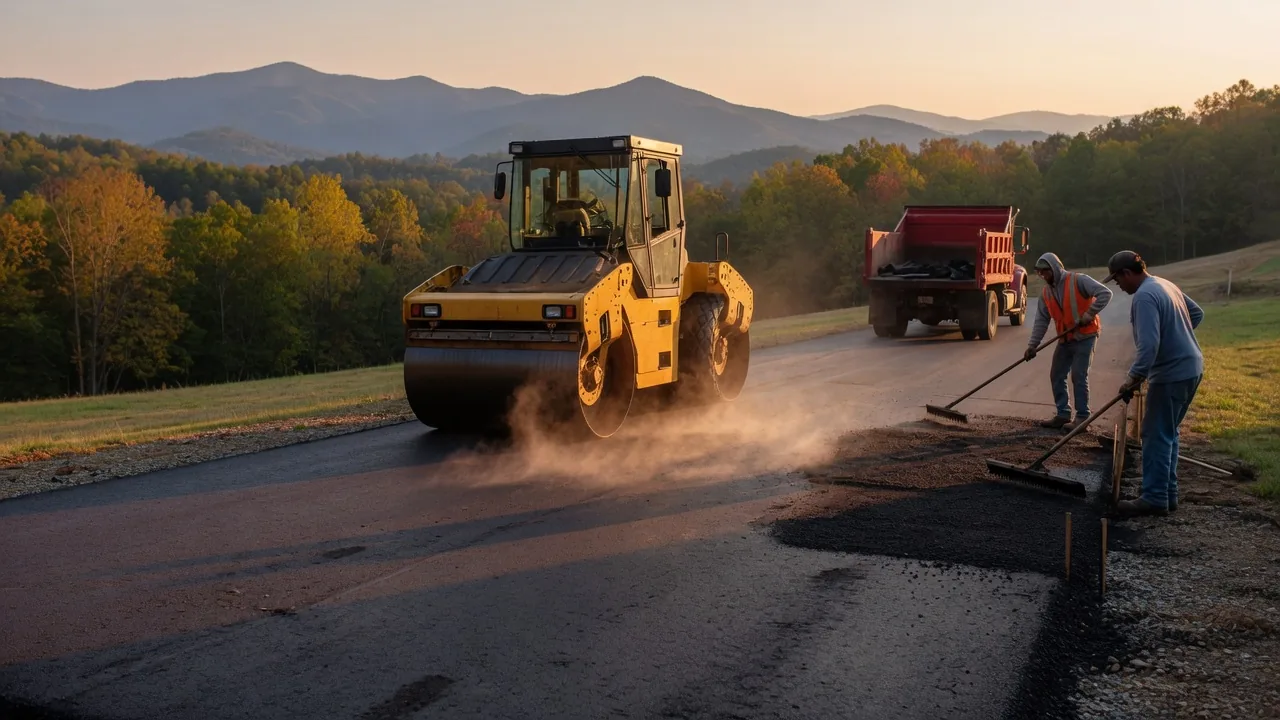
A rule of thumb worth memorizing: the base is two to three times the cost of the surface. A tar and chip driveway that needs a full rebuild of four inches of compacted crushed stone over clay can carry a stone line item many times the bituminous surface. A driveway that already holds a firm, drained gravel base adds stone only where ruts have collected.
| Scope | Typical price range | What drives the range |
|---|---|---|
| Resurface existing sound gravel base | $3,200–$5,500 | Base depth needed, chip size, length and width |
| Reshape, add 2 in. crushed base, then surface | $5,000–$7,200 | Grade, ruts, drainage away from the house |
| Full rebuild over clay or fill, 4 in. compacted base | $7,000–$11,000 | Excavation, stone trucked in, compaction passes |
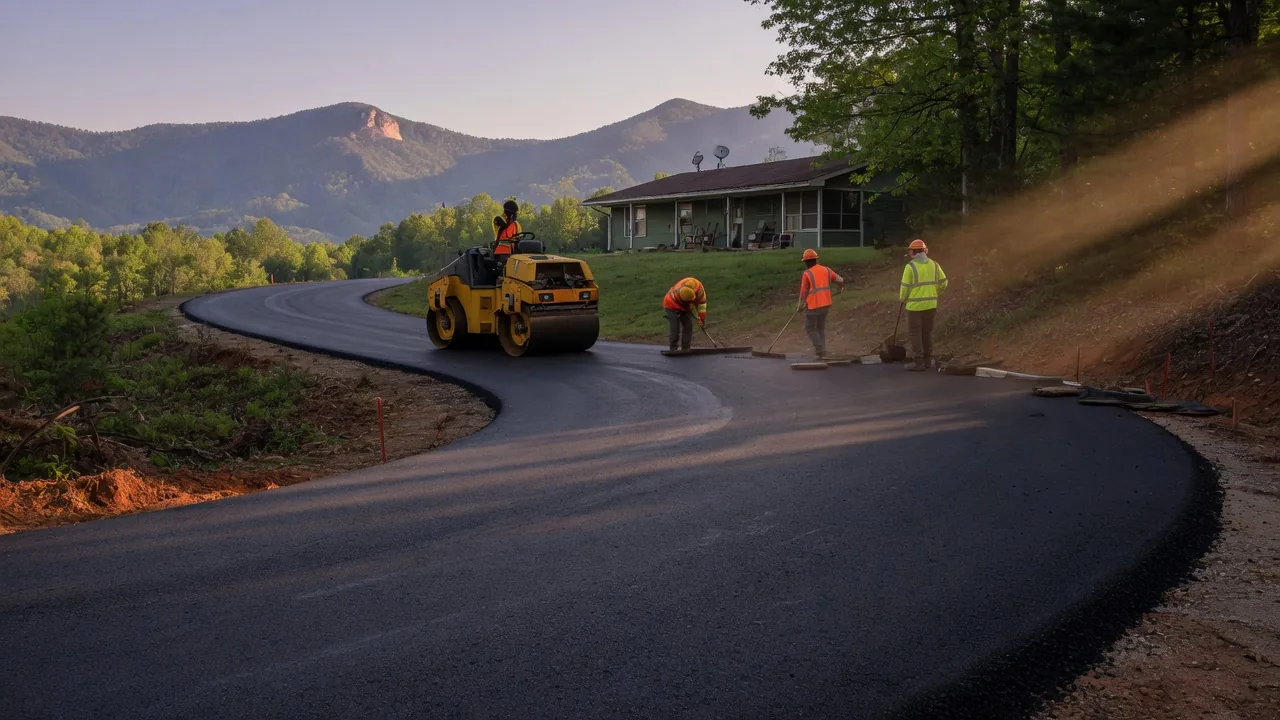
| Steep or switchback approach toward the Smokies | Add $1,500–$4,000 | Erosion control, wider base, haul difficulty |
All of those are ranges because the stone is what moves them. A bid that names a firm price before someone probes the base is guessing at your ground. See the Haywood County cost picture for the county table these numbers cross-check against.
The water problem comes before the stone problem
Haywood County is a wet county. The federal disaster record shows 19 declared events touching this area over 1973-2026, and the overwhelming majority are storm, flood, and rain-family events. If water crosses your driveway on its way downhill and the grade has nowhere to send it, no amount of crushed stone fixes it. The water will undercut the base and lift the chip seal from beneath.
So before anyone quotes a tar and chip driveway in Clyde, the questions worth asking are: where does the uphill water go, does the drive shed water into the county ditch or the road edge, and does the gravel base already drain or collect. The NC Office of State Fire Marshal code officials are the ones who look at site drainage and access when residential work reaches inspection, and the same logic applies whether or not your particular driveway gets pulled into a permit review. Drain first, stone second, tar and chip third.
Permits, access, and who is allowed to bid it
If the work touches the public road edge and the county right-of-way, the driveway connection is a permitting question. North Carolina handles that plumbing through the NCDOT, with applications lodged via NCDOT Connect. A crew that has done this in Haywood County will already know whether your driveway mouth needs a culvert pipe, a flared end, or a re-graded approach, and will have folded it into the number. A crew that only talks about tar and chips does not.
Licensing is the second filter. North Carolina requires a general contractor license once a job crosses the cost threshold in state law, and the NC Licensing Board for General Contractors is where that threshold and the license lookup live. For a residential driveway the threshold may or may not be tripped depending on scope, but the point is to ask for the license number and confirm it, not to take a business card on faith. The local page at paving contractors in Clyde walks through the vetting questions in order.
What tar and chip actually does well here
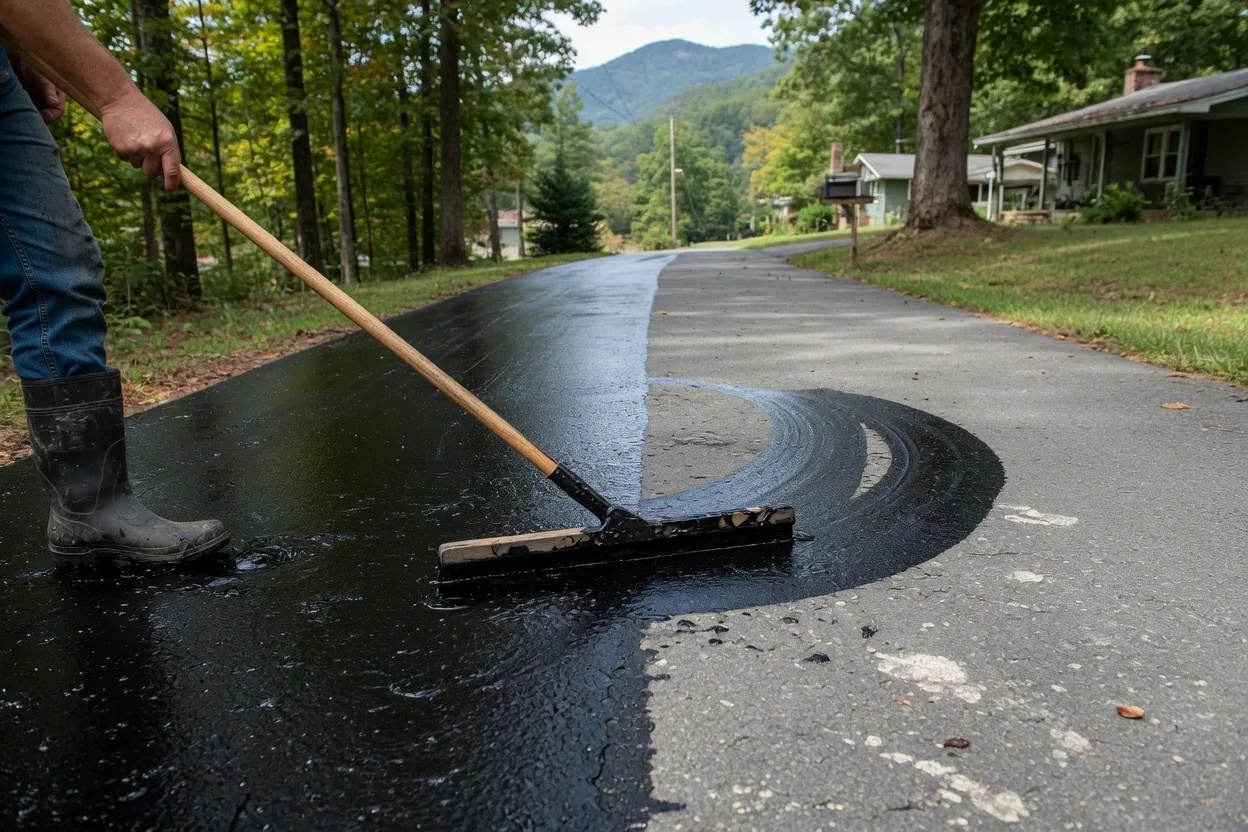
Tar and chip is not a compromise. On the long, curving, low-traffic driveways that define Clyde and the hollows above it, it outperforms hot mix asphalt for the money because it flexes with the freeze-thaw cycle instead of cracking in straight lines. Haywood County sees enough winter temperature swings that a rigid mat laid thin will crack at every seam and every tree root. A properly built chip seal takes that movement and keeps its surface.
What it is not is cheap to fix once it fails. If the base was wrong, the failure shows up as potholes, delamination, and ruts within a few seasons, and it costs as much to strip and rebuild as the driveway cost the first time. That is why the stone layer is not the part to negotiate down. Read the tar and chip overview for the surface spec itself, and if the driveway is meant to carry heavy loads like a delivery truck or a trailer, tell the contractor that before the base is designed, not after.