Why Candler driveways aren't Asheville driveways
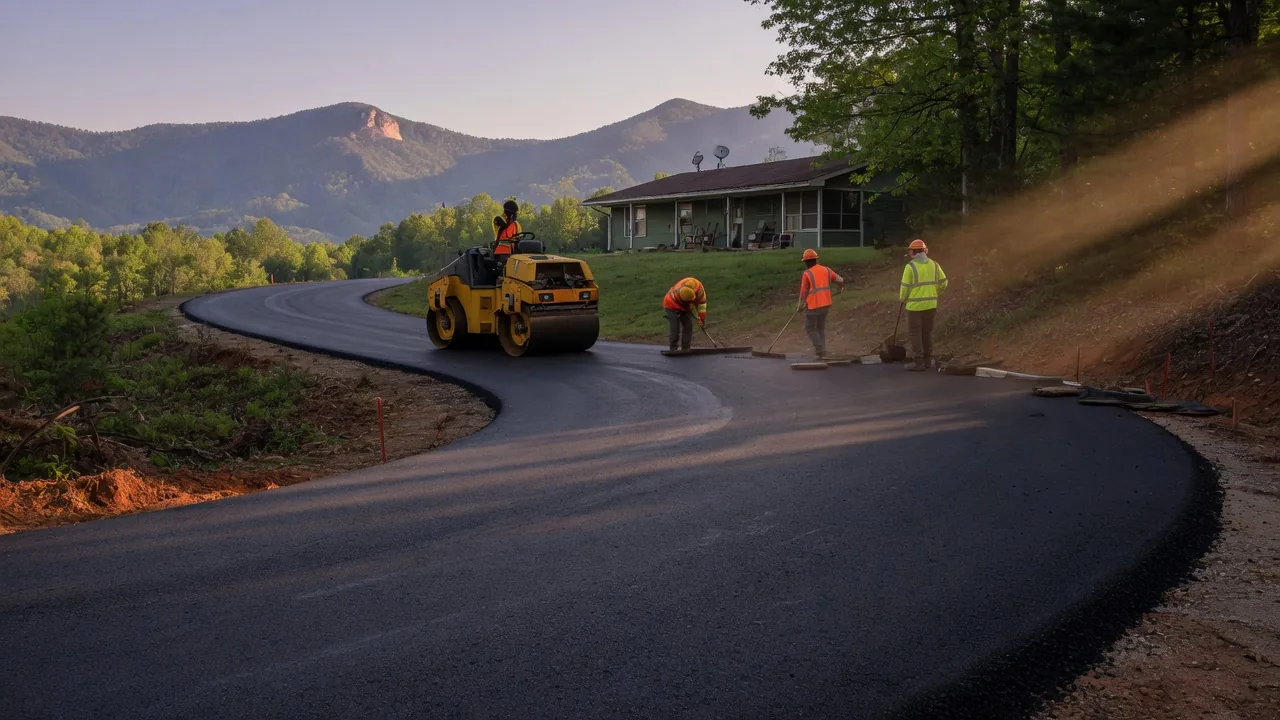
Candler is where Buncombe County's housing thins out and the driveways get serious. Instead of a 40-foot asphalt pad behind a West Asheville bungalow, you get a 200-to-500-foot run off a two-lane road, cut into a hill, ending at a house pad that was graded by whoever built the place. Some of these runs were last surfaced in the 1990s and have been patched with whatever was on hand since. Others are new builds where the driveway was an afterthought once the foundation was in.
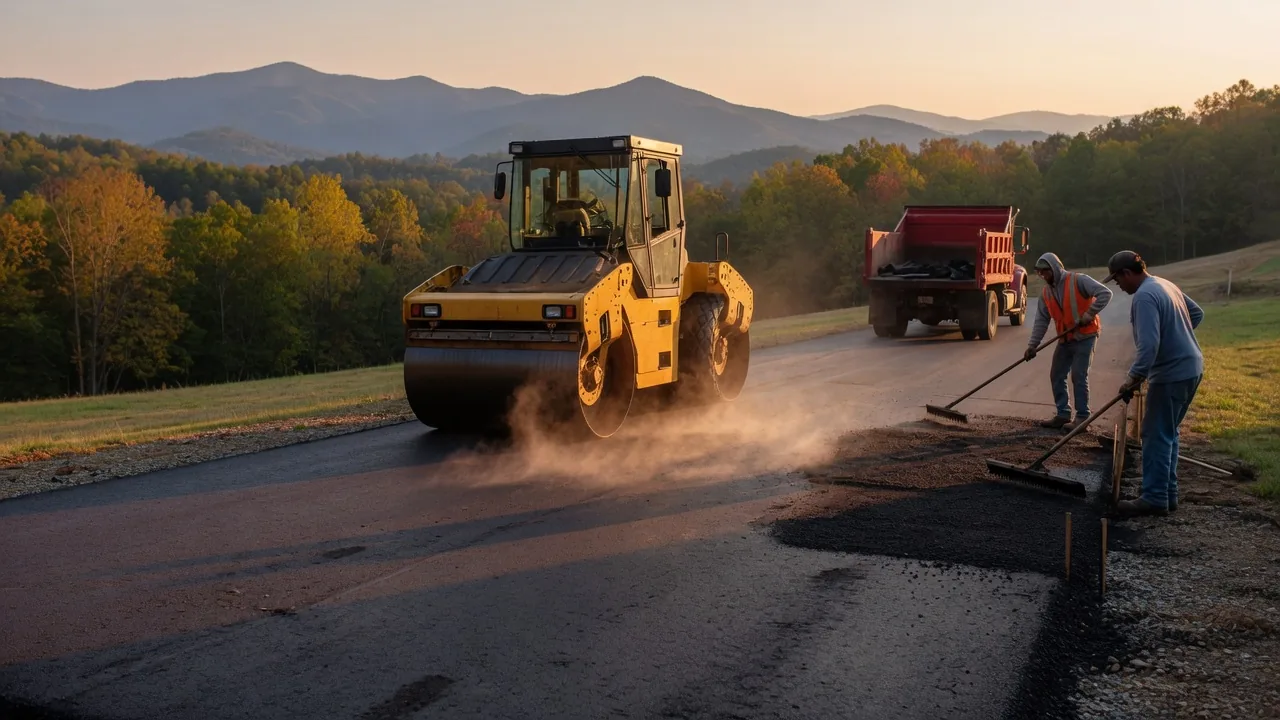
That geography is why tar and chip keeps winning out here over hot-mix asphalt. The slope-grade, crushed-stone look matches the rural character, the surface handles freeze-thaw better than a thin asphalt overlay, and it can be resealed in sections rather than repaved whole. The catch is that tar and chip only performs as well as the base under it, and in Candler the base is where the money goes.
Drive through the Hominy Valley, up Sardis Road toward the county line, or out past the Enka ballfields and you'll see the pattern: gravel spurs that got tarred a decade ago, then tarred again when the first coat broke down. The houses on those drives sit on lots that were carved out of larger parcels, so the driveway often follows an old logging road or farm lane rather than a straight builder cut. That means curves, cross-slope, and grade changes that a Chick-fil-A parking lot never has to solve. A Candler driveway is less a construction product than a negotiation with the watershed it sits on.
Asheville proper has its own driveway problems, but they're the opposite ones. City lots are short and flat, hemmed in by retaining walls and neighbors, and the work is all access and staging. In Candler, the work is all length and water. A crew that only runs city jobs will underestimate both the trucking time to reach the far end of a run and the volume of stone it takes to hold a slope through a wet season. That's why local estimates swing so wide before anyone shows up with a tape: a 300-foot Candler run is a fundamentally different project than a 60-foot Asheville one, even before you talk about the surface.
What the price actually reflects
Three variables drive almost every Candler tar and chip quote: total square footage, slope, and how much base work is required. Long rural runs look cheap per square foot until you account for trucking, edge stone, and water management. Steep runs need crowned surfaces, water bars, and sometimes extra stone to prevent the chip from washing downhill in a heavy event.
| Scope | Typical Range | Notes |
|---|---|---|
| Chip seal over sound existing surface | $2.50-$3.50 / sq ft | Short runs, minimal base repair |
| Full tar and chip install with new base | $3.50-$5.50 / sq ft | Grading, compacted stone, two-chip pass |
| Long rural run (300+ ft) with shoulders | $7,500-$14,000 total | Edge stone, drainage, culvert if needed |
| Steep slope treatment (over 12%) | Add $0.75-$1.50 / sq ft | Crown, water bars, reinforced base |
| Pothole and rut repair before resurface | $600-$2,200 | Full-depth patching, not just top dressing |
For a Buncombe-wide view of how tar and chip stacks up against asphalt, the asphalt driveway cost breakdown for Buncombe County lays out both, and the tar and chip service page covers what a proper two-chip application includes.
It helps to know where the dollars actually land. On a typical Candler job, the visible surface — binder and chip — is usually the smallest slice. Base stone, hauling, grading, and edge treatment eat the rest. A bid that quotes a per-square-foot number without breaking out those line items is hiding the part of the job most likely to change once the crew starts digging. Ask how many tons of base stone the job assumes, what compaction standard the base has to hit, and whether the quote includes shoulder stone. If the answer is a shrug, the number is fiction.
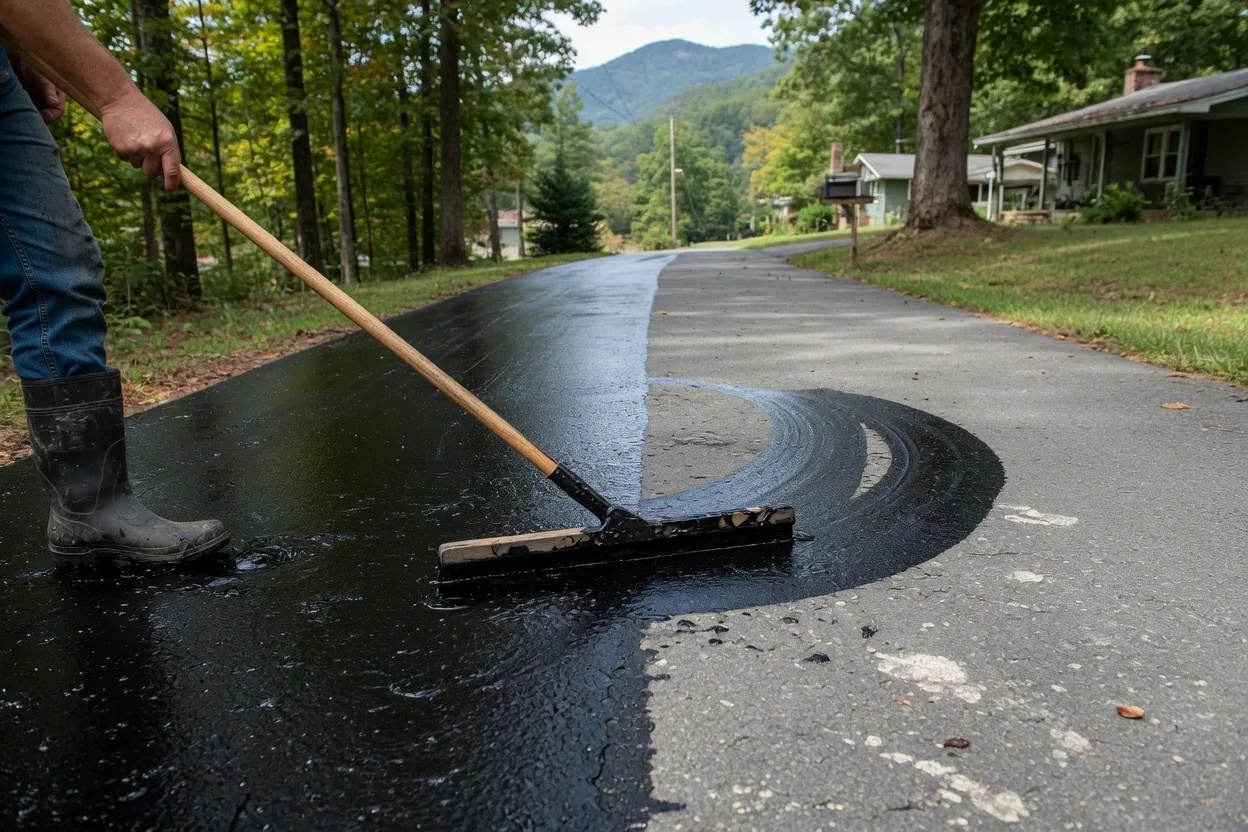
Maintenance pricing is simpler and worth understanding up front. A straight reseal on a sound Candler driveway with no base problems is a fraction of the original install, and it's the reason tar and chip makes sense on long rural runs: you're not repaving the whole thing, you're renewing the binder on top of a base that's already paid for. The math only breaks when the base has failed, and then no amount of new chip will save it.
Water, slope, and the driveway that disappears
Western North Carolina's storm record is the single best predictor of which Candler driveways will fail next. 19 federal disaster declarations touch this county across 1973-2026, and the pattern is consistent: heavy rainfall on saturated ground. On a flat suburban lot that's a nuisance. On a Candler hillside it's a driveway leaving for the road below.
Before anyone talks stone, the drainage question has to be answered. Where does uphill water cross the drive? Is there a culvert, a French drain, or nothing? The National Weather Service keeps the rainfall records that make this argument concrete, and the practical takeaway is that a tar and chip surface with no water management is a two-year investment. Crowning, ditching, and where applicable a reinforced turnout above the grade change are what make the surface last a decade or more.
The failure modes in Candler are consistent enough to recognize from the road. The classic one is the driveway that was cut straight down a slope with no crown, so every storm sheet-flows across the full width and carries the fines out of the base. Within a couple of seasons you get the telltale bald strip down the center where the chip is gone and the binder is exposed. The second is the driveway that catches uphill runoff from a cut bank above it, with no water bar to divert the flow before it hits the surface. That one doesn't just lose chip — it loses base, and the fix is a rebuild, not a reseal. The third is the low spot at the culvert where the pipe is undersized for what actually comes off the hill. Homeowners often discover it during the first big storm after installation, which is the wrong time to learn the pipe was the cheapest one on the truck.
None of this is exotic engineering. It's the ordinary craft of building a road on a hillside, and it's the part of the job that separates a Candler driveway that lasts from one that doesn't.
Permits, access, and the NCDOT question
If your Candler driveway meets a state-maintained road, the connection point is a regulatory matter, not a contractor preference. New or substantially altered driveway aprons and culverts on NCDOT right-of-way require a driveway permit, and applications go through NCDOT Connect. The main portal lives at ncdot.gov. This catches Candler homeowners off guard more than Asheville ones, because far more Candler properties front state roads rather than city streets.
For the paving work itself, North Carolina's Licensing Board for General Contractors sets the dollar threshold where a project must be handled by a licensed general contractor. A small residential reseal typically falls under it; a full install with grading and a new culvert often does not. Ask any Candler paving company which side of that line your job sits on, and get it in writing.
There's also the work that happens at the roadside itself. Widening an apron, replacing a failed culvert, or paving through a right-of-way ditch all touch state-controlled ground, and the inspector's concern is drainage for the road, not just for your driveway. A culvert sized for your property still has to pass the water the state road sends your way. Homeowners who skip the permit sometimes find out later when a road-maintenance crew pulls the pipe out during ditching and leaves them with a raw trench. The permit isn't red tape for its own sake — it's the record that ties your connection to the state's drainage plan.
Choosing a crew that knows Candler ground
The right questions here are different from the ones you'd ask in town. Has the crew worked on your road's grade, or is this the first time they've run a chip spreader on a slope above 10 percent? Do they bring their own stone, or broker it out and add a markup you can't see? Will they quote edge stone and shoulder work separately, or bundle it into a number you can't audit?
Every quote should specify chip grade, binder type, application rate, and the compaction method used on the base. If a bid is one line, it's a bid you can't compare. The Candler paving contractors page covers what a real local crew brings to a job, and the questions worth asking before signing.
Two more things separate a Candler-experienced crew from a tourist. First, they know which local quarries the stone comes from and how that stone behaves on a slope — some aggregate holds an edge better than others, and that matters on a crown. Second, they schedule around the season honestly. Tar and chip wants a dry surface and mild temperatures, and a crew that promises a January install on a shaded north-facing Candler drive is telling you something about how the rest of the job will go. The good ones will also walk the drive with you before quoting, point at the exact places water crosses it, and tell you which of those places the quote does and doesn't address. That conversation is worth more than the last few hundred dollars of difference between bids.