Where the money actually goes on a Buncombe County lot
Two quotes for the same 8,000-square-foot lot in West Asheville can differ by twenty thousand dollars, and almost none of the gap is the asphalt itself. Hot-mix asphalt is a commodity sold by the ton, and tonnage is fairly predictable once you know the square footage and thickness. The spread lives in the work underneath and around the blacktop.
Here is what actually moves the bid on a Buncombe County commercial lot: how much unsuitable subgrade has to be excavated and replaced, how much stone base is needed to bridge our clay-and-weathered-rock soils, whether storm drainage has to be added or repaired, how much sawing and demolition comes with the tear-out, and how far the haul is to an asphalt plant and a certified disposal site. Slope matters more than people expect. A lot on a hillside off Merrimon Avenue that sheds toward a building needs catch basins and a swale that a flat lot on Airport Road simply does not.
That is why the honest starting point is a commercial paving site walk and a core sample, not a phone number. Anyone quoting per-square-foot off a satellite image is guessing at four of the five variables that decide your price.
Scope versus price: what each level of work really costs
Parking lots are not one job. The table below maps the common scopes you will be quoted here to realistic installed ranges. These are regional bands, not a bid — depth, haul distance, and site access move the number in either direction.
| Scope of work | Typical cost range | What drives it |
|---|---|---|
| Crack fill and sealcoat only | $0.25–$0.55 / sq ft | Number of cracks, cleaning, number of coats |
| Mill and overlay (1.5"–2") | $3.50–$7.00 / sq ft | Milling depth, leveling course, drainage fixes at edges |
| Full-depth reconstruction | $6.00–$12.00 / sq ft | Base stone depth, subgrade repair, haul-off of old pavement |
| New lot on graded subgrade | $5.50–$10.00 / sq ft | Stone base, compaction, drainage structures, striping |
| Stone base only (no asphalt) | $2.50–$5.00 / sq ft | Depth of compacted stone, geotextile, subgrade repair |
| Drainage structures and piping | $1,200–$6,000+ per structure | Catch basins, trench length, connection to storm system |
The full parking lot paving cost breakdown page goes line by line if you want the arithmetic behind those ranges before you call anyone.
The drainage question decides whether the job lasts
Asheville sits in a bowl of the Blue Ridge where summer thunderstorms can drop an inch in twenty minutes, and in counties with heavy federal disaster records (19 declared events here, 1973-2026), saturated soil is the normal condition some years, not the exception. Water that stands on a lot finds the weakest seam in the asphalt, freezes, expands, and by the second winter you have alligator cracking that no sealcoat will fix.
So any paving bid worth reading answers three drainage questions in writing: where does the water go when it leaves the lot, what slope is the finished surface graded to, and what happens to the runoff that used to soak in before the lot was paved. Parking lots are a regulated stormwater source in most of Buncombe County, and the NC Department of Environmental Quality sets the standards local plans implement. If a quote has no drainage line item, it is not a cheaper quote. It is a quote for a smaller job that will need a bigger one later.
Permits, licensing, and why the paperwork protects you
Most commercial lot repaving in Asheville does not require a building permit when no structure changes, but adding or reconfiguring a curb cut or driveway apron that touches a public street almost always needs an access permit from NCDOT or the city, depending on who owns the road. Stormwater work often triggers a separate review. None of this is optional, and none of it is the contractor's private business. Ask who is pulling what.
On the contractor side, North Carolina ties licensing to project value: general contracting above the statutory threshold requires a license from the NC Licensing Board for General Contractors, and you can verify any license number in about two minutes on their site. Paving itself is not a separately licensed trade in this state, which is exactly why the license check and a certificate of insurance matter more here than in trades with their own boards. Work that touches fire lanes or signage near a building may also bring in code review under the NC Department of Insurance and the state building code.
Doing the lot right in phases instead of all at once
Many Asheville properties cannot shut down their parking for a week, and they should not have to. A lot can be built back in halves, with mill-and-overlay on the good half this season and reconstruction on the failed half next, as long as the whole thing is planned on one drawing first. Phasing without a plan is how you end up with three different asphalt thicknesses and a drainage swale that stops at a property line.
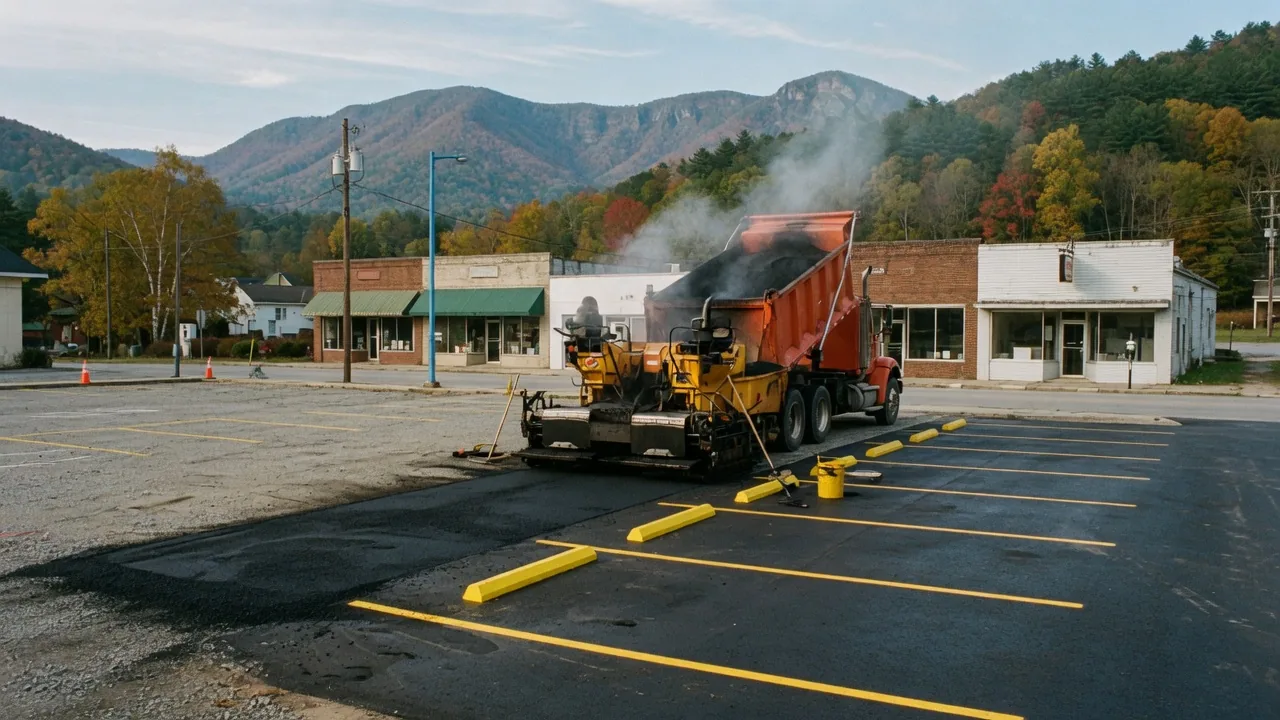
Striping is the last five percent of the budget and the first thing everyone notices, so it should be in the same scope as the pavement, not a separate afterthought. Layout the stalls and aisles against the current code and fire access requirements, then let the pavement cure before paint. Our parking lot striping page covers layout and ADA stall requirements if that piece is going out to bid on its own.
The one thing to insist on regardless of scope: a written compaction spec and a smoothness test. A lot that looks perfect in October and is rutted by April was almost never a materials problem. It was a base problem, and the base is the part you cannot see in a photo.