What Buncombe County driveways actually look like
West Asheville's grid of modest bungalows has short, flat concrete ribbons out front, but cross the French Broad into Westwood or head up the ridges toward Town Mountain and the driveways change completely. Long, narrow, and sometimes steep enough that a delivery truck won't attempt them. Older subdivisions in Haw Creek and Beverly Hills were laid out in the '60s and '70s, when asphalt was cheap and base prep was often minimal. Those driveways are now 40 to 50 years old and hitting the end of their service life at the same time the freeze-thaw cycles are getting more erratic.
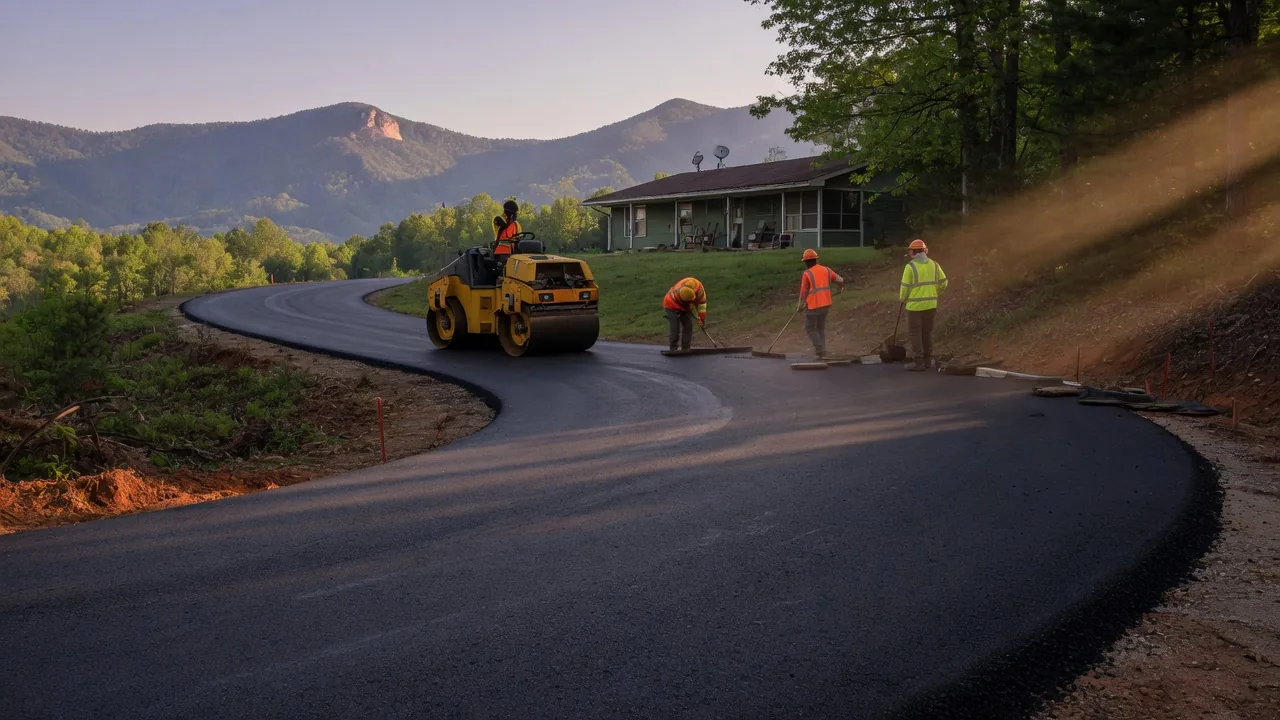
Head out toward Leicester or Sandy Mush and you're in a different world entirely — gravel transitions to asphalt at the property line, pavement narrows to a single lane, and the driveway becomes a quarter-mile ribbon cut into a hillside. These rural approaches often have no turnaround, no culvert at the road, and a grade that pools water at the bottom of the hill every time it rains. Repairs there aren't just about asphalt; they're about getting equipment up a slope and figuring out where water has been running for decades.
| Scope of work | Typical Buncombe range | What drives it |
|---|---|---|
| Single pothole patch | $150 – $400 | size, depth, access for equipment |
| Multiple potholes / small area repair | $400 – $1,200 | count, whether they cluster in one zone |
| Crack filling (per linear foot) | $1 – $4 | crack width, cleanup needed, total length |
| Full-depth repair (per square foot) | $4 – $9 | depth of failed base, drainage, slope |
| Driveway-wide repair / partial overlay | $1,500 – $4,500 | square footage, number of failed zones, edge conditions |
Those ranges are honest working numbers for this county, not quotes. A driveway that's 200 feet long on a 12% grade is a different job than a 30-foot pad in front of a ranch house, and any contractor who gives you a firm price before walking the slope is guessing.
Why mountain driveways fail differently
Flatland asphalt fails mostly from age and traffic. Buncombe County driveways fail from water moving downhill and finding every weak spot in the base. A driveway cut into a hillside on the west side of the county catches runoff from the bank above it, and that water sits against the uphill edge until it finds a crack. Once it's under the asphalt, freeze-thaw cycles do the rest. The federal record shows this isn't a rare event: 19 federally declared disaster events have touched Buncombe County (1973-2026), most of them storm and flood family. That pattern shows up as washed-out base material, edge crumbling, and potholes that reappear in the same spot every spring.
The practical takeaway is that patching without addressing drainage is a temporary fix. If water is still running across the surface or pooling at the edges, the patch will fail again within a season or two. Pothole repair done right includes checking where the water goes after the patch is in. Our pothole repair guide walks through what that looks like on a slope.
There's also a difference in how the freeze-thaw cycle hits here compared to the Piedmont. Asheville sits in a valley that traps cold air overnight, and ridges above 3,000 feet see more freeze events than the city itself. That means two driveways a mile apart can age at completely different rates. A west-facing slope that thaws in the morning sun and refreezes at night cycles harder than a shaded north-facing driveway that stays frozen for days. Contractors working this county learn to ask which direction the driveway faces before they quote anything.
Permits, codes, and what applies to your driveway
Most residential driveway repair in Buncombe County doesn't require a building permit, but work that touches the county right-of-way or changes drainage onto a public road may need a driveway permit from NCDOT (the state handles access permits for state-maintained roads; the county handles its own). The North Carolina Building Code Council (NC DOI) sets the residential code that governs structural work if you're rebuilding a retaining wall or regrading near a foundation. Repair contractors doing large-scale work fall under the state licensing threshold rules (NC Licensing Board for General Contractors) once a project crosses $40,000. For typical driveway repair in this county, those thresholds rarely apply, but a contractor who can't explain when they do is a red flag.
One thing that does trip up mountain homeowners: if your driveway crosses a stream or drainage swale, or if you're regrading near a creek, you may be dealing with state water-quality rules. The North Carolina Department of Environmental Quality (NC DEQ) regulates work that disturbs streambanks or wetland areas, and Buncombe County has plenty of both. A repair that just patches asphalt won't trigger it, but a repair that involves replacing a culvert or reshaping a ditch might. Ask the contractor whether they've pulled permits for that kind of work before.
Resurfacing vs. repairing: when the math favors each
The decision point usually comes down to how much of the driveway has failed. If the damage is isolated to a few potholes and some edge cracking, repair is almost always the right call. If more than about a quarter of the surface is cracked, rutted, or alligatored, resurfacing starts to make more sense than patching piece by piece. The cost to repair a driveway that's already at that stage often approaches the cost to resurface it. Our asphalt resurfacing cost guide breaks down the numbers for this region. For a driveway that's structurally sound but showing surface wear, resurfacing adds years of life at a lower cost per square foot than full replacement.
One caveat specific to this county: if the base under the driveway is failing from water intrusion, resurfacing just puts a new layer over the same problem. A contractor should check the base before recommending resurfacing, not just look at the surface.
On longer mountain driveways, there's a middle path worth asking about: full-depth repair of the failed zones only, then a partial overlay over the rest. That's often the sweet spot on a 150-foot Haw Creek driveway where the top section is still solid but the bottom has been taking water for years. It costs less than a full resurfacing and lasts longer than patching because the base under the worst sections actually gets rebuilt.
How to keep a repair quote honest
Three things protect you when you're getting bids in Buncombe County:
- Get the water story first. Ask every bidder where the water goes when it rains and what they're doing about it. A repair quote that doesn't mention drainage is a patch, not a fix.
- Price per square foot, not per job. Square footage can change once the crew starts digging out failed base. A per-square-foot price keeps the change order honest.
- Compare against the county range. If a bid lands far outside the table above, ask them to walk you through why. Slope, access, and depth of failed base vary enormously here, and how they explain it tells you whether they've actually done this work in the mountains.
Wondering how repair compares to full replacement? See the asphalt driveway repair guide for the regional picture, or check what resurfacing costs in this area before you decide.
One more local habit worth adopting: schedule the walkthrough after a rain. A driveway that looks fine on a dry Tuesday can tell a completely different story when there's water sheeting across it. Contractors who know this county will often ask to come back when it's wet, and that's a good sign they understand what they're looking at.