Why haul distance shapes every Maggie Valley lot price
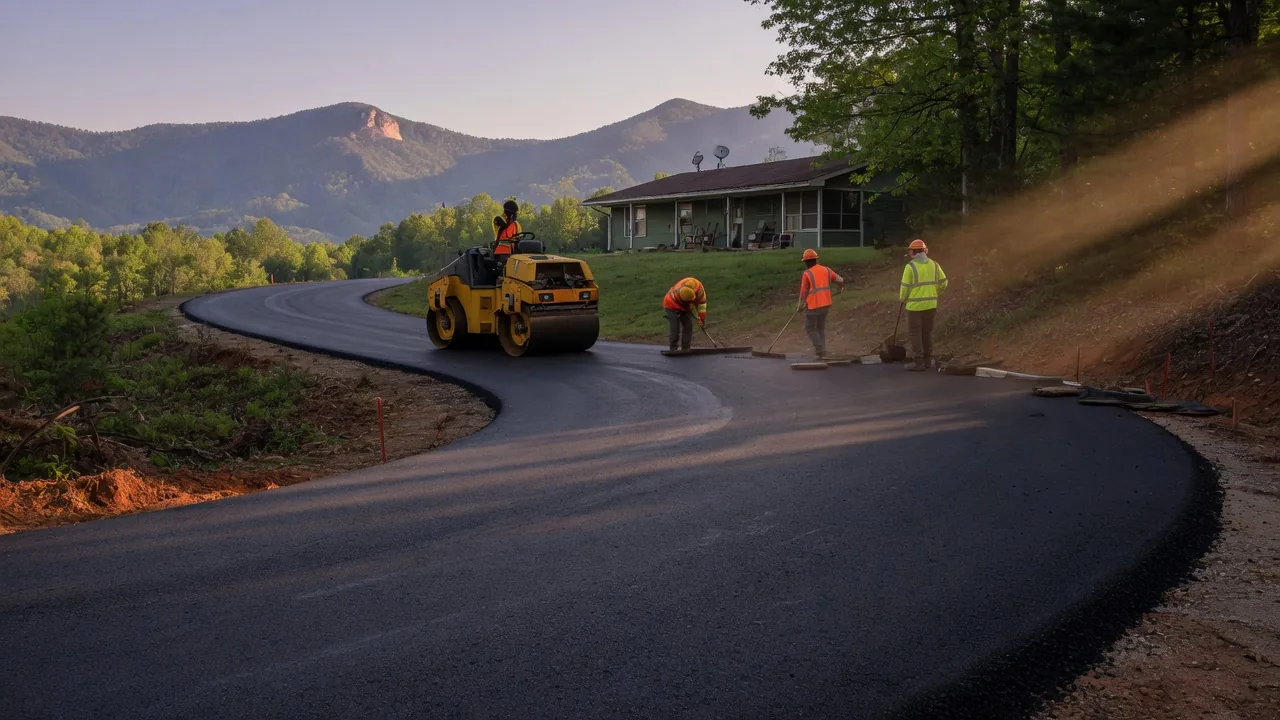
There is no commercial asphalt plant in Maggie Valley. Mix comes up from the Waynesville area, and on a good day that is a 20 to 30 minute run depending on where the truck turns off. That matters more here than in a flat county, because hot mix has a narrow window between the plant and the roller. Push past it, and the mat cools before it compacts, which shows up two winters later as raveling and longitudinal cracking. A lot up past Soco Road or tucked behind a steep gravel approach eats into that window before the first screed hits the ground.
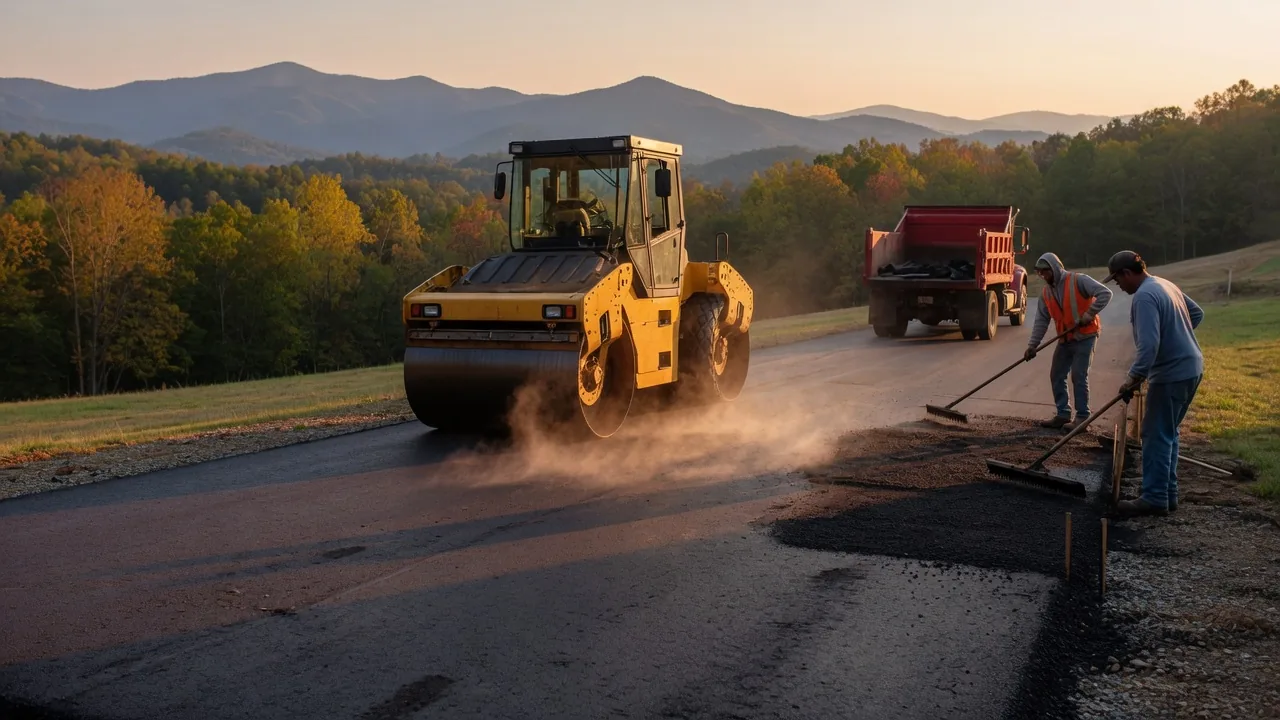
The practical result: crews working Maggie Valley lots price in the haul, the slow dump, and sometimes a second truck just to keep the paver fed. A tight lot that would take one clean day off a flat Raleigh road can stretch to three or four here. That is not markup. It is what the mountain does to a paving schedule.
What the grade does to a crew day
Haywood County lots sit on some of the most varied commercial ground in western North Carolina. A motel lot on a flat strip along the main corridor paves fast. A church lot cut into a slope behind it does not. Steep drives off the road affect three things at once: how the paver tracks, where water wants to pond, and whether a loaded dump truck can turn around without backing onto the road. NCDOT controls access where a lot meets a state-maintained route, so driveway aprons and entrance geometry have to be squared with that before a crew starts (NCDOT).
Drainage is what separates the lots that hold up from the ones that do not. Western NC sees enough rain that a lot graded flat to the shoulder will pond, and ponded water is what kills a mat in five years instead of fifteen. Proper crown, cross-slope, and an inlet at the low corner are basic. Skipping them is how you end up calling a contractor back before the original invoice is paid.
The cost picture for a Maggie Valley lot
Numbers below are working ranges for the trade in this area, not quotes. Every lot has its own base condition, square footage, and access story, and the bid should reflect all three.
| Scope | Typical price range | What moves it |
|---|---|---|
| Reseal and restripe small lot | $1,800–$4,500 | Square footage, crack footage, line count |
| Mill and overlay | $3.50–$6.00 per sq ft | Mill depth, base condition, haul distance |
| New asphalt over prepared base | $5.00–$9.00 per sq ft | Stone depth, grading, drainage, access |
| Full reconstruction with new base | $9.00–$16.00 per sq ft | Excavation, subgrade repair, detention |
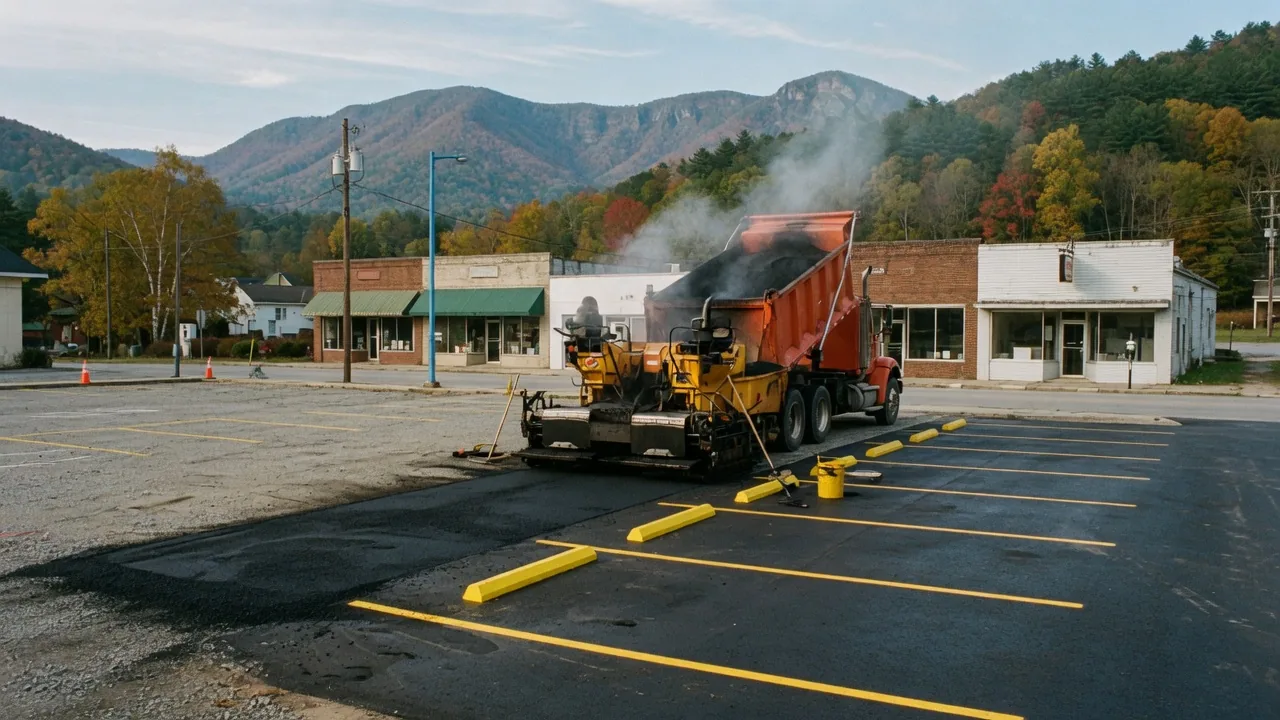
| Striping only (per stall) | $8–$22 | Layout complexity, ADA stalls, arrows |
A multi-lot commercial property off a main corridor prices toward the low end of these bands because the crew can mobilize once and stay. A scattered small lot with a steep approach and no staging area prices toward the high end, sometimes above. The county breakdown at Haywood County asphalt costs shows the same pattern for residential work. For the wider service picture, see parking lot paving.
When the fix is not actually asphalt
Some lots here have failing subgrade, not failing surface. That shows up as alligator cracking across a wide area, depressions that hold water after every storm, and a base that pumps when a truck rolls over it. Overlaying that lot looks good for one season and then fails again. The honest call is a partial reconstruction of the bad panels first, then a uniform surface course on top of a base that can carry it.
Stormwater rules matter too. Any lot redevelopment that increases impervious area can trigger state stormwater review, and the requirements vary with the receiving water. NC DEQ is the authority on that (NCDEQ), and getting the question answered early saves a redesign later. In a county where so much runoff drains toward mountain creeks, this is not a formality.
Choosing a crew that knows the valley
Three things worth asking before signing: how far the plant is from the lot and how the crew plans to hold mix temperature on the haul; whether the proposal includes drainage, edge restraint, and ADA layout or treats them as extras; and whether the contractor carries the right license classification for the job size, which the NC Licensing Board for General Contractors tracks at nclbgc.org. The third one is boring until something goes wrong.
The weather angle is real here. Western NC has a shorter reliable paving season than the piedmont, and the county's federal disaster record (19 declared events across 1973-2026) is heavy on flood and storm damage, which is exactly what chews up an asphalt edge. A crew that has worked this valley knows to schedule around it. If a bid seems too cheap for the square footage and the terrain, that is the tell: something is being left out of the scope.
Ready for a real number? The local crew directory at Maggie Valley paving contractors is the next step.