How hot mix travel and tough access set the price here
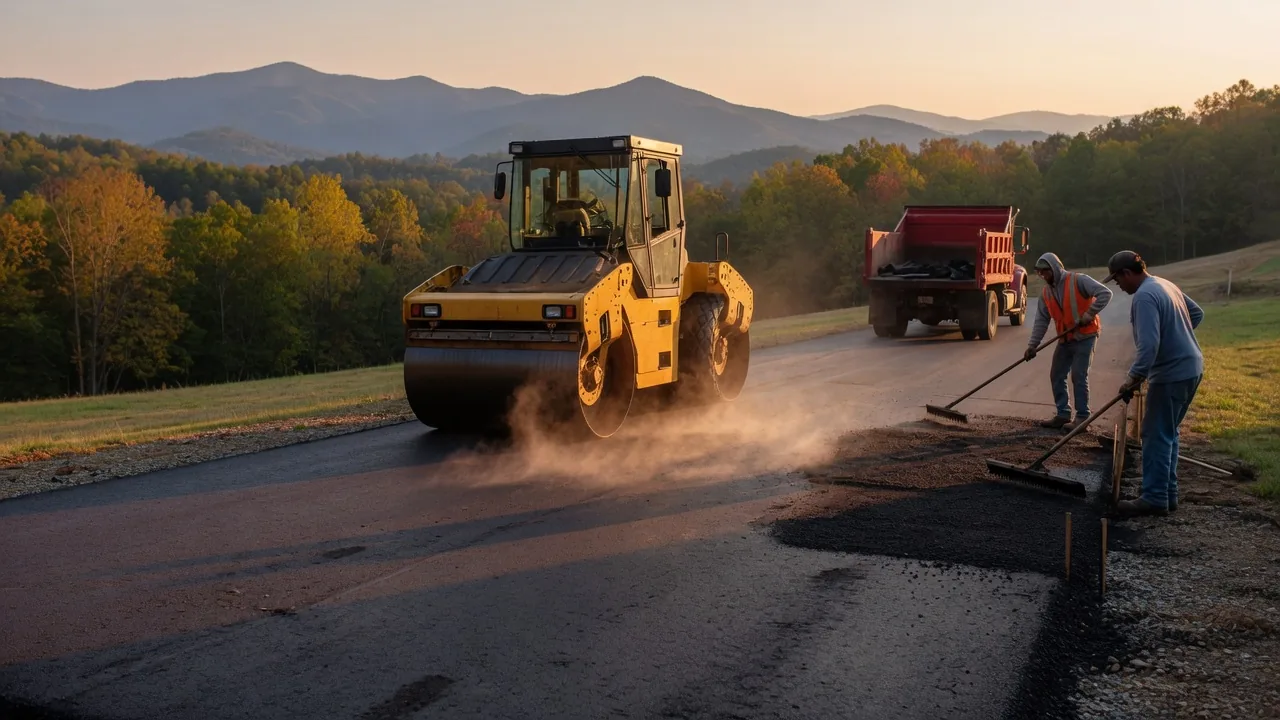
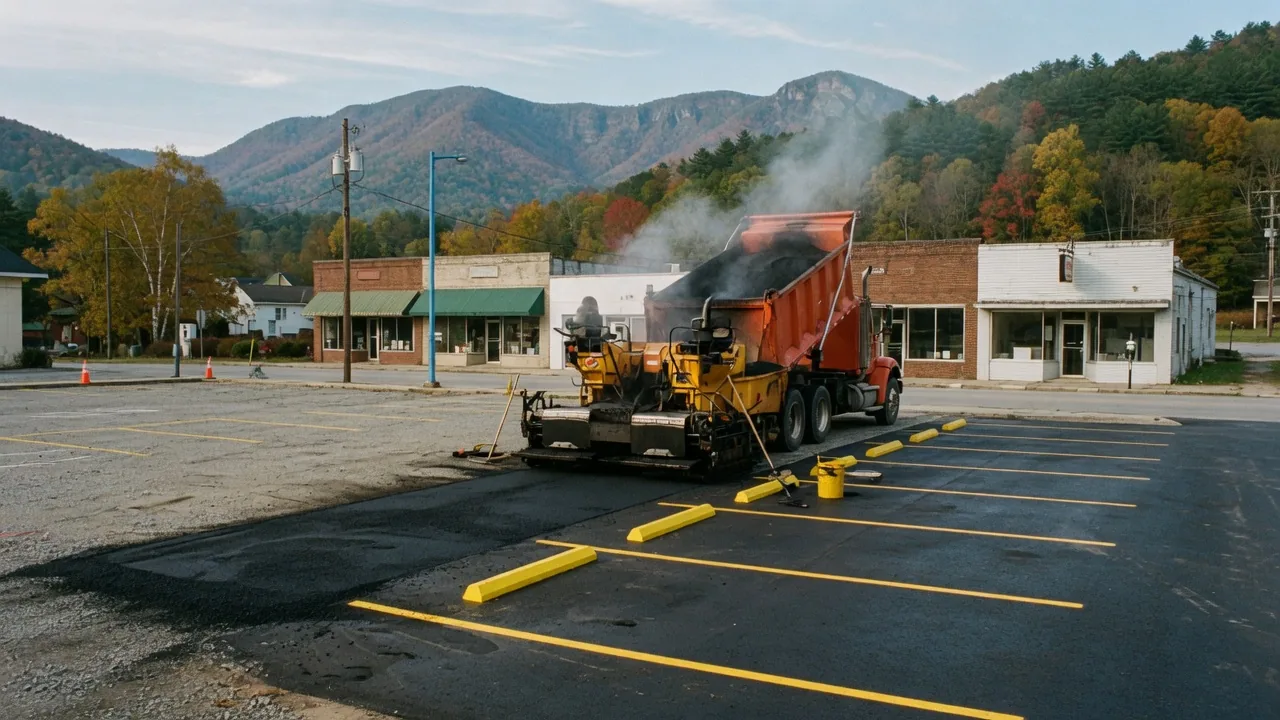
Henderson County has no hot-mix asphalt plant of its own. Every ton of pavement that goes down on a driveway in Hendersonville, Flat Rock, Mills River, Etowah, or up toward Bat Cave and Gerton starts somewhere else and rides in on a dump truck. Asphalt is a perishable product: it leaves the plant at roughly 275 to 300 degrees and has to be placed and compacted before it drops below about 185 degrees, or the mat goes down weak and raggedy. That clock, not the contractor's mood, is what a Henderson County driveway is actually racing.
The practical result is that distance and access matter more than the square footage in a lot of quotes. A plant that is a 35-minute drive from a job off a winding two-lane road can tighten the usable window enough that the crew either runs a smaller load, works faster, or brings an extra truck to keep the paver fed. Each of those options shows up on the invoice.
Consider what the drive actually feels like. A truck pulling out of a plant near the interstate still has to climb into the county on roads that were laid out to follow the ridges, not to move freight. By the time it reaches a driveway off a route like the climb toward Jump Off Rock or the narrow stretches above Saluda, that asphalt has been in the bed longer than a flatland job would ever allow. The crew knows it. The spreader knows it. The price reflects it.
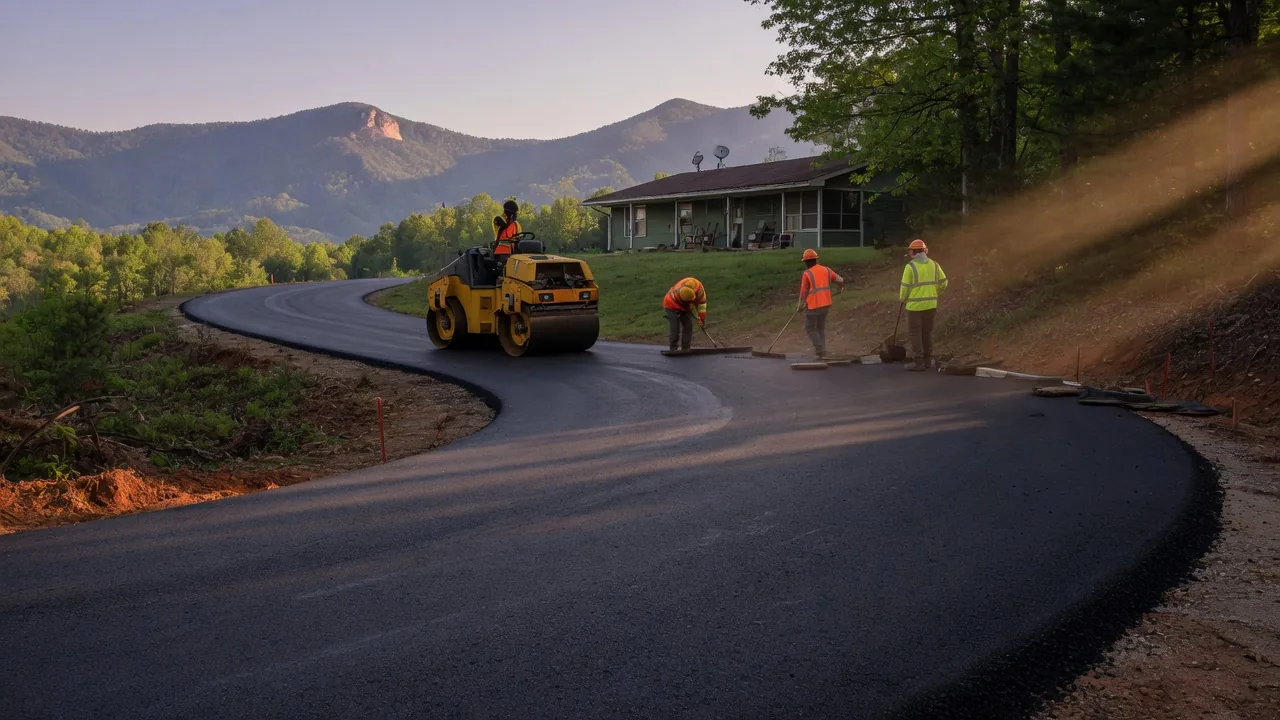
Access compounds it. Plenty of driveways here climb a grade, switchback once, and run between trees and a retaining wall before they reach a turnaround. A full-size tandem dump truck needs real width and a place to empty. When it can't get in, material is shuttled in on smaller equipment, laid in more passes, and the day stretches out. That is the single most common reason two Henderson County driveways of the same size price differently.
There is also the matter of what a driveway has to cross. On the gentler piedmont-style ground around Mills River and Etowah, a run can often go in straight and wide. Up in the steeper hollows, a driveway is more likely to cross a spring seep, hug a cut bank, or need a culvert just to stay dry. Each of those obstacles is a chance for the base to hold water, and each one adds a step before the first truck ever backs in.
Compare your situation against our asphalt driveway cost guide for a region-wide baseline before you weigh any single bid.
What Henderson County homeowners typically pay
The table below reflects real working ranges for this county — mountain access and piedmont-style flat lots both included. These are ranges, not quotes. Any firm number given before someone walks the grade and checks the base is a guess.
| Scope of work | Typical Henderson range | What drives it |
|---|---|---|
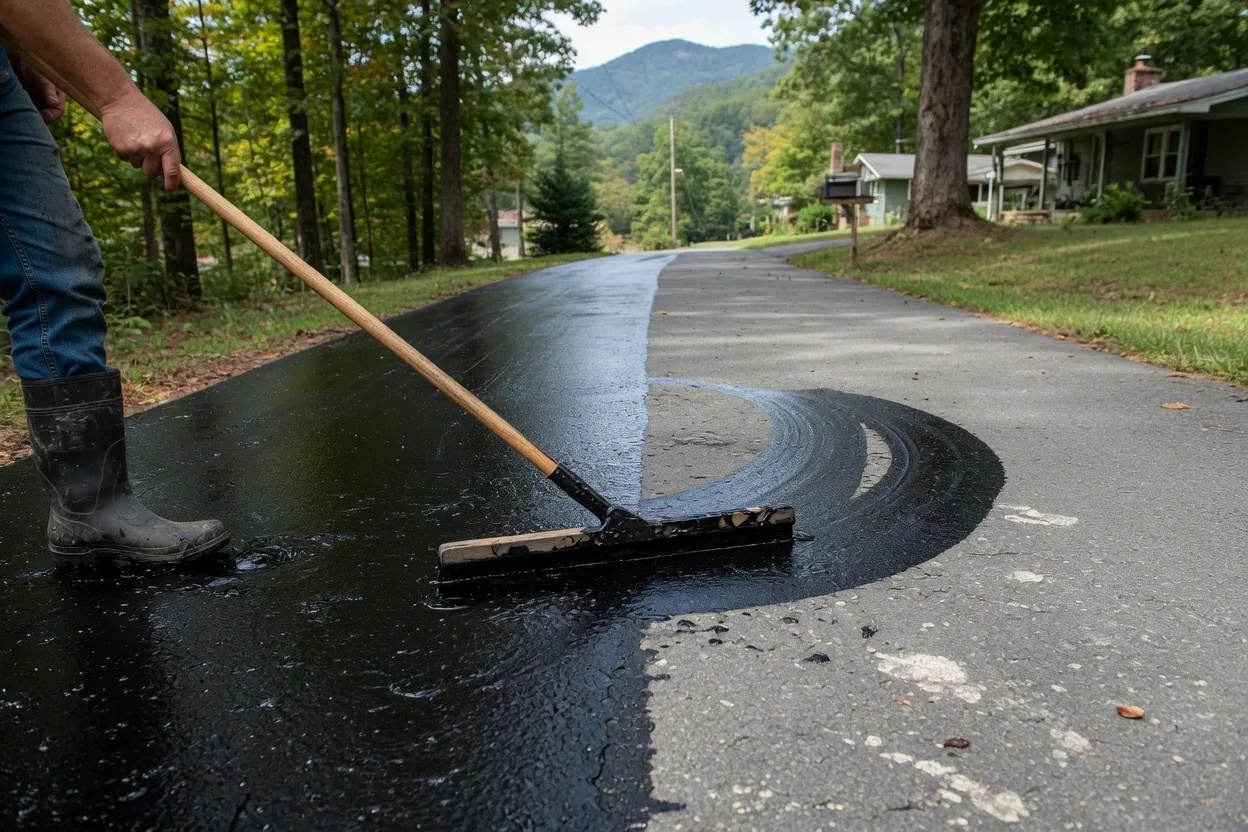
| Driveway sealcoat (existing asphalt) | $350 – $900 | square footage, crack prep, coat thickness |
| Overlay / resurface over sound base | $2,200 – $5,500 | depth, edge milling, drainage correction |
| New driveway — base prep and paving | $4,500 – $9,500 | length, width, base depth, haul access |
| Long or steep mountain-grade driveway | $9,000 – $18,000+ | grade, switchbacks, culvert, truck access |
Two normal-size driveways one ridge apart can differ by thousands, and the reason is almost always access. A short straight shot off a county road in Etowah and a switchbacked climb above Gerton may both be the same length on paper, but the second one asks the crew to do more work with less room and less time. If a bid is far outside the band above, ask what the grade and the turnaround cost them — the answer should be specific.
It also helps to know which side of the range your driveway sits on before anyone quotes it. Flat, open ground with a clear approach almost always lands low. Anything that makes a truck driver stop and think before backing up goes the other way. Sealing is the one line item that stays fairly predictable from one end of the county to the other, because a sealcoat rig does not care much about grade — but everything that involves a dump truck does.
Permits and the rules that touch a driveway project
Most paving work on an existing driveway doesn't need a building permit, but the moment a driveway connects to a state-maintained road, NCDOT controls the access point. New driveway connections and many significant changes to an existing one require a driveway permit through the department (NCDOT), and the application runs through the state's NCDOT Connect permit portal. This matters in Henderson County, where a lot of mountain properties tie directly onto a numbered state route. Paving a driveway is not the moment to discover your culvert was never approved.
Separately, general contracting on a project that crosses the state's cost threshold falls under licensing rules from the North Carolina Licensing Board for General Contractors. For paving-specific work this rarely binds, but it is a fair question to ask any contractor bidding a large job. And because stormwater leaving a driveway is a water-quality issue, the EPA maintains the federal stormwater guidance that local rules are built on — worth a look if your driveway drains toward a creek or a neighbor's property.
One more piece worth knowing: if your driveway ties to a road inside the city limits of Hendersonville or another incorporated town, local access standards may apply on top of the county and state rules. A contractor who works this county regularly will already know which roads are state-maintained and which are not, and that single distinction decides whether a permit is even part of the conversation.
Why the wetter stretches of the county ask more of a driveway
Henderson County's weather is generous to plants and hard on pavement. The same rainfall that makes this county green also works on the base under your driveway. When water can't get off the surface and away from the edges, it finds the subgrade, softens it, and the asphalt above starts to flex and crack. A federal record track: 16 declared disaster events have touched Henderson County across 1978-2026, most of them storm and flood related. That is not background trivia — it is the reason driveway drainage here is not optional decoration.
The fix order is the same one we give on the structural side of our business: move the water, then pave. That means correct crown, functioning culverts, and a grade that sheds runoff rather than pooling it at the bottom of a slope. On the steep ground that defines a lot of this county, water arrives fast at the bottom of a driveway and has to be given somewhere to go. A bid that paves a sloped run without addressing that is selling you a driveway that will start failing at the low end first.
Our asphalt paving overview walks through how drainage fits into a proper paving job — and if you are choosing between repair and replacement, asphalt driveways covers when each makes sense.
Keeping a Henderson County paving bid honest
Four questions separate a real bid from a cheap one:
- Where is the mix coming from? Ask which plant and roughly how long the haul is. A crew that knows its travel time has thought about the temperature clock. One that hasn't may place cold, unworkable asphalt on your driveway.
- How deep is the base? New driveways live or die on compacted stone depth. "We'll add some gravel" is not an answer; a number in inches is.
- What happens to the water? Any bidder who doesn't mention drainage on a sloped Henderson County lot has skipped the hard part.
- Is the price by the ton or the job? Tonnage and truckloads change once the work starts; a per-ton figure keeps change orders honest.
If a bid lands well outside the table above, make them explain why in plain terms. Sometimes there is a real reason — a brutal grade or a base that's failed completely — and how clearly they explain it tells you most of what you need to know.
It also pays to ask for a couple of local addresses they paved a few years back. In this county the weather will have already told the story: a driveway that drained properly still looks tight, and one that didn't is already showing the cracks along the edges. Seeing finished work in person, on terrain like yours, is worth more than any brochure. And before you sign anything, walk the job with the bidder and point at the specific spots that worry you, whether it's the low corner where water sits or the tight turn where a truck has to back in. A contractor who takes that walk seriously is the one you want pouring your driveway.