What mountain access does to crew scheduling
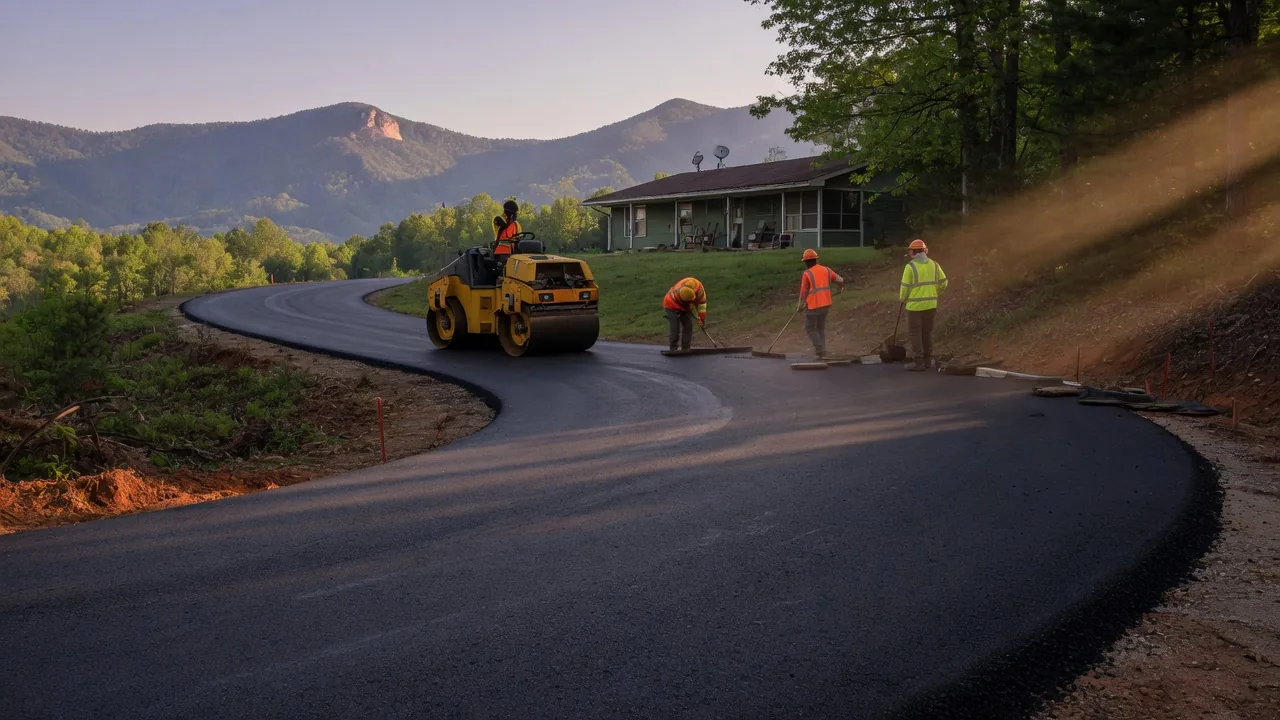
Asheville sits in a bowl of ridges, and that bowl decides how your driveway gets built. Most of Buncombe County's residential lots slope enough that a paving rig cannot simply back up to the work. A crew hauling hot mix from the plant up a switchback lane burns more time positioning, more fuel, and more trucks per ton than a flat lot off a numbered highway. Short, graded, and wide-open beats long, tight, and steep every time on price. If your driveway climbs hard from the road or pinches between a retaining wall and a tree line, expect the estimate to reflect the haul and laydown difficulty before a single ton is placed.
NCDOT maintains the vast majority of roads outside Asheville's city limits, and any new or relocated driveway connection to a state road runs through an NCDOT driveway/access permit. Inside the city, Asheville's own review process controls the approach apron, sight triangles, and stormwater. Which one you deal with is the single biggest fork in the paperwork. For broader material and scope context, see our asphalt driveways overview.
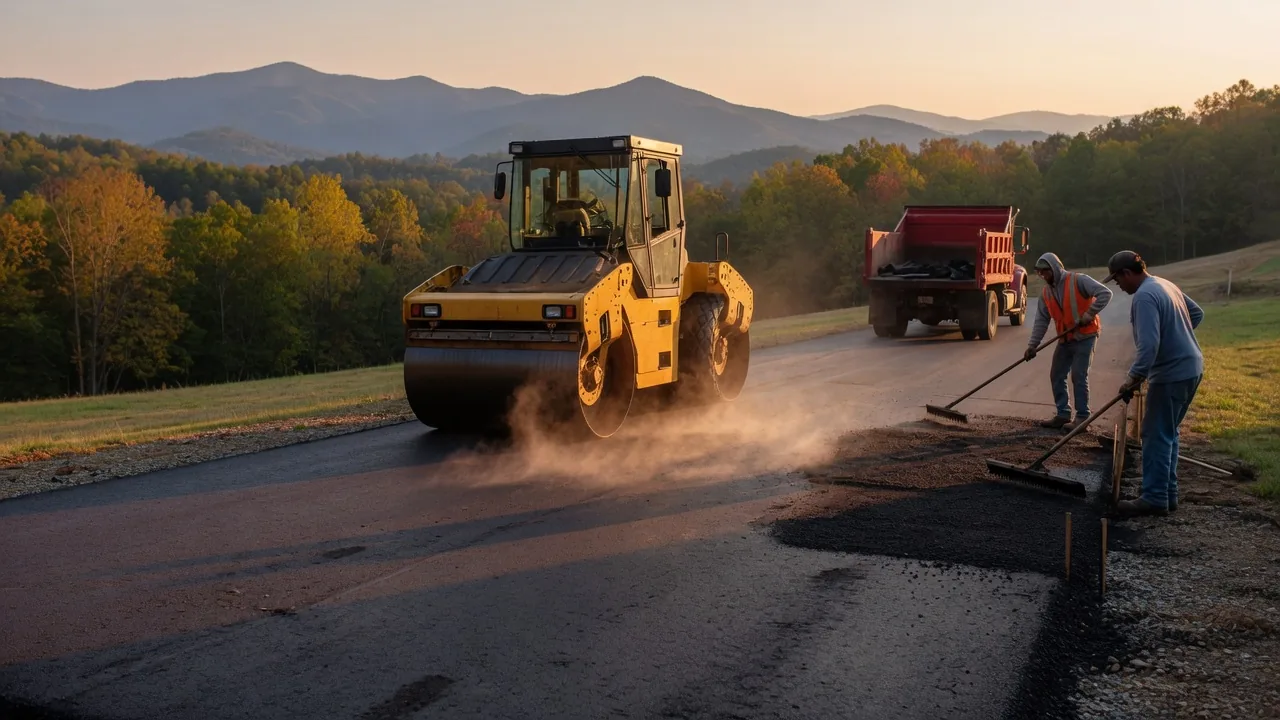
The reason haul distance keeps coming up is that hot mix is a perishable product. Asphalt leaves the plant at a temperature that only stays workable for a limited window, and the farther a truck climbs into a ridge, the more of that window is gone before the screed ever touches the surface. On flat ground along a corridor like Sweeten Creek or Long Shoals, a truck can cycle quickly. Up a one-lane drive off a road like Town Mountain, Elk Mountain, or the upper reaches of Beaverdam, every load takes longer to get in and out, and the crew may need a smaller truck or a shuttle just to reach the driveway. That is why two driveways of identical square footage can price differently: the access, not the asphalt, sets the clock.
Buncombe also has a housing pattern worth knowing. Older lots close to the city are tight, walled, and short. Newer lots out toward Fairview, Leicester, Weaverville, and Black Mountain tend to be longer runs on steeper terrain, where a driveway may be several hundred feet from the mailbox to the house. A long rural run needs more base stone, more culvert, and often a turn-around or pull-off that a tight intown driveway never includes. When you read an estimate, check whether the length and the grade were actually priced or just assumed.
Who reviews your driveway, and when
North Carolina separates access management (NCDOT) from building code (local inspections under the NC Department of Insurance and Building Code Council). A driveway is usually an access question, not a building-code question, but that shifts when the driveway serves a new structure, crosses a stream buffer, or triggers land-disturbance rules through NC DEQ. The matrix below is the working version most Buncombe projects fall into.
| Scope | Typical review |
|---|---|
| New driveway connection to a state-maintained road | NCDOT driveway access permit; sight-distance and apron standards apply |
| Driveway inside Asheville city limits | City review of approach, stormwater, and site plan |
| Resurfacing an existing driveway, same footprint | Generally no permit — no new access point created |
| Widening or adding a turn-out | Often yes — any change to the connection is reviewed |
| Driveway crossing a stream or wetland | Possible DEQ and federal review; buffers and culvert sizing matter |
| Steep grade above threshold | Extra engineering, drainage, and sometimes a variance |
The practical timeline matters as much as the matrix. NCDOT access reviews are handled out of the district office that covers this part of the mountains, and the turnaround depends on how complete the submitted sketch is. A plan that shows the apron width, the culvert or ditch, and the sight distance down the road moves faster than one that shows a centerline and nothing else. If your proposed drive sits near an intersection, a curve, or a crest where oncoming traffic appears late, expect the reviewer to ask for more, because that is exactly the geometry the standard is written for.
Inside Asheville, the city's review often runs alongside a site plan if you are building or adding a structure, which is where driveway work most often gets tangled with grading and stormwater permits. A resurface that never touches the connection is the easy case. A new cut through a curb, a changed approach angle, or a second access point is the one that pulls in city engineering. When in doubt, call before you cut the bank, because correcting an unapproved apron is far more expensive than submitting a sketch.
Slope limits and the drainage question
Buncombe County's terrain means grade is not cosmetic, it is the whole project. A driveway that climbs steeply needs either more length to spread the rise or engineered drainage to keep stormwater from sheeting onto the road, a neighbor, or your own foundation. Reviewers look at culvert sizing, ditch capacity, and where water leaves the site. This is where a flat-rate driveway quote falls apart: the same square footage on a gentle slope and on a 20-percent grade are different jobs. Western North Carolina sees enough water-driven damage that storm history is part of the conversation here — with 19 federal disaster declarations across 1973-2026, drainage gets asked about at review, not improvised at the excavator.
If grading or drainage correction is part of the scope, that work can trigger land-disturbance rules even when the driveway itself is small. The NC DEQ and its erosion-control program are the reference point when soil moves near a waterway, and the federal side of that picture sits with the U.S. Environmental Protection Agency where wetlands or waters of the United States are involved. A culvert sized too small is the classic mountain driveway failure: it works in a dry spring, then a summer downpour sends the creek over the road and the gravel into the neighbor's yard.
Grade also changes the surface itself. A steep asphalt drive sheds water fast, which sounds good until the water reaches the bottom and has nowhere to go. That is why mountain driveways usually need a proper ditch on the uphill side, a defined outfall, and sometimes a cross-drain or a swale to break the flow before it gains speed. Asphalt on a hard climb is also more prone to scuffing and shoving under tires in summer heat, and to freeze-thaw cracking in winter where water sits in low spots. A drainage plan that actually works is not an upsell on these lots; it is the difference between a driveway that lasts and one that keeps getting patched.
What the permit-and-scope bill looks like
Permit fees are the small line. The real number is scope, and on mountain lots scope is driven by access. The table below reflects typical Buncombe County bands for planning purposes, not a quote. For a fuller cost breakdown, see our new driveway installation guide.
| Scope | Typical range |
|---|---|
| NCDOT or city access permit and minor plan review | $250-$750 |
| Engineered plan for steep grade or stream crossing | $800-$3,000 |
| New asphalt driveway, standard grade, short run | $6-$12 per square foot installed |
| Extended or steep-grade driveway with drainage | $9-$18 per square foot installed |
| Culvert, ditch work, and stormwater controls | Project-specific, often 15-30 percent of total |
| Resurfacing existing driveway, same footprint | No permit; $2-$5 per square foot typically |
Two line items surprise homeowners most. First is stone base. A mountain driveway that carries a loaded truck or a fuel delivery needs enough compacted base to keep the asphalt from flexing, and on soft or wet ground that base depth climbs. Reusing an existing gravel drive sounds like savings, but if the gravel was never shaped and compacted properly, the paving crew is really rebuilding a road, not resurfacing one. Second is the connection work at the apron: widening the flare, adjusting the culvert, and matching the road grade. That is small square footage and a lot of the job's fuss, which is why it can carry a disproportionate share of the price.
Conversely, a few things do not have to be expensive. If you already have a sound gravel drive on a moderate grade with working drainage, resurfacing in the same footprint typically escape the permit process entirely and stays in the lower band. The mistake to avoid is paving over a failing base or a drainage problem, because asphalt will faithfully reproduce every soft spot you gave it, only now it is harder to fix.
Licensing, and what a driveway contractor should carry
North Carolina requires a licensed general contractor once a project crosses the state threshold set by the NC Licensing Board for General Contractors. A simple driveway resurface usually falls under it; a full new access with grading, culvert, and structural retaining can push past it. Ask any contractor which license they hold and check it. Plumbing, heating, and fire-sprinkler work falls under a separate board (NC State Board of Examiners), which occasionally matters when a driveway project includes utility relocation. If you are extending an existing driveway rather than building a new one, our driveway extension page covers the scope differences and where review still applies.
Licensing is not the only credential worth asking about. Insurance matters on these lots, because slope work means equipment can shift and a retaining wall or a parked car can be in the path. Ask for proof of general liability and workers' compensation coverage, and ask who is responsible if a truck damages the approach apron or a buried utility. A contractor who handles NCDOT and city paperwork regularly will also know the local reviewers, the typical comments, and roughly how long a sketch takes to clear, which is real value on a schedule.
Also be wary of anyone who treats the permit as optional. On a state road, an unpermitted connection is not a gray area; it is an enforcement question NCDOT can pursue at any time. That means the cheapest bid can become the most expensive job if the driveway has to be reworked to meet the standard after the fact.
What skipping the access permit costs later
An unpermitted connection to a state road is an NCDOT enforcement issue, not just a paperwork annoyance. It can mean a required removal or rebuild at your expense, and it surfaces at resale when a buyer's inspector sees an apron with no record. Inside the city, the same logic applies to stormwater and grading. The permit is cheap relative to the driveway. The National Weather Service records for this region show how quickly mountain drainage overwhelms a poorly built approach, which is exactly why reviewers ask the question up front. Do the permit before the excavator, not after.
There is a quieter cost too, and it is the one that shows up mid-project rather than at closing. If the connection is not approved, the paving crew cannot legally finish the apron, the driveway dead-ends at a raw cut, and the rest of the schedule stalls while the paperwork catches up. On a steep lot that stall can stretch across a wet season, which is exactly when an unfinished cut bank wants to move. Getting the sketch approved early keeps the excavation, the culvert, and the asphalt in a single dry window.
For anyone buying or selling in Buncombe, a permitted, documented driveway is also a minor selling point. It answers a buyer's first question about access, and it tells them the drainage was designed rather than guessed. That is worth more in this terrain than a fresh coat of sealer ever will be.