Asphalt paving and sealcoating, Asheville NC

Paving Steep Driveways in Asheville, NC

Steep driveway paving in Asheville typically runs $6,500–$22,000 for most residential driveways, with long or heavily engineered slopes exceeding that. Also useful: water running down a steep driveway, asphalt driveway cost in NC and asphalt driveways. Hot-mix asphalt, tar and chip and sealcoating for mountain driveways, lots and private roads across five Western North Carolina counties.

  • Free on-site estimate, price in writing
  • Hot mix that holds on a real mountain grade
  • Water directed off the drive before it cuts a channel
  • Illustrated below: what the finished job looks like

Pictured: illustration: a steep asphalt driveway climbing to a mountain home. An illustration of the work, not a job photo.

Get a free estimate

Tell us about the driveway, lot or road. We measure it, check the base and the water, and put a real price in writing.

Free, no obligation. A written price after the site visit.

Free on-site estimateA real number, in writing, after we measure and check the base.
Base first, then blacktopCompacted stone, drainage, then hot mix, in that order.
Five countiesBuncombe, Haywood, Henderson, Madison and Transylvania.
Straight answersWe say when a patch or an overlay is the honest fix.
Quick answer
Paving Steep Driveways in Asheville, NC

Steep driveway paving in Asheville typically runs $6,500–$22,000 for most residential driveways, with long or heavily engineered slopes exceeding that. What sits under the asphalt decides the price here: red clay, old gravel, or haul-road fill on a Buncombe County mountainside often needs 6–12 inches of compacted crushed stone before any hot mix goes down.

19
federal disaster declarations on record in Buncombe County
Hurricane Dorian
most notable event in the federal record
1973–2026
span of the declaration record
Asheville
Buncombe County hub

What actually sits under a Buncombe County slope

Dig a test hole on most Asheville-area slopes and you find one of three things: sticky red clay that holds water like a bowl, a thin skim of old gravel over that clay, or fill pushed up by a developer decades ago with no compaction records. Each one changes how much stone the driveway needs before a single ton of asphalt arrives. Clay won't drain, fill won't stay put, and a steep grade sheds water fast enough that any soft spot becomes a rut by the second spring. That is why two driveways the same length and width in this county can differ by five figures: you are not buying asphalt, you are buying a base. The asphalt driveways page covers the surface options; this page is about what has to happen underneath before they matter.

The base build: how deep the stone really goes

On flat coastal ground, 4 inches of compacted stone under 2 to 3 inches of asphalt is a common spec. On a 12 to 20 percent grade in Buncombe County, that number climbs. A typical steep-driveway build here lands at 6 to 12 inches of crushed stone in lifts, compacted in layers so the material actually locks instead of migrating downhill. Where the subgrade is soft clay or undocumented fill, the crew may need to over-excavate, bring in a geo-textile separator, or undercut the worst pockets entirely. Geotextile fabric between the native soil and the stone is cheap insurance on a slope; skipping it is how a driveway that looked fine in August turns into a washboard by March. Grading has to move water across the drive, not down the wheel tracks. That's a design decision, not a paving decision, and it's the one most out-of-town crews skip. If water is already the problem, start with the water-running-down-driveway fixes before you spend a dollar on surface.

What steep driveway paving costs here, by scope

The number that matters is the base, not the blacktop. Use this table the way you'd use it in a bid meeting: match your driveway to the closest row, then read the stone column first.

ScopeTypical base prepPrice range
Short flat-to-mild drive, sound gravel base already presentRegrade, 2–4 in. top-up$6,500–$9,500
Moderate slope, mixed native soil, 200–400 sq ft6–8 in. compacted stone, new fabric$10,000–$15,000
Steep grade (15%+), clay or undocumented fill8–12 in. stone, possible undercut or geogrid$16,000–$22,000+
Long mountain run (500+ linear ft) with drainage workEngineered base plus swales, culverts, turnoutsQuoted per site

These are regional bands, not a flat rate, and the wide top end is real: a steep run over failed fill can cost more in excavation than a flat driveway costs in total. The asphalt driveways cost page breaks down the asphalt portion separately, which helps when a bid lumps stone and surface into one line and you can't tell what you're paying for.

Drainage is the whole job on an Asheville slope

Federal disaster records for this county (19 declared events over 1973-2026) are not trivia — they are the reason every steep driveway here needs a water plan. Buncombe County gets soaked by tropical remnants and stalled summer storms, and a slope that sheds water poorly will lose its base to saturation long before the asphalt wears out. The National Weather Service's local data (weather.gov) shows why this region is a drainage problem in a way flatland crews underestimate. A real design moves water off the wheel path with cross-slope, catches it in swales or turnouts, and discharges it somewhere that won't erode the cut below. Culverts sized for the 25-year storm, not the last drizzle. And every concrete or asphalt apron near the road has to satisfy NCDOT driveway access rules (ncdot.gov) — a permit point that surprises homeowners who assume their driveway is entirely their business.

Who should be doing the work

North Carolina does not license paving contractors as a trade, but it does license general contractors above a statutable project threshold, and any grading, drainage, or retaining involved can cross that line. The N.C. Licensing Board for General Contractors (nclbgc.org) publishes the thresholds and lets you verify a license by name. For anything involving a culvert, an outfall, or work in a stream buffer, N.C. Department of Environmental Quality rules (deq.nc.gov) may apply, especially near the French Broad watershed. None of this is designed to scare you off — it's the checklist that separates a paving company from a guy with a trailer and a skid steer. Ask for the license, the stone spec in writing, and the drainage drawing before you sign anything.

The three questions that keep a steep-driveway bid honest

“What's the stone depth, and how many lifts?” If the bid says “proper base” without a number, the number is zero until proven otherwise. “Where does the water go when it leaves the drive?” A slope that dumps onto the neighbor's yard or into your own foundation is not finished — it's relocated. “What happens if the subgrade is worse than your test hole showed?” A contractor who won't talk about a contingency clause is a contractor who plans to argue about it later. Get the spec, get the drainage plan, and remember that on an Asheville slope the cheapest asphalt bid is usually the one that skipped the part you can't see.
Buncombe County, NC: the storm record

Federally declared disaster events19
Named storms in the recordHurricane Dorian, Hurricane Florence, Hurricane Fran, Hurricane Helene, Hurricane Ian, Hurricane Isaias
Incident typesFire, Flood, Hurricane, Severe Storm, Snowstorm
Record span (fiscal years)1973–2026
Source: FEMA OpenFEMA disaster declarations. County-level federal declarations, not individual claims.
Questions people ask

Straight answers

How much does it cost to pave a steep driveway in Asheville?
$6,500–$22,000+ for most residential drives, depending almost entirely on base prep. Short drives over sound gravel sit at the low end; steep runs over clay or old fill can exceed the top figure once excavation and drainage are included.
Why is my steep driveway quote so much higher than my neighbor's?
Base. One driveway sits on compacted gravel, the other sits on red clay or undocumented fill that has to be undercut and rebuilt with 8–12 inches of stone. Same asphalt, completely different job underneath.
Can I just pave over my existing gravel driveway on a slope?
Only if the gravel base is deep, well-compacted, and draining properly. On most Buncombe County slopes it isn't, and paving over a failing base is how you pay twice — once for the asphalt, once for the tear-out.
Do I need a permit to pave or improve my driveway?
Driveway access points on state-maintained roads require an NCDOT permit (ncdot.gov). Grading, retaining, or drainage work that crosses project thresholds can also trigger N.C. general contractor licensing rules (nclbgc.org). Ask before you dig.
What grade is too steep to pave?
Asphalt can hold on grades past 20 percent with the right mix and base, but the real limit is drainage and traction, not the asphalt itself. Above about 15 percent, base design and water control become the whole project.
Asphalt or concrete for a steep mountain driveway?
Asphalt flexes with seasonal soil movement, which suits mountain slopes; concrete cracks more readily when the base shifts. Both live or die by the stone underneath, so pick the base first and the surface second.
How long before a new steep driveway needs sealing?
Typically 6 to 12 months after paving, once the asphalt has cured, then every 2 to 3 years. On a steep drive, sealing is less about looks and more about keeping water out of the surface layer.
Our work

Our work

Illustration: fresh black asphalt on a driveway curving up a wooded mountain lot. Built by Mountain Asphalt Paving.
Illustration: fresh black asphalt on a driveway curving up a wooded mountain lot.
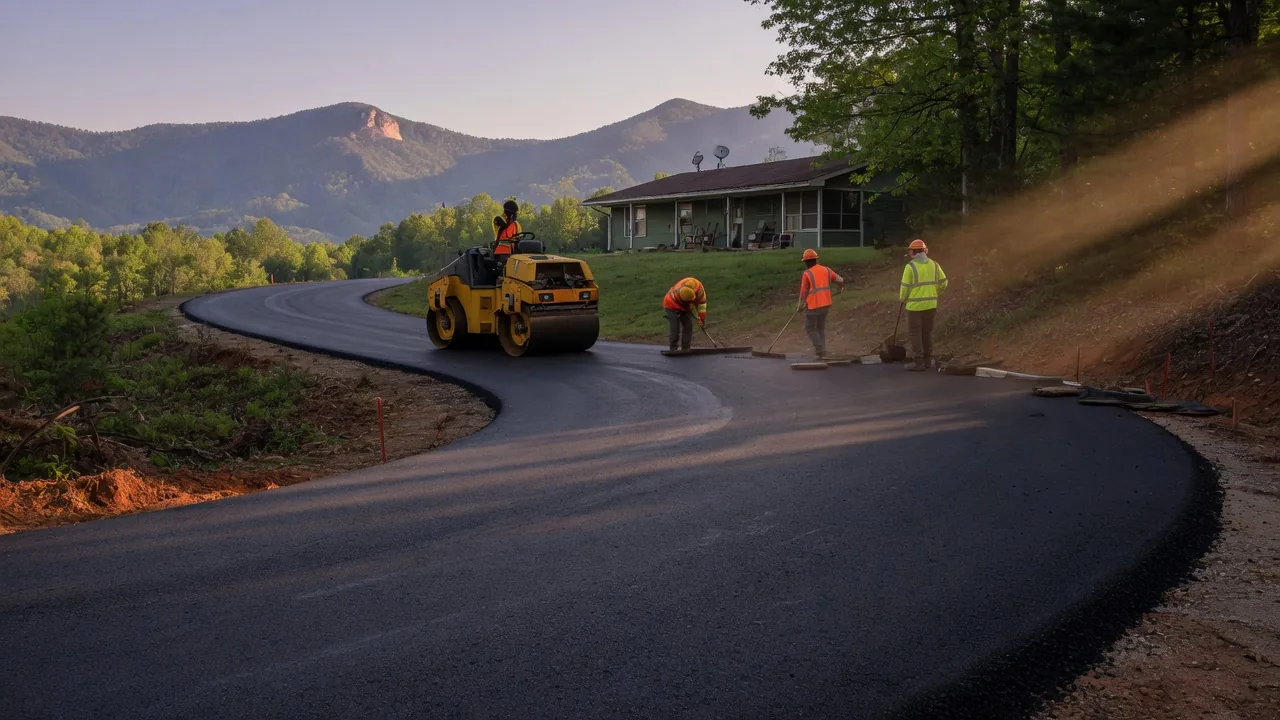
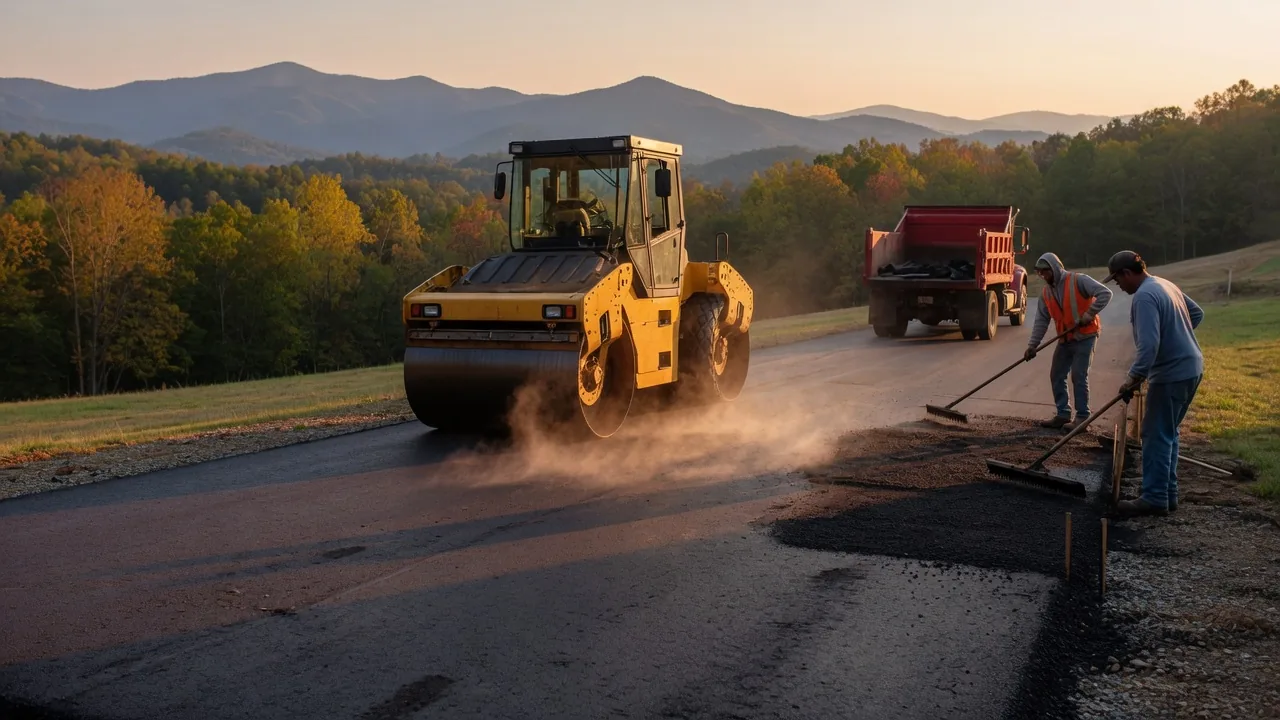
Illustration: a roller compacting hot-mix asphalt on a residential driveway. Built by Mountain Asphalt Paving.
Illustration: a roller compacting hot-mix asphalt on a residential driveway.
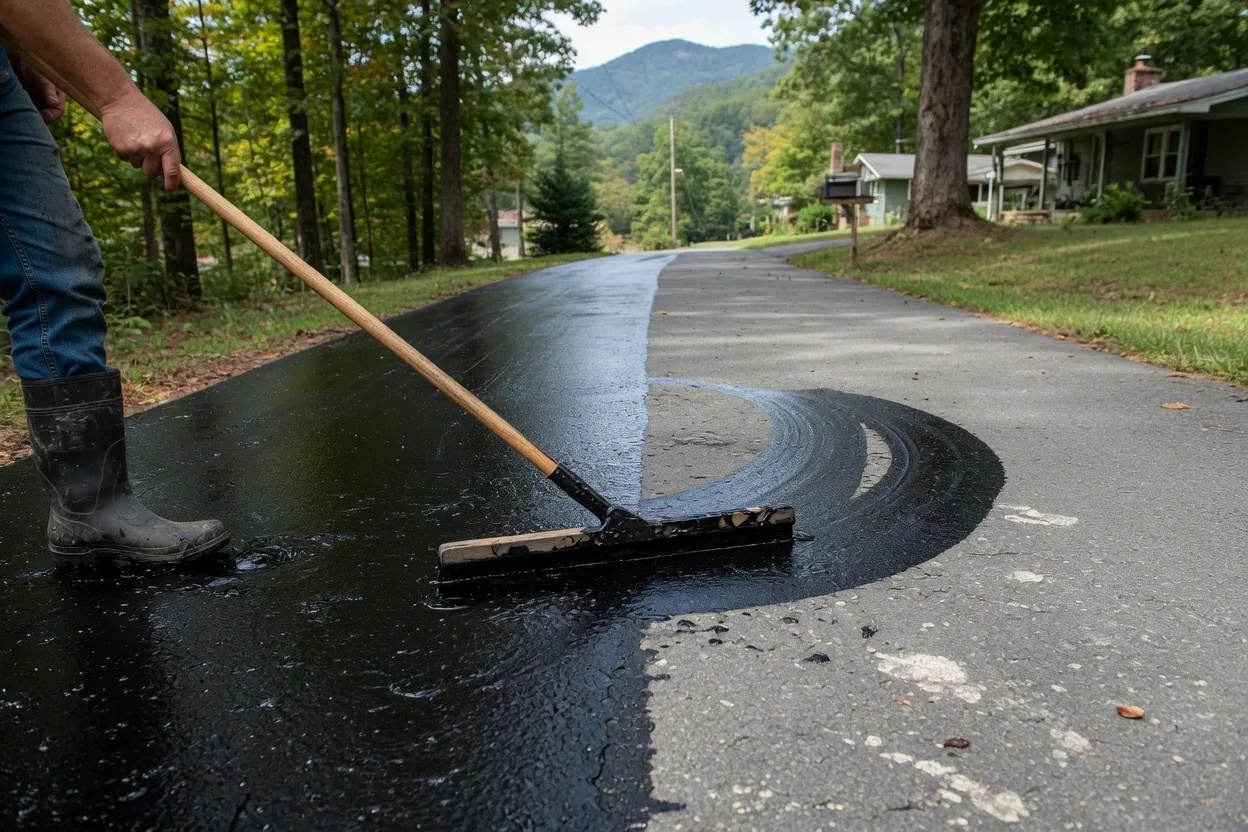
Illustration: sealcoat going down by squeegee, the treated half glossy black beside the faded half. Built by Mountain Asphalt Paving.
Illustration: sealcoat going down by squeegee, the treated half glossy black beside the faded half.
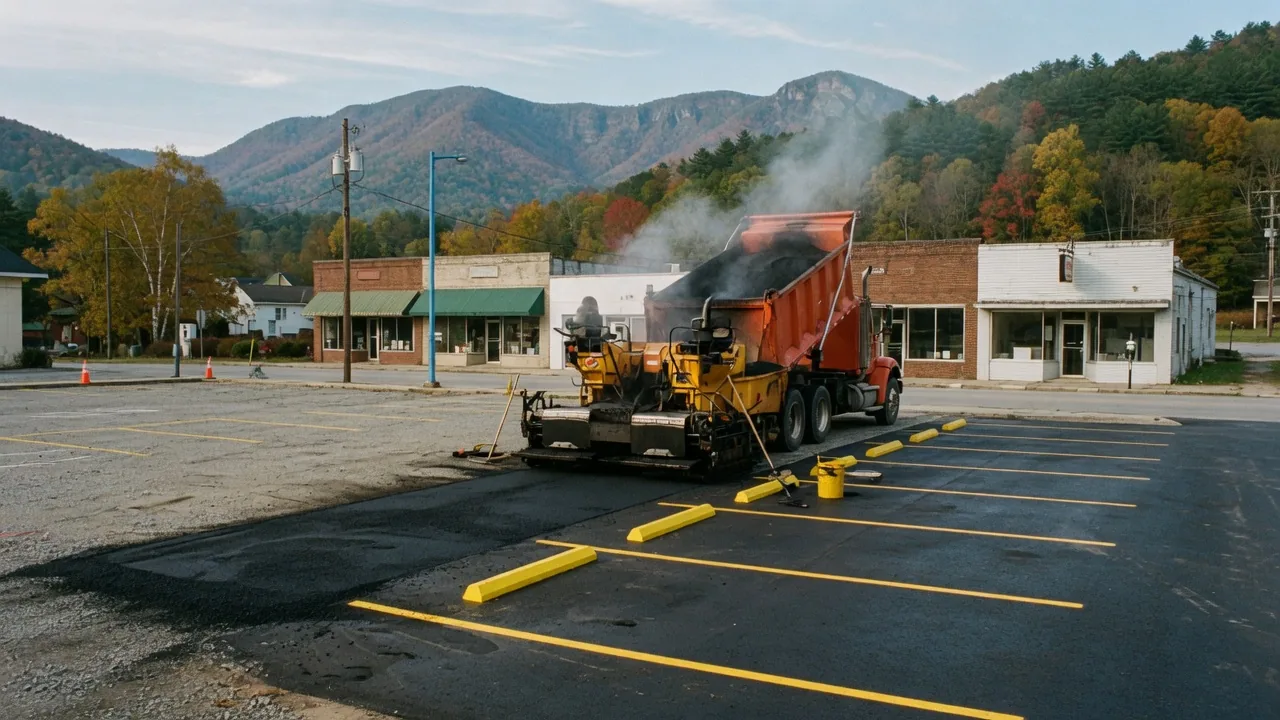
Illustration: a small parking lot being paved, with fresh striping on the finished half. Built by Mountain Asphalt Paving.
Illustration: a small parking lot being paved, with fresh striping on the finished half.
Get a quote

Tell us about your project. We price it straight.

Where it is and what you need — that's all it takes to start. You get a clear scope and an honest number, and your info never gets sold to a list.

Get a free estimate

Free, no obligation. A written price after the site visit.