Depth and mix get decided by what drives on the driveway, not by the driveway's color
Most driveway quotes around Hendersonville come down to a question homeowners never hear asked out loud: how many tons crossed this apron last year, and on what tires? A flat half-circle off a quiet street near Boyd Park carries garden trailers and a minivan. A driveway feeding a lawn crew, a landscape trailer, or a box truck working the commercial edges of the US-25 corridor around Hendersonville loads its edge every time it turns. Same town, different asphalt.
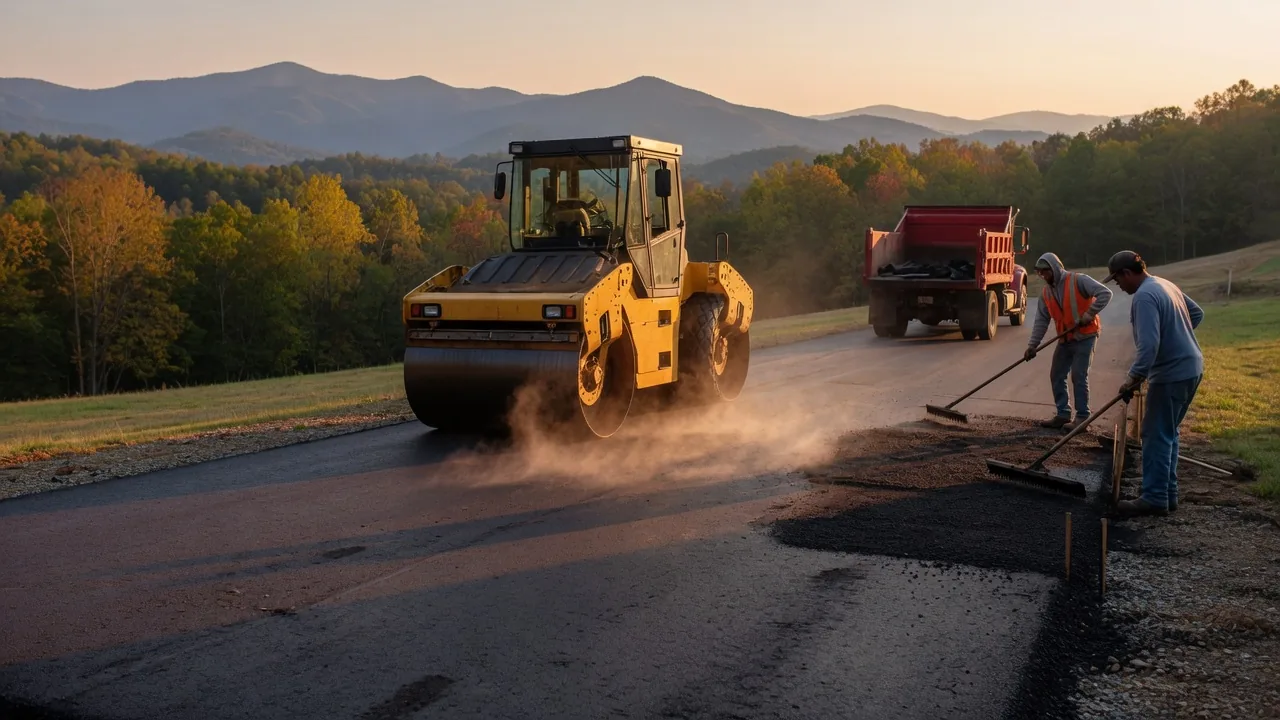
Two inches of compacted surface mix over a properly prepped subgrade is a legitimate driveway in light use. It is not a legitimate driveway where a loaded trailer pulls in at an angle in July. Three inches, placed in two lifts so the lower lift can lock before the top goes down, is the honest specification once weight or turning loads enter the picture. The mix matters too: surface courses run finer aggregate for a smoother finish, while base courses carry larger stone for structure. A single lift of the wrong mix at the wrong depth is how a driveway looks new in spring and shows its first alligator cracking by the second summer.
What Henderson County terrain does to a paving scope
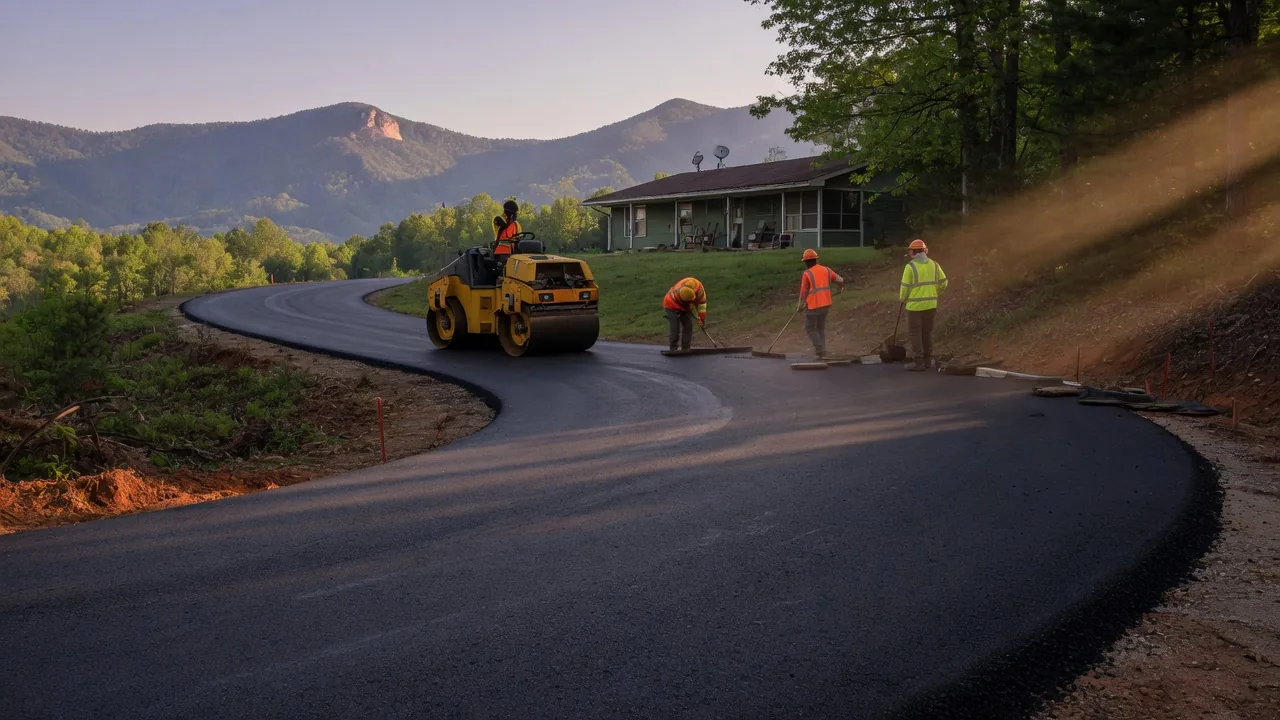
Henderson County is not flat, and it is not uniformly steep either. Newer subdivisions off Howard Gap and off Spartanburg Highway sit on graded pads with short, mild drives. Older homes closer to downtown Hendersonville, and the lanes climbing toward Edneyville and the Blue Ridge escarpment, often have drives cut into a slope with a culvert at the bottom and a retaining edge of one kind or another at the top.
Slope changes the scope in three ways. Water has to be turned before it reaches the asphalt, not after — a driveway that ponds at the garage door has a grading problem no thickness of mix will solve. The stone base has to be built heavier on soft or previously disturbed ground so the surface course has something to sit on. And steep aprons need a tack coat and careful joint placement so the transition between driveway and street does not open up after the first freeze. A bid that lists only square footage and dollars, with nothing about subgrade, drainage, or edge restraint, has not yet described your project.
Henderson County price picture
Ranges below reflect typical residential scopes in this county and are meant for planning, not as a quote. See the Henderson County driveway cost breakdown for a fuller line-item view, and the asphalt driveway guide for how each scope is built.
| Scope | Typical range | When it applies |
|---|---|---|
| Crack fill and sealcoat only | $350-$1,200 | Sound asphalt with surface wear, no structural failure |
| Overlay, 1.5-2 in, existing base sound | $2,400-$5,500 | Aged but stable driveway; surface refreshed |
| New driveway, 2 in single lift | $3,200-$6,500 | Light cars, short flat run, fresh base |
| New driveway, 3 in in two lifts | $5,500-$11,500 | Trailer traffic, turning loads, steeper grade |
| Full removal and rebuild with base correction | $9,000-$22,000 | Failed base, drainage rework, or slope repair |
Grade, haul distance for stone, and how much subgrade correction is needed move the number more than footage does. Two neighbors with the same square footage can be thousands apart on that basis alone.
Water, weather, and why the base gets tested here
Henderson County's federal disaster record is dominated by storm and flood events: 16 declared events touch this area across 1978-2026. That history is not trivia for a paving decision. Every one of those events pushed water across driveways whose base was never designed for that volume, and asphalt that sat saturated through a wet season will telegraph it later as rutting at the edges and pumping at the joints.
Before a surface goes down, the base needs to drain. That means the slope away from the structure is correct, the culvert or swale at the bottom actually moves water, and the subgrade is compacted rather than simply smoothed. The EPA maintains stormwater guidance for homeowners that is worth a look if your drive sheds toward a street drain or a neighboring lot. On the structural side, the International Code Council publishes the model codes that local adoptions in North Carolina draw from for site and driveway standards.
Where the street meets the driveway: permits and the contractor question
Work in the right-of-way where your driveway meets the public street is not simply yours to dig. New or altered driveway connections along state-maintained roads in Henderson County generally require an NCDOT driveway permit, and applications run through NCDOT Connect; details on access and encroachment rules live at NCDOT. If your apron touches a state route rather than a city street, assume the permit applies and ask who is pulling it.
On the contracting side, North Carolina sets a monetary threshold at which a project becomes general contracting work, and that threshold is administered by the NC Licensing Board for General Contractors. A driveway that is only a driveway usually sits under it, but a combined scope that includes retaining walls, drainage structures, or a larger rebuild may not. The right question is not whether your paving contractor is a licensed general contractor, but whether they know the threshold and will tell you when your job crosses it. Local firms used to Henderson County grades are listed in our Hendersonville paving contractor directory.