Asphalt paving and sealcoating, Asheville NC

Tar and Chip Driveways in Asheville, NC

Tar and chip driveway Asheville NC costs run $2.50–$4.50/sq ft installed. Also useful: tar and chip driveway cost in NC, gravel to asphalt and asphalt driveways. Hot-mix asphalt, tar and chip and sealcoating for mountain driveways, lots and private roads across five Western North Carolina counties.

  • Free on-site estimate, price in writing
  • Asphalt binder with stone chips rolled in
  • Roughly half the cost of hot mix on long lanes
  • Illustrated below: what the finished job looks like

Pictured: illustration: a tar and chip lane, stone chips pressed into the binder. An illustration of the work, not a job photo.

Get a free estimate

Tell us about the driveway, lot or road. We measure it, check the base and the water, and put a real price in writing.

Free, no obligation. A written price after the site visit.

Free on-site estimateA real number, in writing, after we measure and check the base.
Base first, then blacktopCompacted stone, drainage, then hot mix, in that order.
Five countiesBuncombe, Haywood, Henderson, Madison and Transylvania.
Straight answersWe say when a patch or an overlay is the honest fix.
Quick answer
Tar and Chip Driveways in Asheville, NC

Tar and chip driveways in Asheville, NC typically run <strong>$2.50–$4.50 per square foot installed</strong>, or roughly $3,500–$9,000 for a standard two-car driveway, with slope, base prep, and stone size driving the spread. On Buncombe County's graded lots, water — not traffic — decides how long the surface lasts, so crown, edges, and ditch placement matter as much as the binder.

19
federal disaster declarations on record in Buncombe County
Hurricane Dorian
most notable event in the federal record
1973–2026
span of the declaration record
Asheville
Buncombe County hub

On these slopes, the rain picks the driveway's fate before the stone does

Stand at the bottom of almost any driveway cut into a Buncombe County hillside and you can read the whole problem: runoff sheets down the tire tracks, hits the apron, and either finds the ditch or finds your garage. A tar and chip surface fails from the bottom up when that water has nowhere to go. The chip seal itself is forgiving — it flexes, it grips in winter, it takes a plow better than bare asphalt — but it cannot outrun water that is being aimed at it. That is why the first thing a competent crew looks at on a Weaverville or Fairview lot is not the driveway at all. It is the grade above it, the culvert below it, and which way the ground wants the rain to run. A driveway built against that grain will shed stone every spring no matter how good the emulsion is.

The good news is that tar and chip is genuinely well suited to this terrain. It handles the freeze-thaw cycling of a western North Carolina winter with far less cracking than a thin asphalt mat, and it can be built in stages as a budget allows. The bad news is that a lot of driveways around here were laid over whatever the dozer left, and no surface treatment fixes a driveway with no shape. If the base is wrong, the fix starts underneath — see gravel to asphalt for what converting an existing gravel lane actually involves.

How the crown, the edges, and the ditch divide the work

A driveway is a drainage structure that also happens to carry cars. Three features do almost all the work:

  • The crown. A slight rise down the centerline pushes water to both shoulders instead of letting it pond in the wheel paths. On steep mountain lanes, the crown often needs to be paired with a grade reversal — a subtle high point — to break up the velocity of runoff before it reaches the bottom.
  • The shoulders and edges. Loose, uncontained edges are where chip loss starts. The stone at the perimeter needs a defined lip, either rolled into the shoulder or held by a shallow berm, so tires and plows do not peel the surface back a few inches every season.
  • The ditch and the outlet. Water collected at the edges has to be delivered somewhere legal and stable. In Buncombe County that often means a vegetated swale or a piped culvert under the apron, and if it ties into a stream or storm system, the rules get stricter. The NC Department of Environmental Quality governs stormwater and stream-adjacent work, and sediment leaving a driveway during construction is exactly the kind of thing that draws a notice.

Where the driveway meets a state-maintained road, there is a fourth piece: the access permit. Any new or substantially changed connection to a numbered road requires approval through NCDOT, and the culvert sizing at that apron is usually dictated by the permit, not by preference. Skipping it is a common and expensive mistake.

What drives the price on a real Asheville-area driveway

Two driveways the same size can price $3,000 apart because the number is mostly about what is under and around the surface. Expect the following installed ranges, remembering that these are bands, not quotes:

ScopeTypical installed range
Single-coat tar and chip over sound existing base, standard 2-car drive$2.50–$3.50 / sq ft
Two-coat (double seal) for heavier use or steeper grades$3.50–$4.50 / sq ft
Base repair, re-grading, crown restoration before sealing$1.50–$4.00 / sq ft additional
Culvert, ditch work, or apron replacement at the road$1,200–$5,000 depending on length and permitting
Full driveway, 2-car, base already sound and draining$3,500–$9,000 typical

Slope is the quiet multiplier. A steep lane needs a heavier stone, sometimes a tack coat to hold chips on the grade, and more labor to spread evenly without the material running. Long driveways — common on the larger lots out toward Leicester and Barnardsville — mean more trucking, and that shows up as a per-square-foot increase rather than a flat add. A useful comparison for what a fully paved surface costs on the same footprint lives on the asphalt driveways page, and our tar and chip driveway cost breakdown walks the line items in more detail.

When the soil is already halfway to a mudslide

Buncombe County has seen National Weather Service flood and slope failures serious enough that federal disaster declarations here number 19 across 1973-2026 — and the pattern that does the damage is familiar: a wet fall, saturated clay, then a driveway that was already underdrained gives up its shape. Tar and chip is not a structural fix. If a slope is creeping, if there is a spring surfacing in the middle of the lane, or if the subgrade is pumping mud through the surface, sealing over it just buys a year and hides the evidence. Those conditions call for drainage first, sometimes a geotextile and compacted stone base, occasionally an engineered solution. A contractor who quotes a chip seal on a failing subgrade without mentioning any of this is not the one to hire.

There is also a licensing line worth knowing. Driveway and paving work itself does not always require a general contractor license, but many projects — particularly those involving significant grading, retaining structures, or new road access — cross into work that does. The NC Licensing Board for General Contractors sets the thresholds; ask any contractor where they sit relative to them, and get it in writing. Water and drainage work that touches streams or wetlands brings a separate set of rules under DEQ. None of this is exotic — it is just the checklist that separates a driveway that lasts fifteen years from one that gets re-graded every third spring.
Buncombe County, NC: the storm record

Federally declared disaster events19
Named storms in the recordHurricane Dorian, Hurricane Florence, Hurricane Fran, Hurricane Helene, Hurricane Ian, Hurricane Isaias
Incident typesFire, Flood, Hurricane, Severe Storm, Snowstorm
Record span (fiscal years)1973–2026
Source: FEMA OpenFEMA disaster declarations. County-level federal declarations, not individual claims.
Questions people ask

Straight answers

How much does a tar and chip driveway cost in Asheville, NC?
Most two-car driveways run $3,500–$9,000 installed, or $2.50–$4.50 per square foot depending on coats and grade. Slope, base condition, and culvert or ditch work are the biggest swing factors — see our cost breakdown for line items.
How long does tar and chip last on a mountain driveway?
With a sound base and correct drainage, 10–15 years is realistic in this climate, sometimes longer with a refresh coat partway through. The surface itself is durable; the failure mode on Buncombe slopes is almost always water undermining the edges or base, not the seal wearing through.
Can tar and chip be applied over my existing gravel driveway?
Often, yes — that is one of its advantages. The gravel needs to be graded, crowned correctly, and compacted, and any soft spots replaced before sealing. A driveway that has never drained properly should be fixed first, which is what the gravel to asphalt page walks through.
Is tar and chip better than asphalt on a steep driveway?
Usually yes for traction and for handling freeze-thaw. Chip seal gives a rougher, grippier surface in winter and resists the thermal cracking that plagues thin asphalt mats on western NC grades. It also tolerates base movement better. Asphalt is smoother and quieter if the grade is gentle and the base is solid.
Do I need a permit to build or pave a driveway in Buncombe County?
If your driveway connects to a state-maintained road, yes — a driveway access permit through NCDOT is required, and it typically sets the culvert size at the apron. Work near streams or that changes drainage patterns can also trigger state review through DEQ. Local rules vary by jurisdiction, so confirm before work starts.
How soon can I drive on a new tar and chip driveway?
Usually within 24–72 hours depending on weather and emulsion cure, but the surface stays tender longer in cool or humid conditions. Keep heavy vehicles and sharp-turning loads off it for the first couple of weeks — early tire scuffing is the most common cosmetic complaint and it is almost always preventable.
What causes tar and chip driveways to lose stone?
Almost always one of three things: too little binder, an over-wet or dusty base that prevented the emulsion from bonding, or water running across the surface and lifting chips off the edges. The third is the most common in this county and it is a drainage problem, not a paving problem.
Our work

Our work

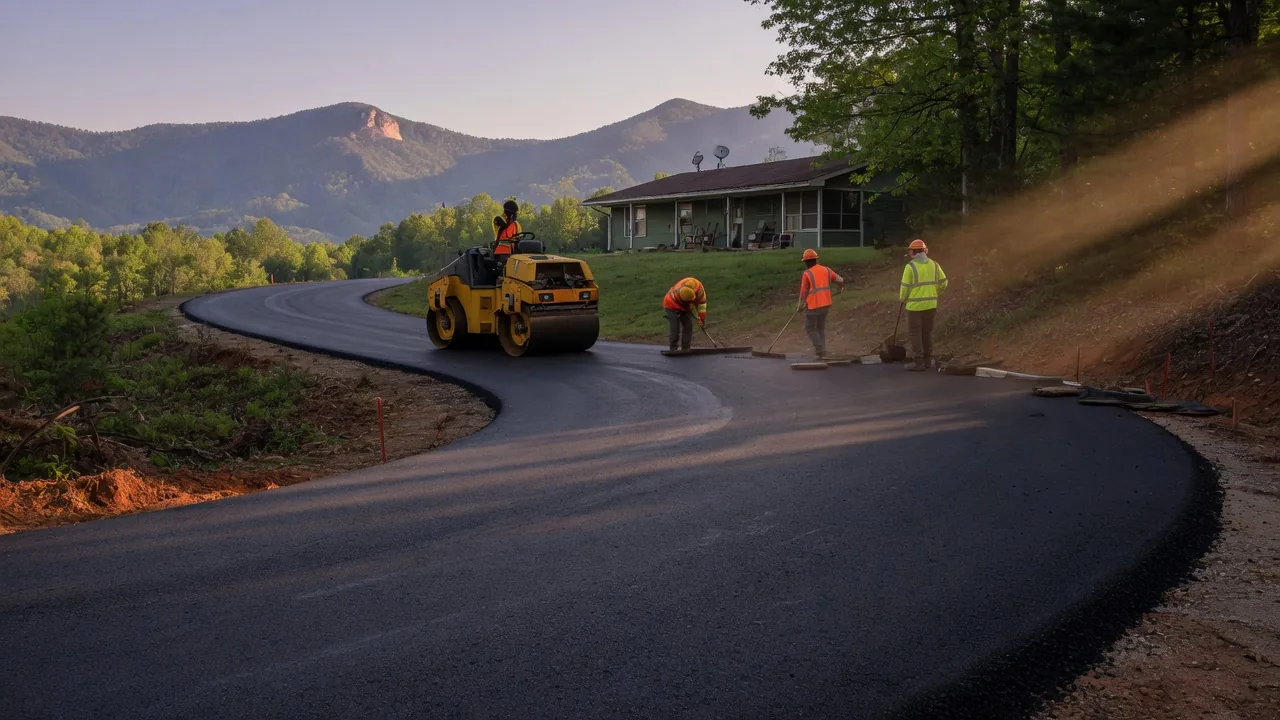
Illustration: fresh black asphalt on a driveway curving up a wooded mountain lot. Built by Mountain Asphalt Paving.
Illustration: fresh black asphalt on a driveway curving up a wooded mountain lot.
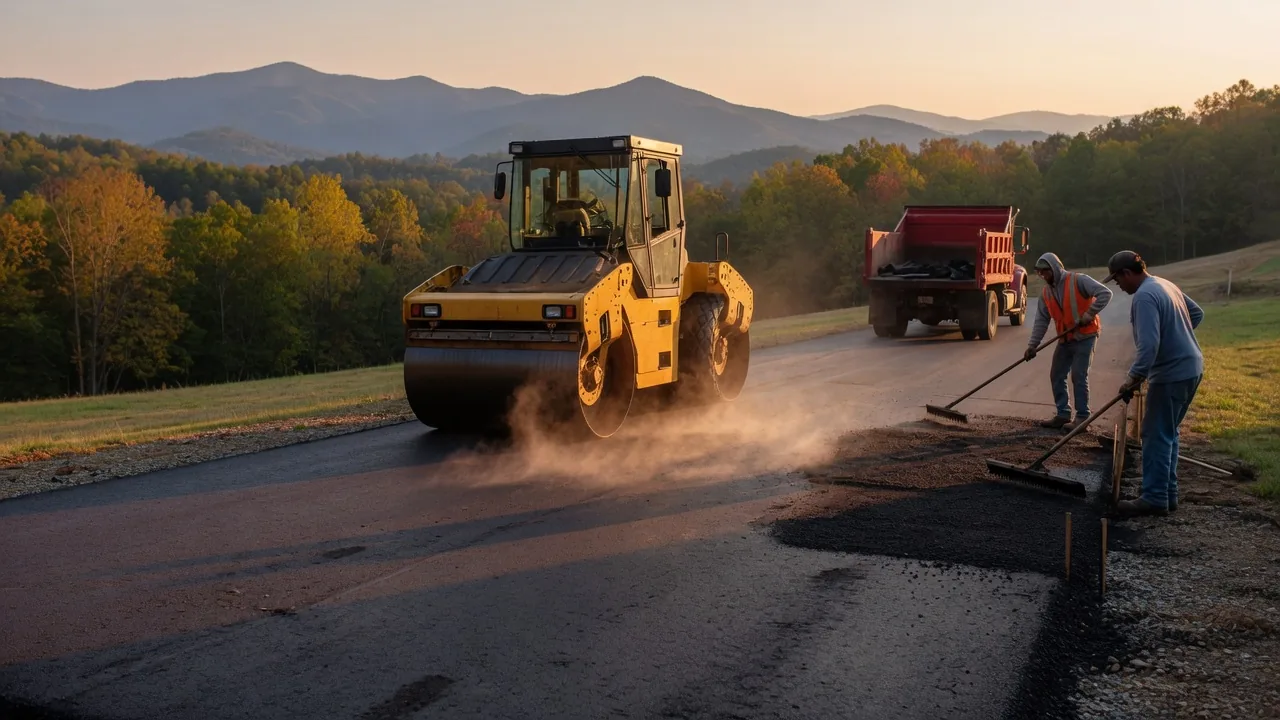
Illustration: a roller compacting hot-mix asphalt on a residential driveway. Built by Mountain Asphalt Paving.
Illustration: a roller compacting hot-mix asphalt on a residential driveway.
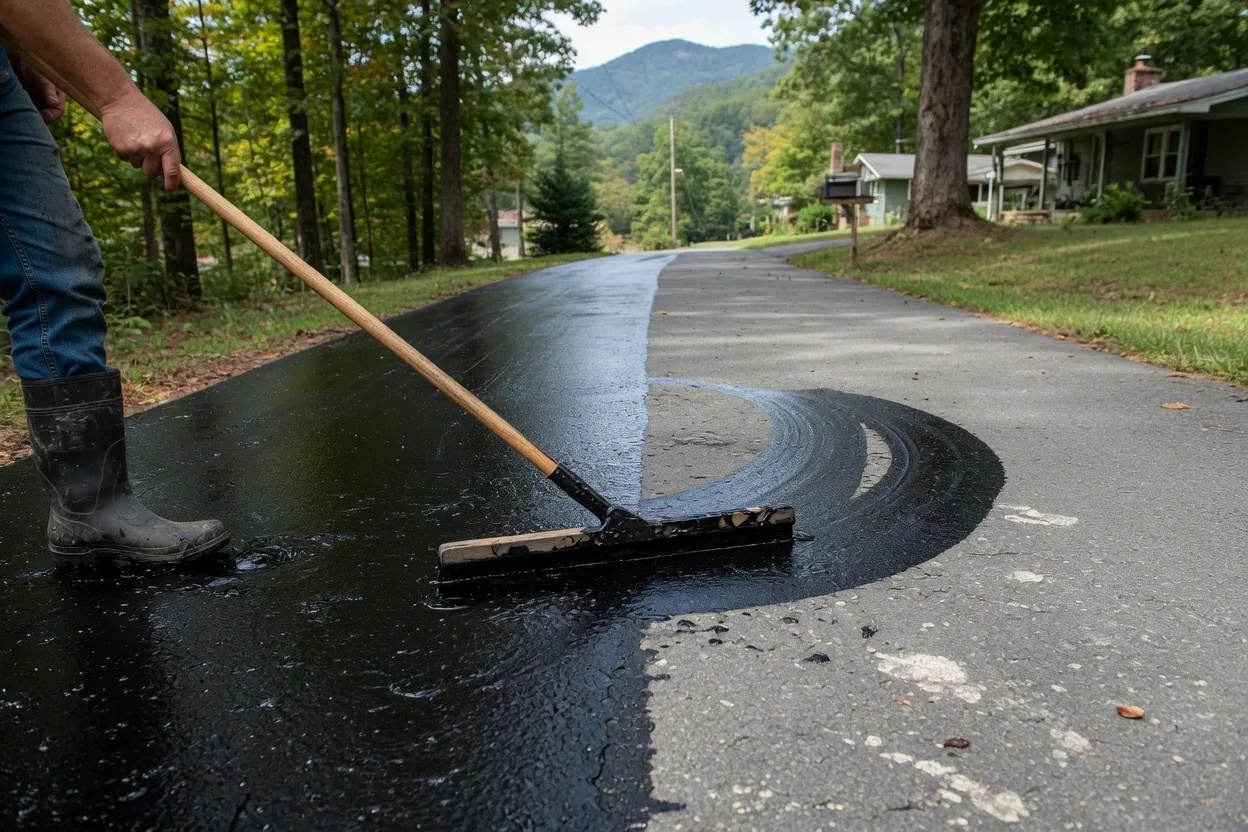
Illustration: sealcoat going down by squeegee, the treated half glossy black beside the faded half. Built by Mountain Asphalt Paving.
Illustration: sealcoat going down by squeegee, the treated half glossy black beside the faded half.
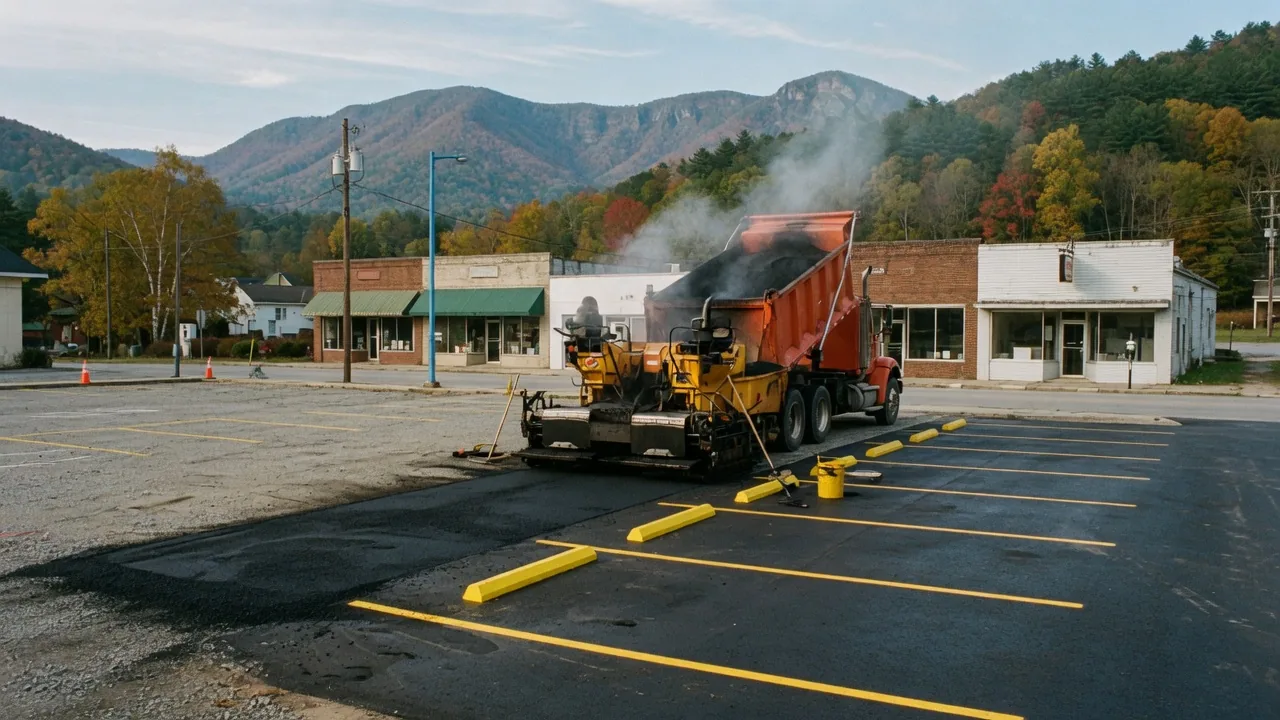
Illustration: a small parking lot being paved, with fresh striping on the finished half. Built by Mountain Asphalt Paving.
Illustration: a small parking lot being paved, with fresh striping on the finished half.
Get a quote

Tell us about your project. We price it straight.

Where it is and what you need — that's all it takes to start. You get a clear scope and an honest number, and your info never gets sold to a list.

Get a free estimate

Free, no obligation. A written price after the site visit.